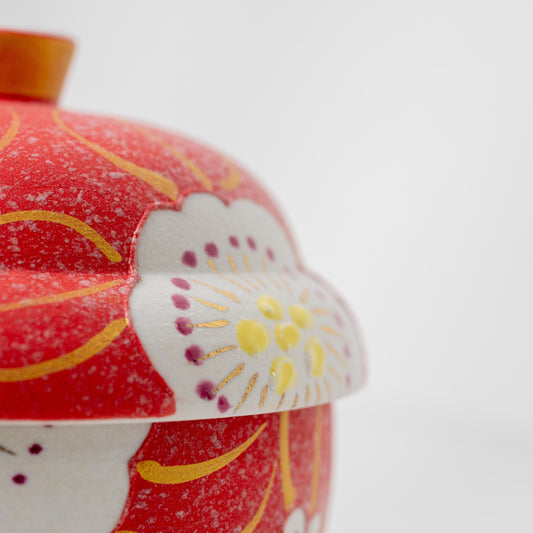
A pair of hand-finished 輪島塗 (Wajima-nuri) lacquer bowls in the traditional 夫婦椊 (meoto-wan / 'husband-and-wife') format, made in 1985 (Shōwa 60). One bowl is finished in vermilion (朱) lacquer, one in deep black (黒), and both are decorated with sasa — Japanese bamboo grass — in hand-applied 蜡絵 (maki-e) gold. The pair arrives in its original paulownia tomobako (signed inside the lid) with both bowls still individually wrapped in maker-stamped washi paper, and the original Wajima association pamphlet folded inside.
📐 Specifications
-
Set: 2 bowls — one vermilion exterior + vermilion interior, one black exterior + vermilion interior (meoto-wan / Japanese 'husband-and-wife' pair)
-
Each bowl: 12 cm rim diameter × 6 cm height (≈4.7″ × 2.4″), 5 cm foot ring diameter (≈2.0″)
-
Each bowl weight: 132 g (≈4.7 oz); pair total ≈ 264 g (≈9.3 oz)
-
Capacity: to be measured by water-fill test before dispatch (typical meoto-wan profile)
-
Substrate: 天然木 (natural wood — Wajima tradition typically keyaki 欅 or asunaro 檜; specific species not declared on the Quality Act label)
-
Surface lacquer: うるし塗装 (urushi)
-
Lacquer base: 地の粉漆下地 (ji-no-ko urushi — the diatomaceous-earth-charged foundation layer that is the signature Wajima technique)
-
Decoration: hand-applied maki-e (蜡絵) sasa bamboo motif in gold, with light green-yellow leaf accents
-
Box: original 桐箱 paulownia tomobako, 28.5 × 15 × 10 cm (≈11.2 × 5.9 × 3.9″); lid exterior 輪島塗 夫婦椊 brush calligraphy; interior 哲 + 伝統工芸師 + maker's red seal
-
Paper wrap: each bowl in maker-stamped washi paper — 特堅牢美術 / 産 輪島塗 / 伝統工芸
-
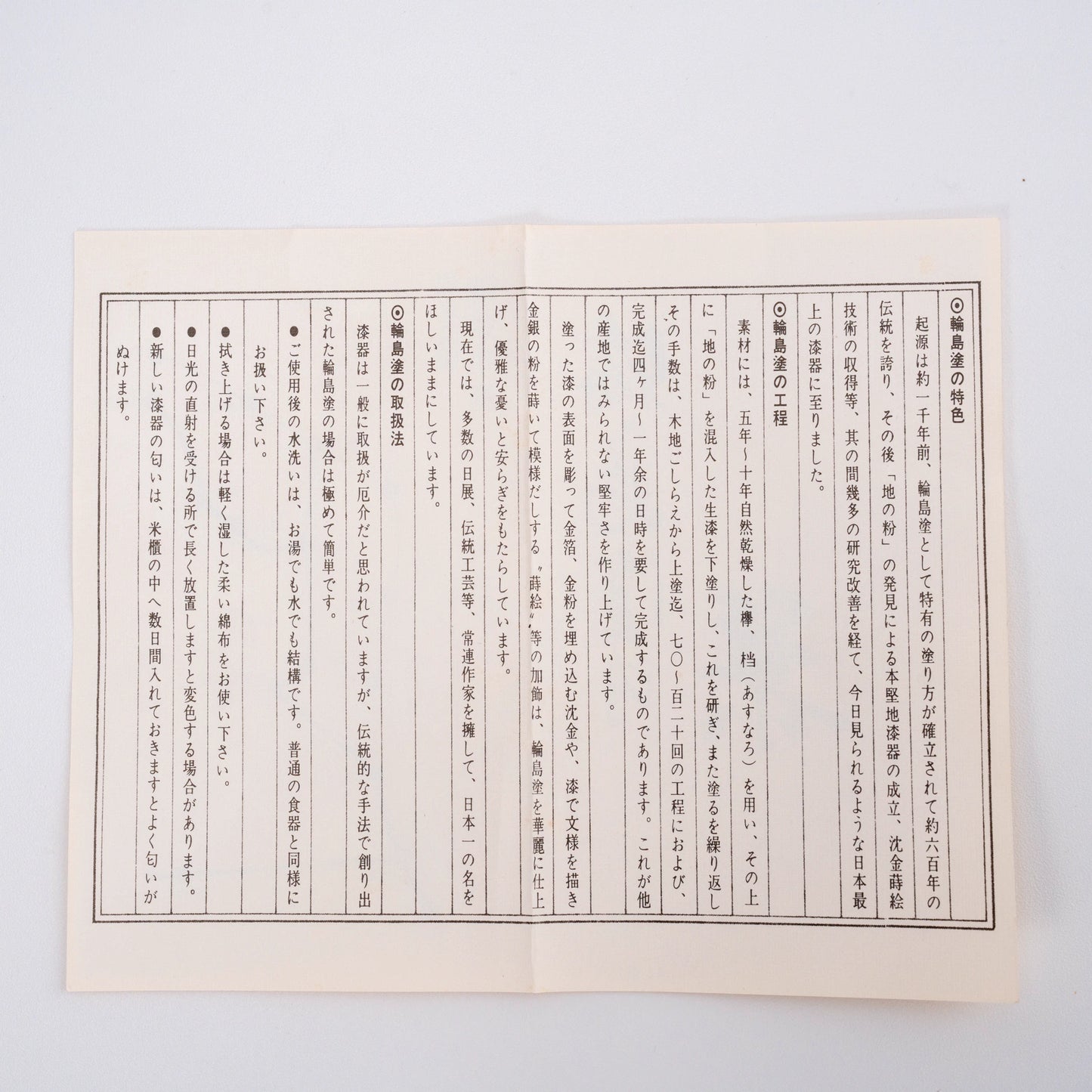
Pamphlet: original 輪島塗の栃 from 漆の里・輪島 (Urushi-no-Sato Wajima — the official Wajima lacquerware association)
-
Quality Indication Act registration: 承認番号 SK-IK-0156 (家庭用品品質表示法)
-
Curated by ZenKiln from a Japanese antique dealer; attribution Tier A (era + origin + craft tradition) + Tier B (signed 哲, designated Traditional Craftsperson — specific named individual not identified)
🏮 Provenance & Attribution
Wajima-nuri (輪島塗) is the lacquerware tradition of Wajima city on the Noto Peninsula of Ishikawa Prefecture. It is one of Japan's officially designated 経済産業大臣指定 伝統的工芸品 (Traditional Crafts recognised by the Minister of Economy, Trade and Industry), and is known for its honkenji 本堅地 method — a 70-to-120-step lacquering process taking between four months and over a year per piece, characterised by a ji-no-ko (地の粉) base layer of charged diatomaceous earth that creates an exceptionally durable foundation.
This pair carries a Tier A attribution chain for era, origin, and craft tradition: original paulownia tomobako with 輪島塗 夫婦椊 brush calligraphy on the lid; maker-stamped washi paper-wrap reading 特堅牢美術 / 産 輪島塗 / 伝統工芸 (Special-Durability Art / Wajima-produced / Traditional Craft); original 輪島塗の栃 pamphlet from the official Wajima lacquerware association; Quality Indication Act registration SK-IK-0156 on the box underside declaring material composition as urushi over ji-no-ko base over natural wood. Production year given as Shōwa 60 (1985).
A Tier B attribution applies to the specific maker. The interior of the tomobako lid bears the signature 哲 (Tetsu) accompanied by the formal title 伝統工芸師 (Dentō Kōgei-shi — Designated Traditional Craftsperson) and a red square maker seal. A second faint scratched mark of two characters appears on the underside of the black bowl. The title 伝統工芸師 is a government-recognised designation given to artisans who have passed a national qualification, so the maker's professional standing is verified — but the specific named individual behind the signature 哲 cannot be attributed without a further match in a Wajima maker registry, so we do not name a specific artist.
🔍 Condition
The pair has been preserved in its original packaging since 1985 and arrives with light surface wear consistent with a 40-year-old hand-finished piece — no major chips or losses are visible in supplied photographs. Antique lacquerware is by nature a record of its years; any minor abrasions, lacquer micro-cracks, or faint scratches that emerge under loupe inspection will be enumerated honestly before dispatch.
✍️ Tomobako & Hakogaki Transcription
Exterior lid (sumi calligraphy):
輪島塗 夫婦椊 — Wajima-nuri Meoto-wan — 'Wajima-lacquer Husband-and-Wife Bowls'
Interior lid (hakogaki, top to bottom):
哲 → Tetsu / Tetsuo → maker's go-mei (signature character)
伝統工芸師 → Dentō Kōgei-shi → 'Designated Traditional Craftsperson'
[red square seal] → maker's studio mark
Paper wrap (each bowl):
特堅牢美術 / 産 輪島塗 / 伝統工芸 — Tokukenrō Bijutsu / san Wajima-nuri / Dentō Kōgei — 'Special-Durability Art Ware / Wajima-produced / Traditional Craft'
Box-bottom Quality Indication Act sticker:
家庭用品品質表示法による表示
· Surface coating type: うるし塗装 (urushi lacquer)
· Base coating: 地の粉漆下地 (ji-no-ko urushi base)
· Substrate type: 天然木 (natural wood)
· Approval number: SK-IK-0156
🎋 Cultural & Craft Context
The two-tone red-and-black pairing seen in this set is one of the classical Wajima-nuri colour traditions: the red (朱 shu) is for one partner and the black (黒) for the other, with both bowls sharing a vermilion interior so the two read as a matched pair when set side by side at the table. The decoration motif — sasa (笹), a short-leaved bamboo grass — is a long-running Japanese decorative subject, often paired with pine and plum (matsu-take-ume / 松竹梅) but here used alone, with each bowl carrying a slightly different sasa branch composition in gold maki-e.
The accompanying brochure, 輪島塗の栃 ('Notes on Wajima Lacquer'), is the standard introductory pamphlet from the official Wajima lacquerware association (漆の里・輪島); it documents the roughly 1,000-year recorded history of Wajima lacquer, the 600-year history of the honkenji method that defines the craft, and notes the typical 70-to-120 production steps and 4-month-to-1-year per-piece timeline.
🧼 Care for Antique Lacquerware
- Hand-wash only in lukewarm water with mild soap; rinse gently and pat dry with a soft cotton cloth
- NO microwave, NO dishwasher, NO oven — heat will damage urushi lacquer and may crack the wood substrate
- Avoid prolonged soaking; never leave in standing water
- Avoid direct sunlight when not in use (urushi colour can shift under UV)
- Store in a cool, ventilated place — preferably back inside the tomobako with the paper wrap
A faint urushi scent from long box storage is normal for older lacquerware. Leaving the bowls in a dry rice container (米櫃) for several days will absorb any residual aroma, per the original Wajima association pamphlet's care notes.
About ZenKiln — A Japan-based curator connecting international collectors with Japan's artisan ceramic tradition. We work closely with the kilns, workshops, and makers featured in our shop — each one disclosed in our About section — and hand-pack every piece in Japan for safe delivery worldwide.
📦 Ships from Japan, hand-packed for safe delivery. Antique pieces are wrapped in their original tomobako and paper wrap, then double-boxed with archival-grade cushioning. Insurance for the full sale value is recommended on all antique orders and is included by default on orders over $250.