Matcha Bowl, Chasen, and Chashaku Care: The Complete Set
9 min readA Japanese matcha set has four to five core pieces, and each requires a different care routine. The bamboo chasen whisk is consumable and the most often ruined — most chasen die from being stored damp, not from old age. The chawan tea bowl needs the gentlest handling of any teaware. The bamboo chashaku scoop and the natsume tea container must never touch water.
This guide is the complete matcha set care manual: how to wash and dry a chawan by bowl type, how to extend the life of a chasen with the right kusenaoshi holder routine, why the chashaku never sees water under any circumstance, and how to store a natsume so matcha stays fresh.
The complete matcha set
A traditional usucha (thin tea) matcha set has five everyday pieces:
| Component | Japanese | Material | Care frequency |
|---|---|---|---|
| Chawan | 茶碗 | Clay or porcelain | After every use |
| Chasen | 茶筅 | Bamboo (single node) | After every use; replace when prongs break or lose their shape |
| Chashaku | 茶杓 | Bamboo or wood | Dry wipe only — never water |
| Natsume / Cha-ire | 棗 / 茶入 | Lacquer or ceramic | Dry wipe only — never water |
| Chakin | 茶巾 | Linen | Hand-rinse after each use |

A chasen is often damaged by being put away damp in a closed container, where moisture remains trapped between the fine prongs. Another common problem is bent or broken prongs caused by drying it flat instead of upright on a whisk holder.
Chasen care — the bamboo whisk
A chasen is split from a single bamboo node into 80–120 fine prongs (hosaki, 穂先) that are then steamed, shaped, and tied. Prong count varies by use: 80-prong whisks are for thick tea (koicha, 濃茶), 100–120 prongs for thin tea (usucha, 薄茶). A chasen is consumable; its working life depends on frequency of use, whisking technique, and whether it dries completely between uses. Tea-ceremony tradition has a ceremonial retirement called chasen kuyō (筅供養).

First use
- Hold the chasen in the palm and pour hot (not boiling) water over the prongs to soften them. Let stand 1–2 minutes.
- Gently splay the prongs outward with your fingers from the center while still warm. This sets the prong spread that makes whisking effective.
- Rinse with fresh warm water and proceed to first whisking.
After each use
- Swirl the chasen in clean warm water — not the bowl you whisked in — to remove all matcha. Repeat with fresh water until the rinse runs clear.
- Never use soap or detergent. Soap residue affects the next bowl of matcha immediately, and the prongs absorb it.
- Gently squeeze the prongs back into their round, slightly splayed shape between your fingers.
- Place the chasen upright on a kusenaoshi (茶筅直し, whisk holder) — a small bamboo or ceramic stand shaped like a flower bud that holds the prongs splayed open. Air-dry completely.
- Once fully dry, store on the kusenaoshi or in an open container. Never store in a closed box or plastic bag while still damp. Trapped moisture encourages mold between the fine bamboo prongs.
The kusenaoshi rule
Drying a chasen flat can press the fine prongs out of shape. A kusenaoshi supports the whisk upright and helps the prongs retain their open form while air circulates around them.
Replacement signals
- Several prongs are broken or visibly snapped.
- The center prongs no longer return to splayed position after washing.
- A musty odor, persistent discoloration, or visible mold develops.
Replace a chasen according to its condition, not a fixed calendar. A whisk used frequently will wear sooner, while careful rinsing and complete drying help it last longer. Replacement is normal; a chasen is a consumable tea tool.
Chawan care — by bowl type
Chawan span the full range of Japanese ceramics: highly porous low-fired Raku at one extreme, vitrified porcelain at the other. The care rules track the body type.

Raku-yaki chawan (楽焼) — black or red raku, fired at low temperature (around 800–1,000°C), extremely porous, light in hand. The most fragile chawan style.
- Rinse with warm water only — never hot, never cold-from-tap.
- No soap, ever. Porous body absorbs everything.
- Air-dry inverted on a clean cloth for at least an hour.
- Never dishwasher, never microwave.
- Pouring boiling water into a cold raku bowl can crack it instantly.
Hagi-yaki chawan (萩焼) — soft glazed earthenware from Yamaguchi Prefecture, famous for its fine glaze crackle pattern (kannyu, 貫入). Hagi develops Hagi no nanabake (萩の七化け, "the seven changes of Hagi"): the kannyu absorbs tea over years and the bowl's appearance deepens. This is desired, not damage.
- Warm water rinse. No soap.
- Soak briefly in warm water before first use to seal the kannyu against immediate staining.
- Air-dry inverted.
Mino-yaki chawan in Shino, Oribe, or Kiseto styles — soft Mino glazes, semi-porous. Care similar to Hagi: warm water only, no soap, air-dry inverted.
Glazed porcelain chawan (Arita, Hasami) — vitrified, glossy, no porosity. The easiest to clean: warm water, a tiny amount of mild soap on a soft cloth if needed, rinse thoroughly, dry with a soft cloth. See our Japanese porcelain care guide for the full porcelain rules.
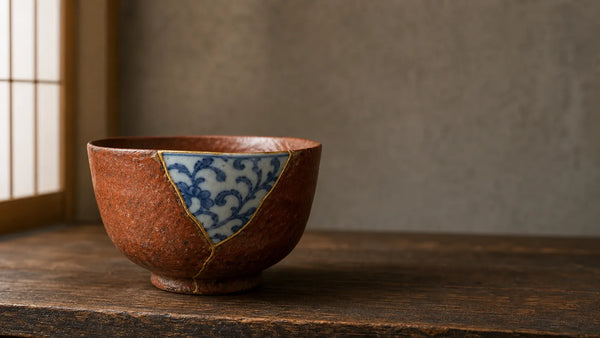
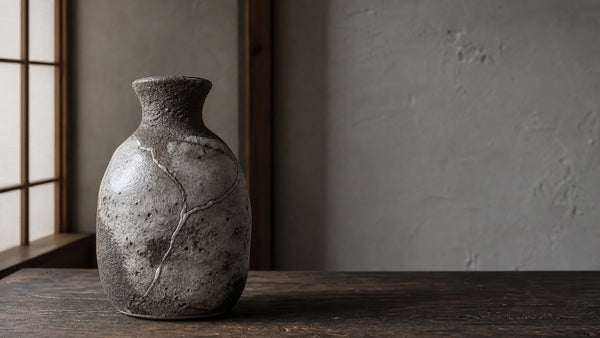
For any chawan with a chip or crack: the traditional Japanese repair is kintsugi — gold-mended urushi repair, suited to pieces with sentimental or financial value.
Chashaku and other no-water pieces
The chashaku (茶杓) is a small bamboo scoop carved from a single piece. It is the most delicate piece in the set in one specific way: it must never see water. Bamboo splits along the grain at the slightest sustained moisture, especially at the carved curve where the scoop meets the handle.

Chashaku care
- After each use, hold the chashaku over a folded chakin or fukin (Japanese kitchen cloth).
- Wipe the scoop end gently from the curve outward to remove any matcha residue.
- Place flat on a soft cloth or in its original paulownia box.
Never: rinse, wash, wet-wipe, or run under any tap. If matcha is caked on, use a small dry brush (a soft natural-bristle artist's brush works) to dust it off. Water damages the chashaku permanently.
The same no-water rule applies to any other bamboo or wooden tea-ceremony accessory.
Natsume tea container care
The natsume (棗) is a lidded container shaped like a jujube fruit, holding the matcha powder before it is scooped. Two main material categories:
Lacquerware natsume (urushi) — most natsume in tea ceremony use. Follow urushi care rules: dry wipe only, no water, no soap, no dishwasher (see our urushi lacquerware care guide).
Ceramic cha-ire — used for koicha (thick tea); typically a small stoneware or porcelain jar. Wipe interior with a soft dry cloth after emptying. Brief warm water rinse is permissible for the exterior only if matcha has spilled; dry immediately.
For both types:
- Matcha is hygroscopic — it absorbs ambient moisture quickly. Always close the natsume tightly when not in use.
- Store in a cool, dry location away from direct light. The container can sit in its original paulownia box for long-term storage.
- Match the amount of matcha in the natsume to your weekly use; matcha loses freshness within 2–3 weeks of opening, regardless of container quality.
Seasonal chawan
Tea ceremony tradition uses different chawan shapes by season:
- Summer chawan (asagao-gata, 朝顔形) — wide, shallow, dish-like. The open shape encourages heat dissipation, desirable in summer.
- Winter chawan (tsutsu-gata, 筒形) — tall, narrow, cylindrical. The closed shape conserves heat, desirable in winter.
These are not strict requirements for casual use but matter in formal practice. Storage is the same regardless of shape.
What never to do
- Never store a chasen damp in a closed container. Trapped moisture encourages mold between the fine bamboo prongs.
- Never dry a chasen flat. Prongs collapse and cannot be re-splayed.
- Never wash a chashaku with water. Bamboo splits along the grain.
- Never put any matcha-set piece in a dishwasher. Including porcelain chawan — soap residue at lid and rim affects the next bowl.
- Never use soap or detergent on a chasen. Residue is impossible to fully rinse from 100+ thin bamboo prongs.
- Never microwave any matcha-set piece. Bamboo dries unevenly and snaps; ceramic chawan crack from uneven heating.
- Never store a natsume open. Matcha absorbs ambient moisture and stales rapidly.
- Never pour boiling water into a Raku chawan. Low-fired body cracks from thermal shock.
FAQ
How often should I replace my chasen?
There is no fixed replacement calendar. Replace the chasen when several prongs break, the center no longer holds its shape, or you notice visible mold or a persistent musty odor. Frequency of use, whisking technique, rinsing, and drying all affect its working life.
Why does my chasen smell musty?
A musty odor usually points to moisture retained between the fine bamboo prongs. If visible mold appears or the odor remains after complete drying, replace the chasen. Going forward, rinse it well, support it upright on a whisk holder, and let it dry completely before storage.
Can I wash my chasen with soap?
No. The 100-plus thin bamboo prongs trap soap residue that cannot be fully rinsed. The next bowl of matcha will carry a faint detergent note, and the bamboo itself absorbs the soap. Warm water swirl-rinses are sufficient; if matcha is heavily caked, multiple warm-water rinses with finger-massaging of the prongs are the maximum.
Do I need a kusenaoshi to take care of my chasen?
A kusenaoshi (茶筅直し, whisk holder) supports the chasen upright and helps the prongs keep their shape as they dry. If you do not have one, use a clean stand that supports the handle without compressing the prongs and still allows air to circulate.
How do I store my chashaku?
Lay it flat on a soft cloth, or place it in its original paulownia (kiri) box. Never in plastic, never in a humid drawer. Wipe gently with a folded dry chakin or fukin after each use to remove matcha residue. Never rinse under water.
How is matcha set care different from kyusu teapot care?
A kyusu is for brewing infused tea and develops a cha-shibu patina on the inside that is part of the seasoning (see our Japanese kyusu teapot care guide). A matcha set is for whisking powdered tea: the chawan is washed clean after every use, the chasen is rinsed and dried after each use, then replaced when worn, and the chashaku and natsume never see water. Different ceremonies, different objects, different care logic.
Editor's note: ZenKiln carries chawan from Hagi, Karatsu, Mino, Raku, and Arita traditions, along with chasen from Takayama — the historic chasen-making center near Nara — and lacquerware natsume from Wajima and Yamanaka. All ship hand-packed from our Sengoku studio in Tokyo with care guidance specific to each piece.