“Who made this, and is the description accurate?” is a useful starting question for a Japanese ceramic. The foot, material, decoration, mark and box can help you ask better questions. Even when those clues seem consistent, they cannot by themselves authenticate an object.
Separate three questions: how was it formed and decorated, when was it made, and does its attribution match the evidence? Factory production can include skilled handwork, and a moulded body can be hand-painted. The description needs to account for those processes accurately.
1. Turn it over: the foot ring (kōdai)
An exposed foot may show trimming marks, body colour and how the glaze ends. A regular foot can be hand-finished, and moulded work can also receive manual finishing. Look without scraping or tapping a fragile piece. Our guide to reading a chawan's foot ring explores what you can observe and what remains uncertain.

2. Read the material: stoneware or porcelain
Porcelain is often pale and translucent when thin; stoneware and other pottery cover varied bodies, weights and textures. These are tendencies, not definitive tests. Do not use tapping or dripping water to identify a fragile or unfamiliar object. See our guide to Japanese stoneware versus porcelain.
A regional attribution can help you research a piece, but regions may produce more than one type of body. A mismatch between a description and an observation is a reason to ask for clarification, not enough to declare a fake.

3. Look at the decoration: painted or printed
Forming and decoration need separate descriptions. Hand-painting, transfer decoration, moulding and hand-finishing can occur in combination. Raised decoration is not proof of hand-painting: Noritake’s museum material describes raised white decoration made by printing. For the Bunzan-kiln peony pieces, consult the specific product description. Ask how the particular piece was made; visible variation or regularity alone cannot settle the process.

4. The mark on the base: useful, not proof
A base mark may name a kiln or place, or include an auspicious character such as fuku (福, good fortune). Marks can be copied, revived or reused, so compare the inscription with documented examples and the rest of the object.
Ko-Kutani illustrates the difficulty of regional attribution. Much work historically described as old Kutani is now considered likely to have been made around Arita. A style name, collecting label and production location can refer to different aspects of the same object; a base mark cannot resolve that history on its own.
A legible maker’s mark gives you a name to research. Compare the Chōhō-kiln Kutani lucky cat and Seikō-kiln bird mug with their product records.

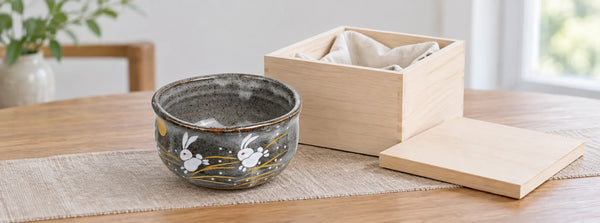
5. The box and the papers: tomobako
Tomobako (共箱) generally refers to a maker-inscribed accompanying box. Hakogaki (箱書き) means a box inscription and can describe writing on a tomobako as well as other boxes. Record who wrote it and whether it belongs with the object: inscriptions can be copied, boxes can be mismatched, and a signed box is one part of provenance. See our guide to the paulownia box behind a tea bowl.

Old, or just made to look old
Wear varies with use, storage, repairs and cleaning. Uneven staining can be imitated, and genuine old objects can look little used. A modern handmade vessel can be entirely genuine without being antique. Dating requires evidence beyond a patina or a worn foot.

Putting it together
Use observations to check the description and identify questions for the seller. Consistent clues are helpful, but they do not replace reliable provenance, comparison with documented works or specialist assessment when attribution and value matter. Our map of Japan's pottery regions provides background for that research.
Reading a ZenKiln listing
Check the photographs and written record for the particular item: maker attribution, material, forming and decorating methods where documented, condition, repairs and whether a box is included. If a needed view or detail is missing, ask for it. Browse our Kutani ware and Arita and Hasami collections for the current selection.
FAQ
Is unmarked Japanese pottery worth anything?
Yes. Many worthwhile pieces are unmarked. Value depends on attribution, age, condition, quality, provenance and market context, and an inscription is not required for an object to have artistic or personal value. For a financial appraisal, use an appropriately qualified specialist.
Further reading: Noritake’s account of its production and quality work illustrates why skilled hands and organised manufacturing should not be treated as mutually exclusive. An individual listing should state only the process and origin supported by its records.