Chūsen: The Pour-Dyeing Craft Behind Tenugui and Yukata
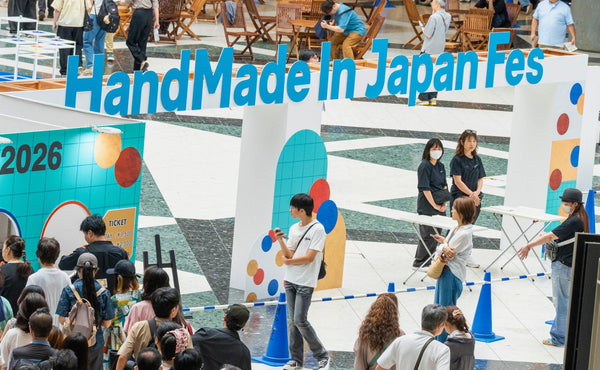
6 min readChūsen (注染, “pour-dyeing”) colours layers of fabric with dye poured from a long-spouted kettle. Stencil-pasting comes first; pouring is a separate stage. This guide explains that sequence and the history connecting Tokyo’s early dye houses with modern techniques developed in Osaka. For the wider craft-fair context, see HandMade in Japan Fes 2026.
What is chūsen?
Chūsen is a dyeing method in which dye passes through folded layers of resist-pasted cloth. The stencil is used to apply the paste and lifted away before dyeing. Dye is applied from both sides of the stack, producing colour visible on both faces of the fabric.
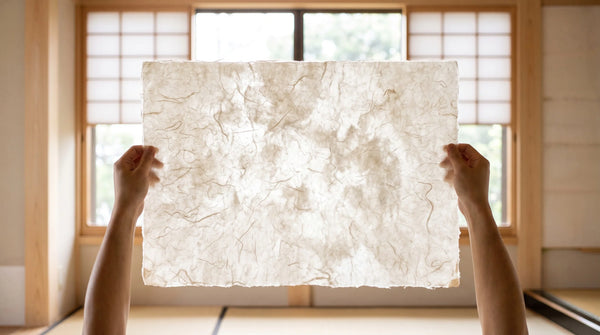
Honzome (本染) is commonly translated as “true dyeing.” It names a process in which dye penetrates the fibres. In a finished piece, look for the intended pattern, the quality of the colour, and the maker’s process description. Surface irregularities alone do not authenticate handwork. Our guide to washi paper looks at another Japanese material through its making process.
From Edo dye houses to Meiji yukata
The Kantō Chūsen Industrial Cooperative’s history distinguishes two developments: early pour-dyeing by Edo indigo dyers, and the modern chūsen technique developed in Osaka during the Meiji period and then brought to Tokyo. The Osaka cooperative’s account explains that later development. Both belong in the history.
Why Tokyo? Partly custom. Edo had a strong culture of giving tenugui as greetings and keepsakes — kabuki actors and connoisseurs commissioned their own designs, and shops handed dyed cloths out like calling cards. That everyday familiarity with dyed cotton made the capital the natural center of the craft. From the late Meiji era chūsen was applied to yukata cloth as well, and by the early Shōwa period it was the signature technique for Tokyo yukata — the light cotton robe still worn to summer fireworks and festivals. Those summer textiles belong to the same seasonal world as the glass, ceramic and cast-iron objects Japan reaches for to feel cool in July and August.
How a chūsen tenugui is made
The sequence combines skilled handwork with equipment for preparation, suction, washing, and finishing. In outline:
- Carving the stencil. A design is hand-cut into shibugami — paper laminated and hardened with fermented persimmon tannin. Tiny bridges are left in so that isolated shapes don't fall out; a fine silk or mesh reinforcement holds the whole stencil together.
- Preparing the white cloth. Narrow cotton (roughly 34–42 cm wide) is scoured and bleached — a step known as wazarashi (和晒) — then straightened and rolled so it will take dye evenly.
- Stencil-pasting — katatsuke (型付け). A spatula spreads resist paste through the framed stencil onto the cloth. The stencil is lifted, the fabric folded back, and pasting repeated. Paste recipes vary: the Tokyo cooperative describes seaweed-and-clay mixtures and rice-based pastes. Sawdust helps keep the pasted layers from sticking.
- Pour-dyeing. The pasted, accordion-folded stack is moved to the dyeing bed. Dye held in a long-spouted kettle (yakan) is poured over the top while suction from beneath draws it straight down through every layer at once. The whole stack is then flipped and dyed again from the back, which is what gives chūsen its even, two-faced color.
- Rinsing — mizumoto (水元). The resist paste and any excess dye are washed out in plenty of water, and the finished pattern appears.
- Drying. After washing and removing excess water, the cloth is hung on racks to air-dry before inspection and finishing.

Dye is drawn through the folded cloth and the stack is turned for dyeing from the other side. This gives colour to both faces; exact appearance depends on the design and dyeing.
Bokashi, sashiwake, Hosokawa: color by hand
The pouring stage is where an experienced dyer earns the title. A single-color piece (isshoku-zome) is the baseline. To place several colors on one cloth without them running together, the dyer pipes little walls of resist paste from a paste tube (nori-zutsu) to dam each area — a technique called sashiwake-zome (差分染). For a gradient, bokashi-zome (ぼかし染) blends two or more dyes as they are poured so the color fades across the cloth with no hard edge. Layered and repeated dyeing is Hosokawa-zome (細川染); for very fine detail the dyer steers the flow with a guiding stick (tsuki-bō, 突き棒).
Controlled gradients are part of the design, and a dyer aims to reproduce them consistently. Small variations may occur, but accidental blotches or poorly controlled bleeding should not automatically be described as desirable handwork.

Chūsen today
Tokyo Honzome Chūsen was designated a National Traditional Craft by Japan's Ministry of Economy, Trade and Industry on October 26, 2023. The name covers chūsen produced by the workshops of the Kantō Chūsen Industrial Cooperative across Tokyo, Gunma and Tochigi. The cooperative was founded in 1951, and today only a small number of family workshops — many in the Katsushika, Adachi and Edogawa wards of eastern Tokyo — still keep the pour-dyeing tradition in daily production.
Contemporary chūsen includes tenugui, yukata, and other textile goods. A workshop’s own process photographs or a demonstration can help explain the distinct pasting, pouring, and washing stages.
When watching a demonstration, first identify the tool. A spatula moving over a stencil usually indicates resist-paste application; a long-spouted kettle at the dyeing bed belongs to pouring. That distinction makes the final white areas and coloured areas much easier to understand.
FAQ
What is chūsen dyeing?
Chūsen colours folded, resist-pasted fabric with poured dye. The stencil is removed after pasting, before the pouring stage. Early Tokyo pour-dyeing and the modern technique developed in Meiji-period Osaka are separate parts of its history.
What's the difference between chūsen and a printed tenugui?
Chūsen dye penetrates the fabric and is applied from both sides of the folded stack. Printed textiles vary in process and penetration, so a pale reverse or a soft edge is not a sufficient identification test. Use the maker’s process description.
Is a chūsen tenugui really the same on both sides?
The colour is visible on both faces because the stack is dyed from both sides. Text and directional motifs appear reversed when seen from the other face, and small colour differences can occur.
What is Tokyo Honzome Chūsen, and when was it recognized?
Tokyo Honzome Chūsen is chūsen dyeing produced by the Kantō Chūsen Industrial Cooperative across Tokyo, Gunma and Tochigi. Japan's Ministry of Economy, Trade and Industry designated it a National Traditional Craft on October 26, 2023. The cooperative itself dates to 1951.
How do you care for chūsen-dyed fabric?
As a general practice with hand-dyed cotton, wash a new chūsen piece separately in cool water for the first few washes, since some loose dye may run. Avoid prolonged direct sun and harsh bleach, and dry in the shade to keep the colors deep. Gentle handling keeps a chūsen tenugui looking its best for years.
Sources: the Kantō Chūsen Industrial Cooperative, the Osaka Orisen cooperative, and Traditional Crafts Aoyama Square. This article is a researched process guide.