Kintsugi: The Japanese Art of Gold-Repaired Pottery
9 min readKintsugi (金継ぎ, “golden joinery”) is the Japanese craft of repairing ceramics with lacquer and a gold-coloured seam, traditionally finished in gold powder. Related lacquer repairs use silver or other finishes. The visible join can become part of an object’s history and appeal; repair does not automatically increase its market value.
This article is a primer for collectors who own a chipped chawan, a cracked Imari plate, or a Wajima lacquer bowl that has finally given up after thirty years of use — and want to understand what kintsugi actually is before deciding what to do about it.
What "Kintsugi" Literally Means
Kin (金) means gold and tsugi (継ぎ) means joining or mending. Kintsukuroi (金繕い) is another name for gold repair. In a traditional lacquer repair, the lacquer-based adhesive and fills hold the fragments; metal powder adheres to a still-tacky finishing coat, not an already fully cured surface.
The choice of word matters. Tsugi (継ぎ) is the same character used for inheriting a family name or continuing a lineage. The repair is framed as continuation, not restoration. The bowl is not being returned to a previous state; it is being moved forward to a new one.
The Philosophy — Wabi-Sabi, Mottainai, and the Broken Tea Bowl
A familiar origin story connects gold repair with Ashikaga Yoshimasa and the staple-repaired bowl Bakōhan. Tokyo National Museum records the tradition that the damaged bowl was sent to China in search of a replacement and returned with staples when no equivalent could be found. This account does not establish the invention or a precise starting date of kintsugi.
The philosophy that grew up around it draws on three older Japanese ideas:
- Wabi-sabi (侘寂) — the aesthetic that finds beauty in the imperfect, the impermanent, and the incomplete. A chipped rim is not a flaw to hide; it is a register of time.
- Mottainai (勿体無い) — a regret at waste, the sense that things have value and should not be thrown away lightly. Kintsugi is mottainai made visible: the bowl is too meaningful to discard.
- Mono no aware (物の哀れ) — a gentle, melancholic awareness of the passing of things. The gold seam is a small monument to the moment the bowl broke.
A repaired bowl is read as a keshiki (景色, "landscape") — a term tea practitioners use for the totality of marks, drips, kiln scars, and now repairs that give a piece its individual character. A kintsugi seam is the most legible chapter in that landscape.
The Three Classic Repair Styles
Most kintsugi work falls into one of three categories, defined by what is missing from the original vessel:
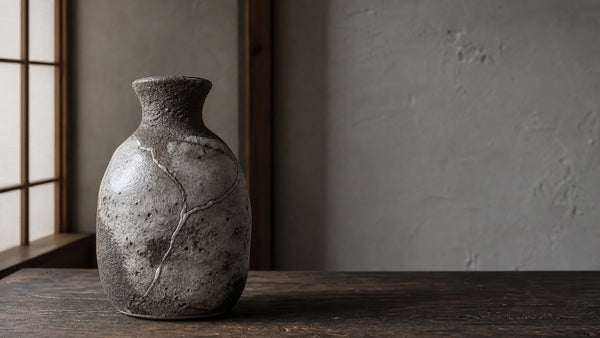
- Hibi (ひび) — crack repair. A clean break or hairline fracture is bonded with urushi, the seam is leveled and polished, and gold powder is fixed onto the still-tacky topcoat. The fragments interlock; little or no material is added. This is the most common form and the closest to what most Western audiences picture when they hear "kintsugi."
- Kake (欠け) describes a chip or missing area. Repairers build up losses with appropriate lacquer-based fills. Mugi urushi uses wheat flour as part of an adhesive; kokuso and sabi are different filling mixtures rather than names for every rice-, wood- or clay-filled paste. The choice depends on the size and role of the fill.
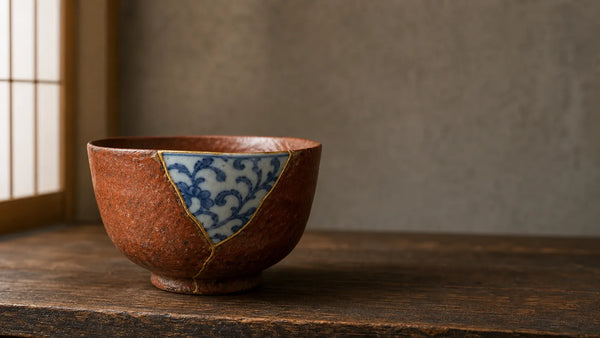
- Yobitsugi (呼継ぎ) — joining fragments from different pieces. The character 呼 means "to call" or "to invite"; yobitsugi is literally "invited joining." When a fragment is lost permanently and no putty fill will do, a shard from another, visually different vessel is shaped, lacquered, and gilded into place. The result is a deliberate patchwork — a blue-and-white shard inside a celadon bowl, joined by gold. Yobitsugi is the most visually dramatic style and is prized by collectors precisely because it refuses to pretend the bowl was ever whole.
How the Process Actually Works
The following is a description of the craft, not a home repair recipe. Raw urushi can cause severe contact dermatitis, and broken ceramic edges can cut. Learn handling and material precautions from a qualified practitioner before attempting work.
- Cleaning and dry-fitting. The break is examined, edges cleaned, fragments dry-assembled to confirm the puzzle.
- Joining. A repairer may use mugi urushi, a wheat-flour and lacquer adhesive, to join fitted fragments. Lacquer curing depends on suitable humidity, temperature and layer thickness; it is not simply the evaporation of water.
- Filling and levelling. Missing areas and surface gaps are built up with appropriate fills, allowed to cure and refined before the finishing layers.
- Metal application. A thin final coat of red or black urushi is applied to the seam; while it is still tacky to the touch, gold powder (or silver, tin) is dusted on with a soft brush or cotton ball, then burnished once cured.
A repair can take weeks or months. The repairer should explain the expected schedule for the materials, conditions and damage; thirty or sixty days is not a universal minimum or a guarantee of readiness for use.
Silver Repair, and Lacquer Without Metal
Gold gets the headlines, but it is not the only finish.
- Gin-tsugi (銀継ぎ, "silver joinery") uses silver powder in place of gold. The seam reads cooler, more restrained, and over time silver tarnishes to a deep grey-black — a slow second act in the life of the repair. Gin-tsugi is often chosen for pieces whose palette would clash with bright gold, particularly Shino, Karatsu, and other earthy stoneware.
- Tin-finished repair (錫継ぎ, suzu-tsugi) offers another grey-toned finish. The quote depends on the work as well as the metal.
- Urushi-tsugi (漆継ぎ) leaves the repair finished in lacquer without a metal dusting. Its colour and surface can be chosen to suit the vessel.
"Is My Piece Worth Repairing?" — A Buyer's Decision Framework
Not every broken bowl is a kintsugi candidate. A useful way to think about it:
- Consider repair when the piece matters to you and you accept a visible join. Ask for a condition assessment and quote, including whether the desired use can safely be restored.
- Compare display repair, functional repair and leaving the piece as it is. Sentimental value need not depend on rarity or production method.
- Do not return an unstable piece to use without assessment. A damaged spout, base or handle can have consequences beyond the appearance of the seam.
The honest test is: do I want this object back in my life, even imperfect? If yes, kintsugi makes sense. If the answer is "I want the object I had before it broke," kintsugi will disappoint, because the repair is meant to be visible.
Modern Kintsugi Kits vs. Traditional Urushi Repair
The last decade has seen a flood of "kintsugi kits" sold online — small boxes containing epoxy or synthetic resin, gold-coloured mica powder, and a brush. These kits make the technique accessible to anyone, and there is real value in that. They are also not the same craft as traditional kintsugi, and it is worth being clear about the difference:
- Modern kits vary in resin, filler and metallic pigment. Some are intended only for decoration. Read the complete system’s instructions; a material name, fast cure or “gold” colour does not establish food-contact or hot-liquid suitability.
- Traditional urushi repair also needs a materials and use assessment. Natural lacquer and real gold do not by themselves certify the whole repair for food contact. A repairer should confirm its intended use and care.
Choose by the object, the repairer’s competence and the intended result. For an older or valuable piece, consult a conservator before an irreversible intervention.
Where ZenKiln Sits in All This
ZenKiln is not a kintsugi repair studio. This article explains the relationship between lacquer repair and lacquerware: both can use urushi, but their mixtures, construction and intended use differ. Check the current product record for any piece you are considering.
If you are looking to commission an actual repair, we recommend searching for a local conservator with formal urushi training rather than booking the first listing that appears online — kintsugi is a slow craft, and competent practitioners are happy to explain their timelines and materials in detail before quoting.
Further Reading on ZenKiln
- Wajima-nuri: Japan's Premier Urushi Lacquerware — the urushi base that makes kintsugi possible.
FAQ
Is kintsugi food-safe?
Only when the complete repair has been confirmed suitable for the intended food, liquid and temperature. Neither “natural urushi” nor “epoxy” settles that question alone. Keep undocumented repairs for display pending advice; avoid microwaving metal-finished repairs.
How long does a kintsugi repair take?
The schedule depends on the repair system, layer thickness, environment and complexity. Traditional work often takes weeks or months. Ask the repairer when the piece is ready and which uses are approved.
What is the difference between kintsugi and yobitsugi?
Kintsugi (金継ぎ) is the umbrella term for gold-finished lacquer repair. Yobitsugi (呼継ぎ, "invited joining") is one specific style within that family — used when a missing fragment is replaced with a piece from a different vessel, creating a deliberate patchwork joined by gold seams.
Why gold? What does the metal actually do?
The metal highlights the join. The lacquer-based adhesive and fills provide the structural repair, and metal powder is applied while the final coating is still tacky.
Can I do kintsugi at home with a kit?
A kit needs its own handling instructions, protective measures and use limits. Raw urushi can cause contact dermatitis; fragments have sharp edges. Do not assume a completed kit repair is food-safe. Valuable pieces deserve specialist assessment before work begins.
Does ZenKiln sell kintsugi-repaired pieces?
This article does not advertise a repair service. Check current listings for the condition and any disclosed repairs on individual pieces.
Editor’s note. This is an educational guide, not a repair or food-safety certification. Historical accounts are distinguished from documented objects; practical decisions require an assessment of the piece and all repair materials.