Chūsen: The Pour-Dyeing Craft Behind Tenugui and Yukata
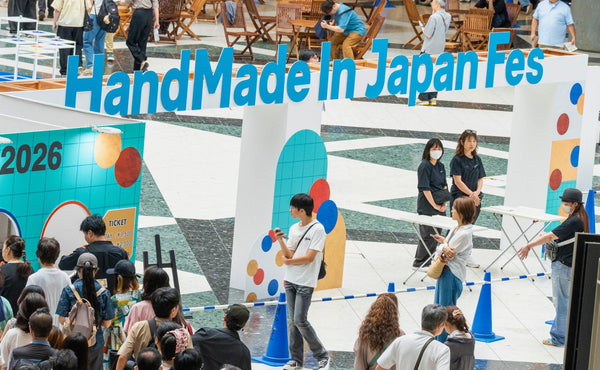
8 min readThe first thing I noticed at the HandMade in Japan Fes 2026 demonstration table was that the dye did not sit on top of the cloth — it went through it. An artisan drew a wooden spatula loaded with paste across a stencil, folded the damp cotton back on itself, and then poured color from a long-necked kettle until it soaked down through the whole stack and out the underside. This is chūsen (注染, "poured dyeing"), the hand-dyeing craft behind Japan's tenugui (hand towels) and summer yukata. In and around Tokyo it carries a formal name, Tokyo Honzome Chūsen, and in 2023 it joined Japan's register of protected traditional crafts. Here is what chūsen actually is, how a piece is made, and why no two ever come out the same.
What is chūsen?
Chūsen (注染) is a Japanese hand-dyeing method in which dye is poured through a resist-pasted stencil into stacked layers of cloth, coloring both faces of the fabric at once. Because the dye soaks in rather than printing on the surface, a chūsen tenugui has no "right" or "wrong" side — the pattern reads the same front and back. The technique took shape among Edo dyers in the mid-19th century and remains almost entirely handwork today.
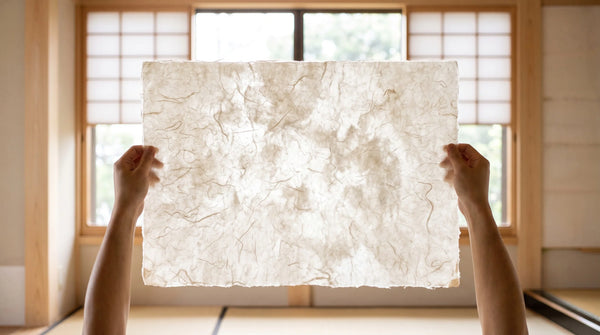
The word honzome (本染, roughly "true-dyeing") is the giveaway. It signals a cloth whose color goes all the way into the fibers, as opposed to a pattern stamped or printed onto one surface. Hold a good chūsen piece up to the light and the design is solid from either side; soft halos where one color bled toward another are not flaws but the signature of dye moving by hand. It is a close cousin, in spirit, to the other handmade materials I saw at the same makers' fair — washi paper among them — where the value lives in a process that a machine cannot quite fake.
From Edo dye houses to Meiji yukata
Chūsen grew out of the kon-ya (紺屋), the indigo dye houses of late-Edo Tokyo. Dyers there were looking for a faster way to color tenugui, and their answer — pouring dye directly through resist-pasted cloth, a method called sosogi-zome (注ぎ染め) — was working by the mid-1800s. In the Meiji period it overtook the older nagaita chūgata (長板中形) stencil method to become the mainstream way of dyeing cotton, because it could color both sides of a fabric in real quantity while still leaving crisp resist-white pattern.
Why Tokyo? Partly custom. Edo had a strong culture of giving tenugui as greetings and keepsakes — kabuki actors and connoisseurs commissioned their own designs, and shops handed dyed cloths out like calling cards. That everyday familiarity with dyed cotton made the capital the natural center of the craft. From the late Meiji era chūsen was applied to yukata cloth as well, and by the early Shōwa period it was the signature technique for Tokyo yukata — the light cotton robe still worn to summer fireworks and festivals. Those summer textiles belong to the same seasonal world as the glass, ceramic and cast-iron objects Japan reaches for to feel cool in July and August.
How a chūsen tenugui is made
Almost every stage is done by hand, and the sequence is unforgiving — one misaligned fold and the whole bolt is off. Simplified, it runs like this:
- Carving the stencil. A design is hand-cut into shibugami — paper laminated and hardened with fermented persimmon tannin. Tiny bridges are left in so that isolated shapes don't fall out; a fine silk or mesh reinforcement holds the whole stencil together.
- Preparing the white cloth. Narrow cotton (roughly 34–42 cm wide) is scoured and bleached — a step known as wazarashi (和晒) — then straightened and rolled so it will take dye evenly.
- Stencil-pasting — katatsuke (型付け). The stencil is framed and laid on the cloth, and a resist paste of glutinous rice and lime is spread across it with a spatula (hera). The cloth is then folded back precisely at the pasted edge and the step repeats — dozens of times down a single bolt — so every layer is masked with the identical pattern. A dusting of sawdust keeps the wet layers from sticking.
- Pour-dyeing. The pasted, accordion-folded stack is moved to the dyeing bed. Dye held in a long-spouted kettle (yakan) is poured over the top while suction from beneath draws it straight down through every layer at once. The whole stack is then flipped and dyed again from the back, which is what gives chūsen its even, two-faced color.
- Rinsing — mizumoto (水元). The resist paste and any excess dye are washed out in plenty of water, and the finished pattern appears.
- Drying. The cloth is hung and sun-dried on tall outdoor frames several meters high — the fluttering banners of drying fabric are the most photographed image of the craft.

Because the dye is poured rather than pressed, it penetrates from both directions and meets in the middle of the cloth. That is the technical reason a chūsen tenugui looks the same on the front and the back — and the reason it can't be reproduced by an ordinary surface print.
Bokashi, sashiwake, Hosokawa: color by hand
The pouring stage is where an experienced dyer earns the title. A single-color piece (isshoku-zome) is the baseline. To place several colors on one cloth without them running together, the dyer pipes little walls of resist paste from a paste tube (nori-zutsu) to dam each area — a technique called sashiwake-zome (差分染). For a gradient, bokashi-zome (ぼかし染) blends two or more dyes as they are poured so the color fades across the cloth with no hard edge. Layered and repeated dyeing is Hosokawa-zome (細川染); for very fine detail the dyer steers the flow with a guiding stick (tsuki-bō, 突き棒).
None of this is exact. The dye finds its own way through the fibers, so slight bleeds and halos vary from piece to piece even within one run. Makers treat that variation as the point rather than a defect — the human wobble that tells you a cloth was poured, not printed.

Chūsen today
Tokyo Honzome Chūsen was designated a National Traditional Craft by Japan's Ministry of Economy, Trade and Industry on October 26, 2023. The name covers chūsen produced by the workshops of the Kantō Chūsen Industrial Cooperative across Tokyo, Gunma and Tochigi. The cooperative was founded in 1951, and today only a small number of family workshops — many in the Katsushika, Adachi and Edogawa wards of eastern Tokyo — still keep the pour-dyeing tradition in daily production.
The craft has contracted with the rise of cheaper printed cloth and synthetic fiber, but it hasn't stopped adapting: alongside tenugui and yukata, workshops now dye shirts, bags and interior goods, and several open their doors for tours and demonstrations like the one I watched. If you want to see it in person, that is the honest recommendation — chūsen is one of those crafts that only makes sense once you've watched the color disappear into the cloth.
At the demonstration booth I watched an artisan make the first pass: a wooden spatula drawn steadily across the stencil, pushing color through the cut pattern in one even stroke. On the frames behind her the results hung drying — a deep-navy length scattered with pale-gold circles, still damp from the bath, and beside it a piece where yellow bled softly into crimson. Every one was different. That bleed, where the color slips past its own outline, is not a flaw to be corrected; among chūsen makers it is the whole point.
FAQ
What is chūsen dyeing?
Chūsen is a Japanese hand-dyeing technique in which dye is poured through a resist-pasted stencil into stacked layers of cloth so both sides are colored at once. It emerged in Edo (old Tokyo) in the mid-19th century and is used mainly for tenugui hand towels and yukata cotton robes.
What's the difference between chūsen and a printed tenugui?
A printed tenugui carries its design on one surface, so the back is pale or blank. In chūsen the dye soaks all the way through the cloth, so the pattern is solid and identical on both faces. Chūsen also shows soft, hand-poured color bleeds that machine printing cannot reproduce.
Is a chūsen tenugui really the same on both sides?
Yes. Because the dye is poured through the fabric from the top and again from the back, both faces take the color evenly. That two-sided, no-wrong-side finish is the defining trait of chūsen and the reason the technique is prized for tenugui and yukata.
What is Tokyo Honzome Chūsen, and when was it recognized?
Tokyo Honzome Chūsen is chūsen dyeing produced by the Kantō Chūsen Industrial Cooperative across Tokyo, Gunma and Tochigi. Japan's Ministry of Economy, Trade and Industry designated it a National Traditional Craft on October 26, 2023. The cooperative itself dates to 1951.
How do you care for chūsen-dyed fabric?
As a general practice with hand-dyed cotton, wash a new chūsen piece separately in cool water for the first few washes, since some loose dye may run. Avoid prolonged direct sun and harsh bleach, and dry in the shade to keep the colors deep. Gentle handling keeps a chūsen tenugui looking its best for years.
ZenKiln works directly with Japanese makers and ships from Tokyo — the craft in this piece is still practiced here in the city, and the notes above come from watching chūsen dyeing in person.