Lucie Rie at Teien: A Review of the East–West Vessels Show
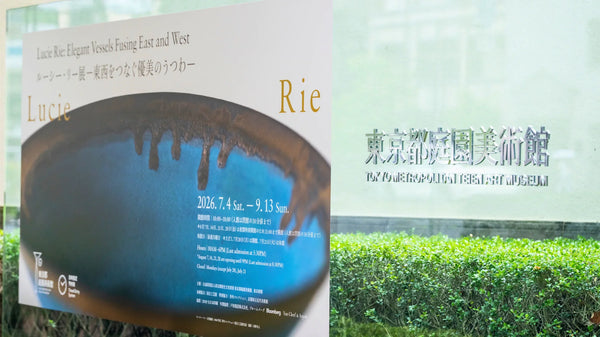
Some exhibitions borrow a building. This one seems to have found its way home. Lucie Rie: Elegant Vessels Fusing East and West runs at Tokyo Metropolitan Teien Art Museum from July 4 to September 13, 2026, and we went in its opening days to see how the most quietly radical potter of the twentieth century reads inside a 1933 Art Deco house. This Lucie Rie exhibition review is the companion to our earlier guide to the show — less what to expect, more what the rooms actually reveal.
Rie (1902–1995) was born in Vienna, trained at its arts-and-crafts school, and by her thirties was an established artist. Then, in 1938, antisemitism forced her into exile in London (the University of Cambridge's Kettle's Yard tells her story well). The exhibition — her first large-scale retrospective in Japan in nearly a decade — gathers her work from Japanese collections, led by the Iuchi Collection deposited at the National Crafts Museum, and sets it alongside the people she was bound to: Josef Hoffmann in Vienna; Bernard Leach, Hans Coper, and Hamada Shōji in Britain. The result is less a monograph than a map of one artist's East–West coordinates.
A house and a potter, both born of the 1920s
The museum's Main Building was completed in 1933 as the residence of Prince Asaka, and it is one of Tokyo's great Art Deco interiors — glass reliefs by René Lalique, decorative schemes by Henri Rapin, the whole vocabulary the prince absorbed during his years in Paris in the 1920s. The very phrase "Art Deco" comes from the 1925 Paris International Exposition of Modern Decorative and Industrial Arts, which the prince and princess visited.
That date matters, because the exhibition's own guide draws a line most visitors would never guess: at that same 1925 Paris exposition, a ceramic figure the young Vienna student Lucie Rie made with a classmate was shown in the Austrian pavilion — a pavilion shaped by Hoffmann, the Wiener Werkstätte leader who taught at her school. The house and the potter were, in a sense, at the same party a century ago. Placing her pots in these rooms is the show's central argument, and the museum states it plainly: this is a dialogue between the artist's spare vessels and the ornate residence around them. The pots win. A Rie bowl on a plinth, in a drawing room dense with 1930s pattern, does not shrink — it clarifies.

From Vienna to London — by way of a button
The most human room in the show is the one about survival. When Rie reached London her work was barely known there, and during the war she could not get a license to make pots at all. So she made buttons.
Unable to work as a potter in wartime London, Lucie Rie made ceramic and glass buttons for the fashion trade — miniature laboratories for the forms and glazes she would later become famous for. In 1946 a young refugee named Hans Coper joined her studio to help with the buttons and became her lifelong creative partner. Decades later, Issey Miyake used her buttons in a 1989 collection.
The glass buttons came first, made through the Bimini firm run by a fellow Viennese émigré; the ceramic ones followed at her own Albion Mews studio, where she could match a couturier's fabric swatch with a bespoke glaze in a matter of days. It is easy to walk past a case of buttons. Don't. Everything Rie is known for — the compressed form, the improbable color, the discipline of small decisions — was rehearsed here, under economic necessity, at the scale of a fingernail.
How to read a Lucie Rie vessel
If you have only ever seen her pots in photographs, the exhibition corrects two illusions: they are smaller than you think, and their surfaces do far more than the silhouettes suggest. Almost everything is thrown on the wheel, then finished with two signature techniques.
Sgraffito is decoration made by scratching through a surface layer to reveal a contrasting color beneath. Inlay is its inverse — incising lines into the clay and filling them with a slip of another color. Rie combined both with her glazes: manganese for near-black, a metallic bronze, a pitted "volcanic" surface that bubbles as it fires, and fine pink lines banded around white.
The wall labels read like a glaze index — Footed Bowl with Radiating Sgraffito with Manganese, Bronze Glazed Vase, Bowl with Volcanic Glaze, White Glazed Bowl Decorated with Pink Line. A detail worth carrying home: until she acquired a high-temperature electric kiln in 1948, her London work was low-fired earthenware; the porcelain and stoneware pieces most people picture came later. (If that distinction is new to you, our guide to stoneware versus porcelain is a five-minute primer.) What unites all of it is restraint used as intensity — a flaring conical bowl, a bottle with a trumpet neck, and nothing on them that does not earn its place.
The East–West thread — Leach, Coper, and Japan
Why show a British-Austrian potter in Japan, and why fold in Japanese ceramics? Because Rie stood inside a conversation that was already crossing oceans. The pivot is Bernard Leach, who spent his early career in Japan from 1909, befriended Yanagi Sōetsu and the Shirakaba literary circle, learned raku under the sixth Ogata Kenzan, and in 1920 returned to England with Hamada Shōji to build a Japanese-style climbing kiln at St Ives. The studio-pottery world Rie entered in London was already thinking with Japan's Mingei (folk-craft) movement in the back of its mind.
Rie was never Leach's disciple — their sensibilities differed sharply — but the show's inclusion of Leach's slipware and Coper's austere "Cycladic" forms lets you triangulate her position: warmer and more architectural than Coper, cooler and more urban than Leach. There is even a Western bookend to the Eastern one: in the early 1960s, Wedgwood invited Rie to design jasperware cups and saucers, setting her modern hand against the firm's neoclassical cameo tradition. Fusing East and West, the exhibition's subtitle promises — and it means the phrase literally.
If you go
The show is at the Teien Art Museum's Main Building and Annex, 10:00–18:00, with late openings until 21:00 on the Fridays of August (the 7th, 14th, 21st, and 28th). It is closed Mondays except July 20, and closed July 21; entry is by timed reservation, with tickets at ¥1,400 for adults and free for middle-school students and younger. Photography inside is permitted for personal, non-commercial use only — you'll see visitors quietly framing the bowls — and out of respect for the artists' copyright we have kept this piece to words; the museum's official exhibition page carries the authorized images.

Two events reward planning around: a lecture, "The Evolution of Lucie Rie's Style: From Vienna to London," and a "Making Ceramic Buttons" workshop that turns her wartime story into something you do with your hands. If Tokyo is out of reach, the exhibition travels to Osaka's Abeno Harukas Art Museum from December 26, 2026 to March 7, 2027. For the fuller planning details, our preview guide still stands.
Holding the idea at home
What lingers after the Teien show is not any single famous pot but a way of valuing objects: a thrown form, a considered glaze, a scratched line, made to be lived with rather than only looked at. That is the ground ZenKiln works from, too. We won't pretend our makers descend from Rie — they don't — but if the exhibition leaves you wanting to hold, not just admire, a few contemporary pieces share her instincts. A Kutani matcha bowl in a soft, wabi-sabi grey glaze carries the same trust in a simple curve. A porcelain vase in a flowing colored glaze plays the color game she loved. And a Shigaraki bud vase raked with fine kushi-me lines is a cousin of her incised surfaces. Browse more in gifts for tea lovers or across our drinkware.
FAQ
Where and when is the Lucie Rie exhibition in Tokyo?
Lucie Rie: Elegant Vessels Fusing East and West runs at Tokyo Metropolitan Teien Art Museum (Main Building and Annex, Shirokanedai, Minato-ku) from July 4 to September 13, 2026. It is open 10:00–18:00, closed Mondays except July 20 and also closed July 21, with late openings until 21:00 on the four Fridays of August. Entry is by timed reservation.
Why is the show held in an Art Deco house?
The museum's Main Building was completed in 1933 as the residence of Prince Asaka, an Art Deco interior inspired by his time in 1920s Paris. The exhibition frames Rie's spare modern vessels in deliberate dialogue with these ornate rooms — and notes that both the house and the young Rie trace back to the same 1920s European decorative-arts moment, including the 1925 Paris exposition that named Art Deco.
What techniques is Lucie Rie known for?
Rie threw her forms on the wheel and decorated them mainly with sgraffito (scratching through a surface to reveal a contrasting layer) and inlay (filling incised lines with colored slip). She is celebrated for distinctive glazes — manganese, bronze, pitted "volcanic" surfaces, and fine pink banded lines — and for flaring bowls and bottle forms of extreme economy.
Who were Bernard Leach and Hans Coper to Lucie Rie?
Bernard Leach was a leading British potter, shaped by years in Japan and the Mingei folk-craft movement, whom Rie met after reaching London. Hans Coper was a fellow refugee who joined her studio in 1946 to help make buttons, learned pottery there, and became her lifelong creative partner. The exhibition shows work by both alongside Rie's.
Can you take photos in the exhibition?
Yes — the museum allows photography in the Main Building and Annex during this exhibition for personal, non-commercial use, excluding certain works and displays. Flash, tripods, and selfie sticks are not allowed, and commercial use requires advance application. For publishable images, use the museum's official exhibition page.
Editor's note: ZenKiln is a Tokyo-based studio; we visited this exhibition in person and source our ceramics directly from working Japanese kilns, shipping from Tokyo. We describe museum works in our own words and link to the museum for authorized images rather than reproducing them.