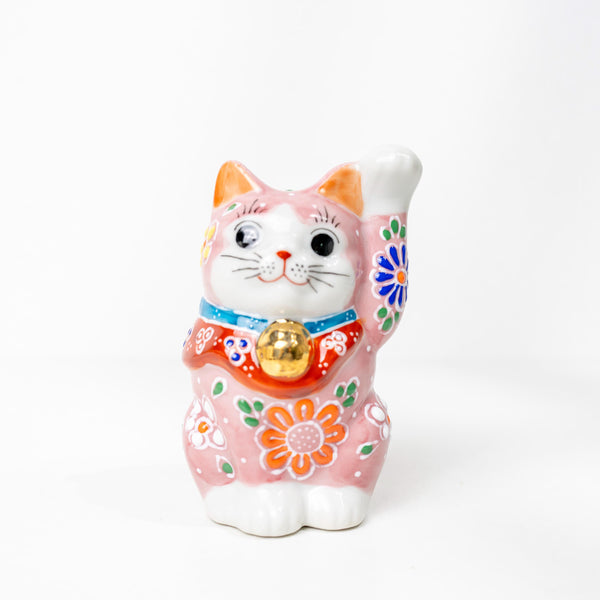
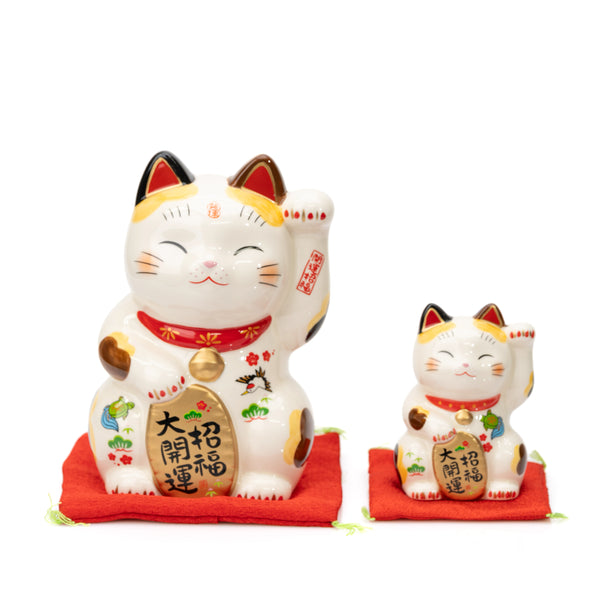
Shop the pieces from this guide ↓
A raised paw does not always move. Some maneki neko are stationary ceramic figures; others have a battery-powered mechanism. Before choosing a lucky cat for a shelf, a shop counter, or a gift, check the exact model. That small step also tells you how to handle and care for it.
This guide uses examples from the ZenKiln collection to separate the two types. Materials, decoration, and mechanisms vary, so keep the instructions supplied with your own figure.
Start with the model rather than the photograph
A still photograph cannot show whether a paw moves. Read the movement and power details, then check the selected size before ordering.
Our stationary Yakushigama lucky cat comes in approximately 8.5 cm (3.3 in) and 15 cm (5.9 in) heights. Both have a raised left paw, remain still, and need no battery. The 15 cm model measures approximately 15 × 10 × 9.5 cm (5.9 × 3.9 × 3.7 in), height × width × depth.
The separate 20.5 cm electric waving Yakushigama cat, model 7841, has a moving right paw and an on/off switch. It measures approximately 20.5 × 16.5 × 13.5 cm (8.1 × 6.5 × 5.3 in). This model uses AA batteries, not included. Check the compartment markings and included instructions for the required quantity and polarity before fitting them.
For a gift, decide whether the recipient would enjoy a moving figure and occasional battery care, or prefer an ornament that simply stays in place. Measure the shelf’s depth as well as its height. Leave space around a moving paw and keep the figure clear of anything that could catch it.
Understand the design and origin
A left paw is commonly associated with welcoming people, while a right paw is associated with financial good fortune. These are customary meanings, not promises of what a figure will bring. Our guide to maneki neko origins explains the traditions, and the color guide covers variations in color symbolism.
Brand, country of manufacture, and shipping location are separate details. Check the stated country of manufacture for the exact model rather than inferring it from a Japanese brand name or from where a parcel ships.
Look at the complete figure too. A ceramic body may have applied color, gold-colored decoration, fabric, paper, or a mechanism. Those additions can need different care from the body itself.
Clean gently and protect the finish

Begin with light dusting using a clean, soft brush or cloth that will not snag raised decoration. Support the body rather than lifting the cat by its paw, ears, collar, or other projecting details.
Do not immerse an electrical figure. Avoid abrasive pads, household sprays, and solvents on an unidentified finish. Painted and gilded surfaces can be vulnerable even when the ceramic underneath appears sturdy. If a surface is flaking, loose, or already repaired, stop cleaning and seek appropriate advice.
A decorative cat is not a piece of tableware. Do not assume it can be washed, microwaved, or put in a dishwasher because another ceramic object can. Follow the maker’s instructions for that model.
Care for the moving mechanism

Switch the figure off before inspecting the battery compartment. Follow the specified battery type, quantity, and polarity rather than copying directions for a similar-looking cat. Keep the mechanism dry, and follow the supplied instructions about removing batteries during extended storage.
If the paw stops, turn the switch off and check the batteries and their orientation as directed. Do not push, pull, or swing the paw to make it restart. If the problem continues, contact the seller or maker with the model number and a description of what happens when the switch is turned on.
Choose a stable display spot
Use an indoor shelf or counter where the figure can stand securely, away from the edge and from routine knocks. Keep it away from splashes, cooking grease, smoke, and persistent dampness. Fabric and paper accessories also benefit from a shaded position.
For a moving model, allow room for the paw throughout its motion. A shop counter can be a welcoming setting, but the figure should not obstruct payment, packing, or other daily work.
When moving or storing it, support the body and cushion projecting parts without pressing on them. Keep the original box if useful, but do not assume a presentation box alone provides enough protection for shipping.
Check whether it is also a coin bank

An opening in the base does not by itself make a cat a coin bank. Confirm that the model is intended for coins and check how they can be removed before adding any. Do not pry at a slot or shake a ceramic figure to retrieve them.
A quick check before giving one
Confirm the selected size, whether it moves, its power requirements, country of manufacture, and what is included in the box. If batteries are not included, let the recipient know. For a gift needed by a particular date, check the current shipping information for the destination rather than assuming an arrival date.
Browse the Lucky Cats collection to compare designs, or start with the stationary Yakushigama models and the separate electric waving model. Choose the expression and scale you enjoy, then let the exact model’s instructions guide its care.
Care reference: Canadian Conservation Institute: Care of Ceramics and Glass. Model reference: Yakushigama catalog. Updated November 2, 2026.