Shop the pieces from this guide ↓
A maneki neko’s colour can express a wish for good fortune, protection or a relationship. Meanings vary across Japan. Where noted, this guide follows the Tokoname Tourism Association’s examples; other interpretations are broader customs. Read the symbolism alongside the maker’s description, as a wish rather than a promised result.
This guide compares the most common colour meanings and shows how colour works alongside paw position, size, and placement. For the history of the figure, read Maneki Neko meaning and origins. For cleaning and display, use our maneki neko care guide.
How to read the colour chart: The chart follows Tokoname’s examples. The product photographs below show how colour, pattern and raised paws appear together on individual pieces in our collection.
| Colour | Meaning | Read more |
|---|---|---|
| White | General good fortune | White Maneki Neko Meaning |
| Black | Protection and yakuyoke, warding off misfortune | Black Maneki Neko Meaning |
| Red | Good health | Red Maneki Neko Meaning |
| Blue | Safety | Blue Maneki Neko Meaning |
| Green | Success in examinations | Green Maneki Neko Meaning |
| Gold | Financial luck | Yellow and Gold Maneki Neko Meanings |
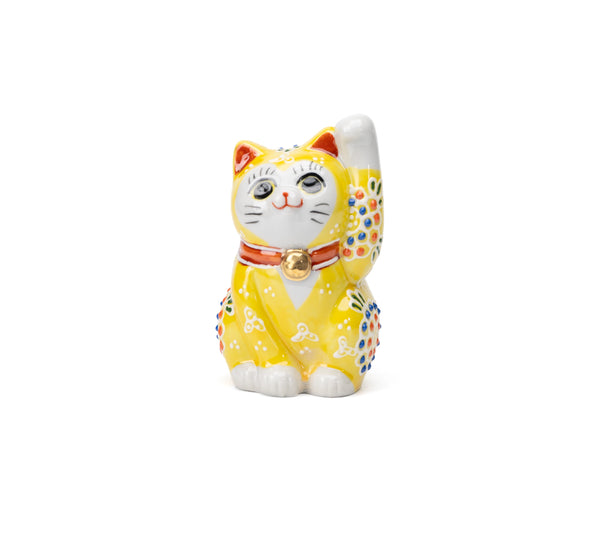
| Yellow | Finding a good partner | Yellow and Gold Maneki Neko Meanings |
| Pink | Affection, relationships or happiness (a relatively modern association) | Pink Maneki Neko Meaning |
| Calico / orange | Calico: broadly auspicious; orange alone has no single fixed meaning | Orange or Calico Maneki Neko Meaning |
What Is a Maneki Neko?
A maneki neko is a “beckoning cat”, shown with one or both paws raised. The gesture invites something closer, and the paw adds another meaning:
- Right paw raised: commonly associated with wealth or good fortune.
- Left paw raised: commonly associated with welcoming people or customers.
- Both paws raised: often interpreted as combining wishes; the maker may give a specific explanation.
Read colour alongside the raised paw
A black cat with its right paw raised, for example, combines a protective colour association with a gesture commonly linked to fortune.
White Maneki Neko Meaning
Tokoname’s guide associates white with general good fortune. Its white ground also makes painted bibs, coins, and flowers easy to see. A white Tokoname Maneki Neko shows the familiar form clearly. Read more in our white maneki neko guide.
Black Maneki Neko Meaning
Black is commonly associated with protection and yakuyoke, warding off misfortune. See a black Kutani maneki neko or read more about black-cat symbolism.
Red Maneki Neko Meaning
Red is often linked with good health. This Kutani cat holding a red tai sea bream combines colour with a separate celebratory motif.
Red maneki neko are commonly associated with wishes for health and protection. A figure with a red fish or collar is a different case: a red accent may belong to the design without giving the whole cat that meaning.
The Tokoname Tourism Association gives red a health-related meaning. Interpretations vary by maker and region, and the figure expresses a wish rather than offering protection from illness.
Some figures have an entirely red body. Others use red on a sea bream, collar, ears, or decorative pattern. A natural calico coat combines white, black, and orange or reddish-brown patches; its coat pattern should not be confused with an entirely red lucky cat.
Red Fuji and a crane stand out against the glossy black body of the Kutani porcelain lucky cat by Chōhō Kiln.
Tai (鯛), sea bream, is associated with celebration through its connection with medetai, meaning auspicious or celebratory. Japan’s Ministry of Agriculture, Forestry and Fisheries discusses this connection. A cat holding a tai can therefore be chosen for a celebration, without assigning a health meaning to every red part.
Choose the figure for the recipient’s taste and the occasion. A tai design can accompany a celebratory note, while an overall red figure may express a wish for good health. Check the current maneki neko and lucky cats collection if you specifically want a solid-red body.
Blue Maneki Neko Meaning
Tokoname’s guide links blue with safety. The Cats on Ceramics collection includes blue-accented figures and feline tableware.
Green Maneki Neko Meaning
In Tokoname’s guide, green expresses a wish for success in examinations. Compare this green Kutani cat with both paws raised with other colours in the Lucky Cats collection, and check the meaning given for each design. If the green design is unavailable, compare the gold-coloured calico cat with both paws raised; its colour and decoration are different.
Other makers may give a particular green design a different meaning, so look at the explanation that accompanies the figure.
For a student, the figure can accompany a personal note of encouragement. Its meaning is a wish, not a prediction of exam results.
The green Kutani figure linked below has both paws raised. Read the gesture and colour as separate design choices, following the maker’s explanation when available.
See the green Kutani lucky cat with both paws raised for its current description and dimensions.
The figure below has a deep green ground, floral motifs, raised white details and gold-coloured accents. Its product description provides the documented material and decorating process; appearance alone cannot establish metal content.
The back of this green Kutani cat carries a red collar bow, a large orange-and-white flower and a curled tail near the base. White scrolls and dots continue between the coloured flowers. Green is the ground for a detailed pattern here, rather than an uninterrupted single colour. A rear photograph is especially useful if you plan to display the figure on a desk that is seen from both sides.

Yellow and Gold Maneki Neko Meanings
Tokoname’s guide gives these two colours different meanings: gold for financial luck, yellow for finding a good partner. Check the description of a yellow Kutani cat or a design in Shop Opening Gifts before choosing it for a particular wish. A gold colour also does not establish the material’s gold content.
A maker may use a different colour scheme or give an individual design its own message. Read the inscription and any supplied explanation together with the colour; these are expressions of a wish, not predictions.
Read “gold” alongside the material description:
- Gold colour: a surface made to look gold, without necessarily containing gold metal.
- Gold-coloured decoration: accents on a bell, collar or coin. Their appearance does not establish the material.
- Gold-leaf or gold-bearing material — some Japanese makers apply real gold leaf (kinpaku) over a ceramic body, or use a gold-bearing overglaze. This is a material claim and needs to be documented for the specific piece.
- Solid gold — a figure made of gold metal, a different product class from a ceramic lucky cat.
The gold-tone calico Kutani cat is a 14 cm both-paws figure with raised decoration and an ema (絵馬), a votive plaque for wishes, at its chest. A different motif appears on the Tokoname lucky cat, which holds a large gold koban. The oval koban coin is commonly associated with wealth.
For a business gift, a gold-coloured cat can acknowledge a wish for prosperity. A yellow cat may carry a different message, or simply be chosen because the recipient likes the colour. Check the dimensions, available display space, and the maker’s explanation before giving one.
Look closely: yellow ground and calico patches
On our yellow Kutani cat, the yellow covers most of the body, while the face, paws and chest remain white. Small raised dots in blue, orange and white follow the lifted paw. On the gold-coloured calico cat, the colour is arranged in separate patches; the green collar continues into a raised bow at the back. These details help distinguish a yellow-bodied figure from a calico design with gold-coloured accents.


Pink Maneki Neko Meaning
Pink is a relatively modern colour association, usually connected with affection, relationships, or happiness. It appears in solid glazes as well as floral decoration. The pink sakura Maneki Neko is an example of colour and motif carrying the meaning together. For more, see our pink maneki neko guide.
Orange or Calico Maneki Neko Meaning
Calico is a traditional, broadly auspicious three-colour pattern. Orange patches can form part of that coat, while orange by itself has no single widely fixed meaning. See a Kutani calico cat and our guide to calico and orange maneki neko.
Choosing a cat for its place
A coin, bib, mallet, sea bream, flower or inscription may add another association. Look at the whole figure, then check its height and footprint for the desk, shelf or entrance where it will stand.
If a figurine would not suit the recipient, Cats on Ceramics also includes mugs and tableware.
FAQ: Maneki Neko Colors
Is a white Maneki Neko a good gift?
White carries a broad good-fortune association in Tokoname’s guide. It can suit a gift when the recipient likes the design; check the size and included packaging before ordering.
Which Maneki Neko color is the luckiest?
There is no agreed ranking. Choose the wish and design that suit the occasion: calico is broadly auspicious, gold is often linked with wealth, and black with protection.