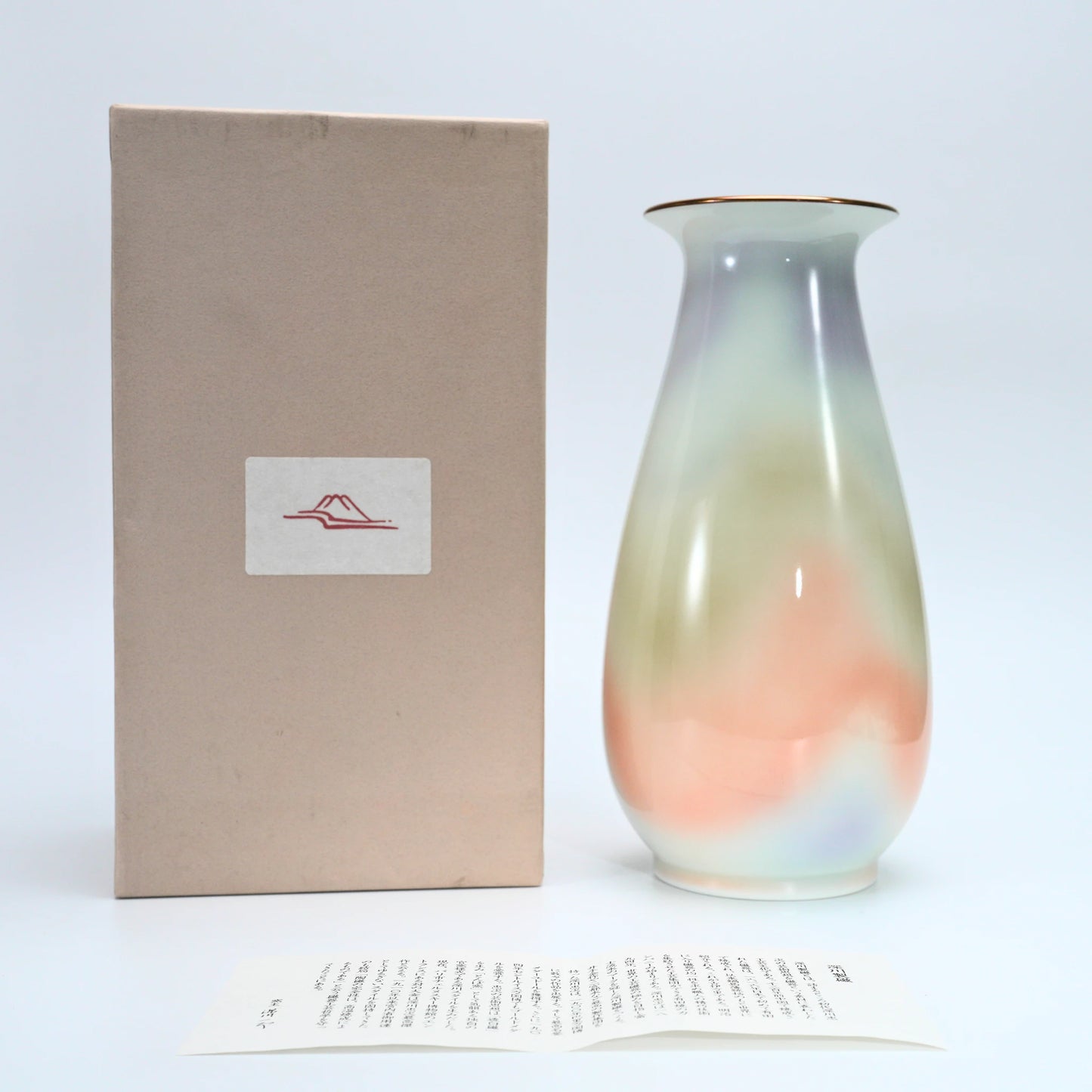
Iridescent porcelain vase by Fukagawa Seiji — the Arita house historically recognized as a supplier to the Japanese Imperial Household since 1910 and won the Grand Prix at the 1900 Paris Exposition. This contemporary piece is from the brand's Harmony series, made with the house's signature Iro-e Saiji (色絵彩磁) overglaze technique and finished with a 24K-style gold rim.
What this is
A single-stem hanaike (花生 / flower vessel) in classic Japanese teardrop form: narrow neck flaring to a slightly everted lip, full pear-shaped body, and a shallow porcelain foot. The exterior carries Fukagawa Seiji's Iro-e Saiji pearlescent gradient — drifting from soft lavender at the shoulder, through pale celadon and sage, into a warm peach belly, and back to ivory at the foot. A fine gold band rings the rim.
The underside carries the Fukagawa Seiji house mark: the stylised Mt. Fuji + flowing-water (富士流水) icon above the technique stamp 「色絵彩磁」 in cobalt blue underglaze.
Form: hanaike / single-stem flower vase, teardrop body with everted lip
Technique: Iro-e Saiji (色絵彩磁) — Fukagawa Seiji's patented high-fire overglaze technique, developed in the late Meiji period; colours are stable and do not fade
Surface: pearlescent / iridescent pastel gradient (lavender → celadon → sage → peach → ivory) with gold rim
Series: Harmony G — Fukagawa Seiji's contemporary decorative line
Made by Fukagawa Seiji in Arita, Saga Prefecture, Japan, curated by ZenKiln
About the maker — Fukagawa Seiji
Fukagawa Seiji (深川製磁) was founded in 1894 in Arita, Saga, by Fukagawa Tadatsugu, a descendant of the six-generation Imari-Arita Fukagawa pottery clan. The house's reputation rests on three milestones in Japanese ceramic history:
1900 — Grand Prix (highest gold medal) at the Paris Exposition Universelle, for the maker's Iro-e Saiji vases. This award placed Fukagawa among the first Japanese porcelain houses recognised internationally.
1910 — Officially designated by the Japanese Imperial Household Ministry (宮内省御用達(1910 historical record)), a designation that Fukagawa Seiji has historical documentation for through the Taishō, Shōwa, Heisei, and Reiwa eras.
Iro-e Saiji — the maker's signature technique, developed by Fukagawa Tadatsugu: overglaze enamels fused into the porcelain at high temperature in a single firing. The colours fuse into the glaze rather than sitting on top of it, giving Fukagawa pieces their characteristic depth and longevity.
The piece you're looking at is from the Harmony series — Fukagawa Seiji's contemporary decorative range that applies the house's Iro-e Saiji technique to softer, more modern colour palettes. It is not an antique or vintage piece; it is a current-production studio piece by the heritage brand.
How to use / who it's for
Single-stem ikebana with seasonal branches — plum, cherry blossom, camellia, autumn maple, pine
Standalone shelf, mantel, or tokonoma decor without flowers — the iridescent surface reads differently under each light source
A wedding, anniversary, or housewarming gift for a collector of fine Japanese porcelain or historical Imperial-supplier ware
A reference example of the Harmony series' contemporary application of Iro-e Saiji
Details & dimensions
Height 22 cm / Body 11 cm / Mouth 8 cm / Foot 7.5 cm / Weight 600 g
Shipping, duties & delivery
Ships from Japan, 1–3 business day handling, 7–14 day international transit
Packaging & gifting
Original Fukagawa Seiji presentation box included; gift-ready as-is
Care instructions
Decorative use only — not certified for tableware. Hand-wash with mild detergent and soft cloth. No microwave, no oven, no dishwasher (gold rim). Avoid sudden temperature shock.




 Sold out
 Sold out
 Sold out