ZenKiln
Arita Hakuji Wind Chime — Hand-Painted Sazanka Camellia Furin, Sen-byou Sometsuke Porcelain
Out of stock
Shopping from the EU, UK, or EEA?
We aren’t yet registered for EU/UK VAT, so we fulfill orders to your region through our Etsy shop — where taxes and duties are calculated and included at checkout, with no surprise fees on delivery.
Buy on Etsy ↗- Porcelain
- Made in Japan
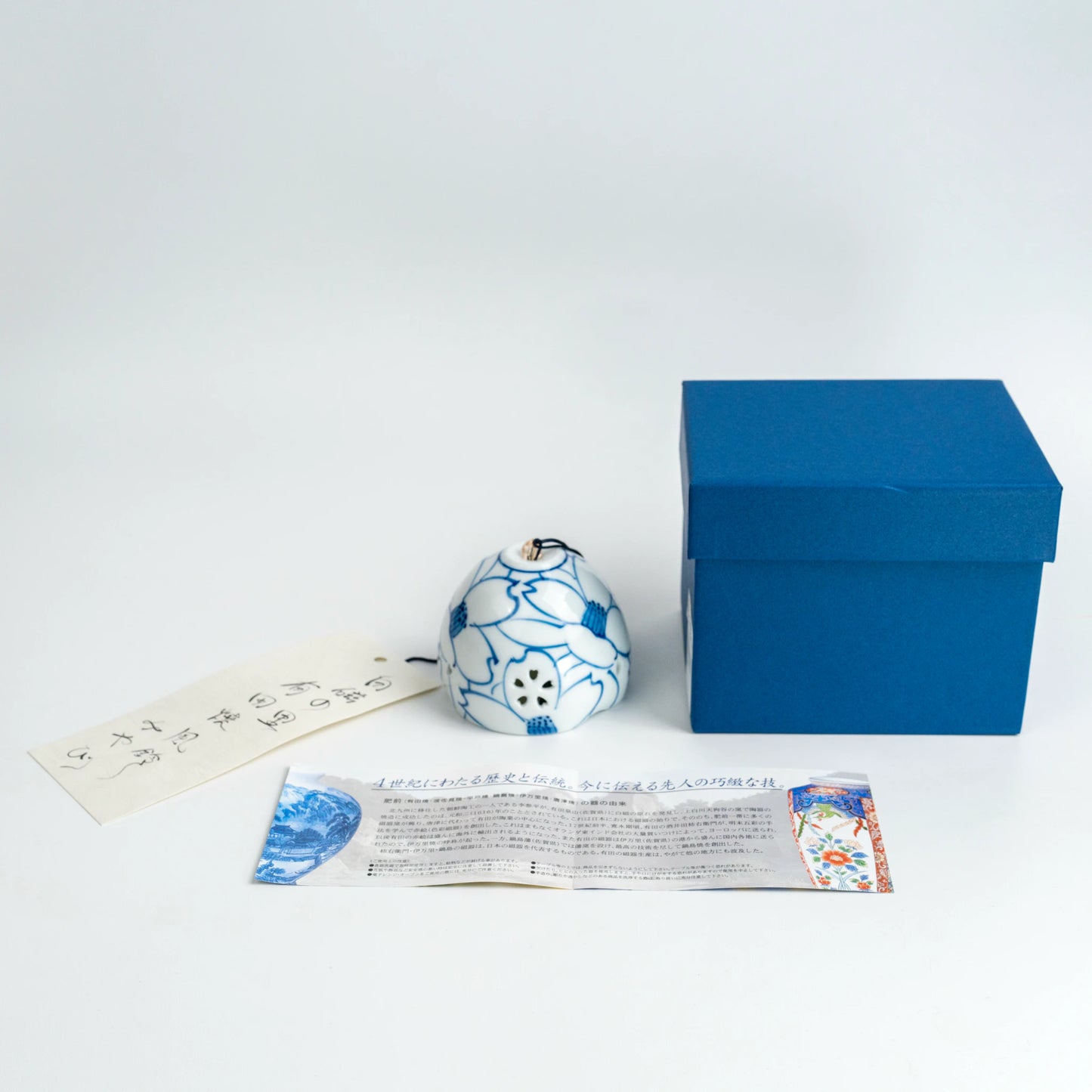
A hand-painted porcelain wind chime from Arita — Japan's first porcelain town, where Lee Sam-pyeong fired the country's first hakuji (white porcelain) in 1616. The dome bell is washed with white porcelain glaze and drawn over with sazanka (山茶花 / Camellia sasanqua) blossoms in pure cobalt-blue 染付 line — the foundational sometsuke technique called sen-byou, where the flowers exist as outline only, with no fill. Small openwork (sukashi) cutouts mark each blossom's heart, letting the air through and softening the chime's tone.
Camellia blooms in late autumn through early winter — the iconic flower of Japanese tea ceremony (chabana) — making this the seasonal complement to spring's sakura motif.
Maker code: NT-733690 · JAN 4965217733690
Made by 西日本陶器 (Nishi-Nihon Toki) / Arita-yaki in Saga Prefecture, Japan, curated by ZenKiln
About Arita ware, sometsuke, and sen-byou
According to the maker's included pamphlet, Arita porcelain began in 元和二 (1616), when Lee Sam-pyeong (李参平), a Korean potter who emigrated to north Kyushu, discovered porcelain stone at Izumiyama (泉山, Saga Prefecture) and fired Japan's first porcelain at the Kamishirakawa Tengudani kiln. The earliest Arita work was 染付 (sometsuke) — cobalt-blue painting under a clear glaze on a white porcelain body. The most restrained version of that tradition is 線描 (sen-byou): outline only, no fill, no shading. It's the technique that lets the white porcelain breathe — and it's what gives this piece its airy, contemporary feel despite its 17th-century lineage.
Use & gifting
- Tea ceremony (sadō) practitioners and chanoyu students — camellia is the chabana for autumn-winter chaji
- Anniversary, housewarming, birthday — quietly elegant ceremonial gift
- Father's Day — masculine restrained palette
- Lovers of japandi, wabi-sabi, and minimalist Japanese aesthetics
- Window, eave, or covered porch — the sukashi cutouts give the chime a softer, more diffuse tone than solid-bodied bells
Reference conversions
- 7.5 cm ≈ 3.0"
- 6 cm ≈ 2.4"
- 90 g ≈ 3.2 oz
Details & dimensions
Shipping, duties & delivery
Packaging & gifting
Packaging & gifting
Care instructions
Care instructions
Returns / damage support

You may also like
-
Sold out -
Sold out