Japanese green teas differ in cultivation, processing, and blending. With Shizuoka’s tea culture as a starting point, this guide compares deep-steamed sencha, shade-grown gyokuro, and matcha genmaicha. The recipes are starting points for home brewing; the instructions supplied with your particular tea take priority.
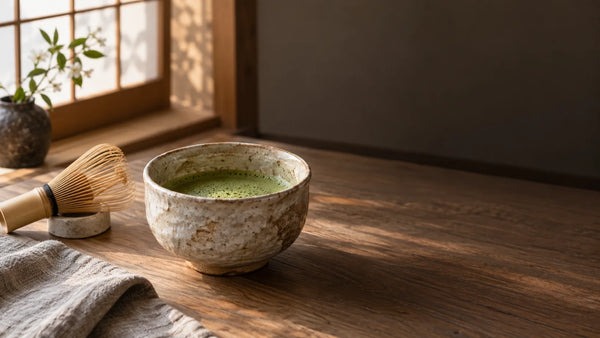
Image note: The tea servings and table scenes are editorial illustrations, not photographs of a particular Shizuoka producer or packet. Infusion colour and leaf appearance vary by tea and brewing method; use the tea maker’s instructions for the tea you have.
These tea styles are made in more than one region. A style name such as sencha or gyokuro does not identify a farm or district: use the origin printed on the packet for the tea in your cup.
Why Shizuoka?
Shizuoka’s tea fields extend across plains, hills and mountain valleys. The World Green Tea Association’s regional overview introduces it alongside other tea-growing areas.
For a particular tea, use the producer’s account of its growing place, cultivar, harvest and processing. Deep-steamed sencha offers one starting point for exploring Shizuoka’s production.
Fukamushi sencha: deep-steamed, everyday green
Sencha is steamed after picking to halt enzymatic oxidation. Fukamushi (深蒸し, “deep-steamed”) means a longer steaming treatment. Not all green tea is steamed: Japanese kamairicha is pan-fired instead.
Longer steaming makes the leaf more fragile, so deep-steamed sencha often contains fine particles and produces a cloudy green infusion. Steaming times vary with the leaf and equipment; one fixed duration does not define every producer’s tea. See Ito En’s deep-steamed sencha brewing guide for a practical explanation of its short infusion time. More on fukamushicha →
The fine leaf can brew quickly. A strainer suitable for deep-steamed tea makes pouring easier, though some fine particles in the cup are part of the style. Begin with a short infusion and adjust for your leaf.

For the second infusion, begin with a shorter time because the leaves are already wet, then adjust to taste. The useful number of infusions varies.
Gyokuro: shade-grown, slow and sweet
Gyokuro (玉露, “jade dew”) is grown under shade before harvest, commonly for around twenty days. Shading helps develop its characteristic umami-rich taste. A concentrated serving made with cooler water is one way to enjoy it, rather than the only valid method. More on gyokuro →
A small, concentrated infusion can feel mellow and broth-like. Pour it into small cups and taste before deciding how to prepare the next infusion. The leaf-to-water ratio here is deliberately higher than for the sencha recipe.

Gyokuro is also associated with Yame and Uji. Check the packet’s origin rather than treating the brewing style as a regional label.
Matcha genmaicha: green tea with roasted rice
Genmaicha combines green tea with roasted rice. Despite the name, the rice is not necessarily unpolished brown rice; polished rice and glutinous rice are also used. Shinyusha’s tea specialist explains these differences. Matcha genmaicha adds matcha powder to the blend, giving additional colour and tea flavour. Ingredients and proportions vary by product.

Matcha genmaicha is normally infused and strained as a loose-leaf blend. It is different from preparing a bowl of plain matcha with a whisk.
A second infusion can be enjoyable, though the matcha contribution is generally strongest in the first cup.
Three starting recipes
| Tea | Leaf | Water temp | Water | Time |
|---|---|---|---|---|
| Fukamushi sencha | 4 g | 70 °C / 158 °F | 180 ml | 30 sec |
| Gyokuro | 4 g | 50–60 °C / 122–140 °F | 60 ml | 2 min |
| Matcha genmaicha | 4 g | 90 °C / 194 °F | 180 ml | 30 sec |
Start with the recipe on your packet if it differs. These examples use cooler water for a concentrated gyokuro and hotter water for matcha genmaicha. Temperature works with time and leaf quantity; it does not set the result on its own.
What to brew it in
Choose a pot with a strainer suited to the leaf. A side-handled kyusu is one option; other handle forms are available. Fine leaf in fukamushi sencha needs an appropriate filter, and small cups suit a concentrated gyokuro serving.

New to brewing Japanese green tea? Our guide to the beginner's tea set covers what you need, and our kyusu care guide keeps your pot in shape.
FAQ
Does Japanese green tea have caffeine?
Yes. Green tea naturally contains caffeine. The amount in a serving depends on the tea, how much leaf or powder you use, the water quantity, and the brewing method. Rice in genmaicha does not make it caffeine-free, and a cooler brewing temperature alone does not establish a low-caffeine serving.
How should I store loose-leaf green tea?
Keep it well sealed, away from heat, moisture, light and strong odours. Follow the producer’s storage advice and use it promptly after opening for the intended fresh character; packaging and tea type affect how long it keeps well.
Recipe reference: Ippodo’s recipe collection shows different methods within a tea category. The table here gives home-brewing starting points, not specifications for every tea of the same name.