Asakura Isokichi: The Family That Reinvented Modern Kutani
6 min readMost potters spend a lifetime perfecting a single signature look. Asakura Isokichi spent his deliberately undoing his. The second-generation head of a Kutani ware (九谷焼, the colorful overglaze porcelain of Ishikawa Prefecture) family kiln, he rebuilt his palette, his forms, and his firing roughly every ten years — and in 1996 became the first Kutani-ware artist to receive Japan’s Order of Culture. This is the story of the Asakura family, the Komatsu kiln they have run for four generations, and why their restless approach still defines what 'modern Kutani' means.
Who was Asakura Isokichi?
Asakura Isokichi (浅蔵五十吉, 1913–1998) was a Japanese ceramic artist and the leading modern master of Kutani ware. Born in Ishikawa Prefecture, he trained under the Kutani painters Tokuda Yasokichi I and Kitade Tojiro, then spent five decades exhibiting at the Nitten, Japan’s national fine-arts exhibition. In 1996 he became the first Kutani-ware artist awarded the Order of Culture — Japan’s highest honor for cultural achievement.
The Tokyo National Research Institute for Cultural Properties records his birth on 26 February 1913 in Terai, Ishikawa, and training under his father, Tokuda Yasokichi I and Kitade Tōjirō. Its chronology lists the 1977 Prime Minister’s Award at Nitten, the 1981 Japan Art Academy Prize for Impressions of Sado, Academy membership in 1984, Person of Cultural Merit recognition in 1992 and the Order of Culture in 1996.
The family kiln: Isokichi Shinkō-gama in Komatsu
The Asakura name belongs to a working kiln, not just a single artist. Isokichi Shinkō-gama (五十吉深香陶窯) sits in Hachiman, Komatsu, and has operated for four generations. Unusually, it handles the entire process under one roof — from throwing and shaping the porcelain body through the final overglaze painting — rather than buying in blanks to decorate, which is common elsewhere in Kutani.
A style that reinvented itself every decade
What set the second-generation Asakura apart was refusal to settle. His own memorial museum describes an artist who created an entirely different style of color, form, and technique roughly every ten years — never resting on a completed manner, always pushing into the next one. Over his career his palette moved from bright, luminous yellows through deeper greens and composite tones, then later into platinum and silver overglaze, and finally toward white, restrained 'colorless' glazes in his cultural-merit years.


Nature recurs through the second generation’s documented work, in both decoration and sculptural form.


The second generation’s documented changes of style form one strand in this continuing family history.
What makes Kutani ware 'Kutani'
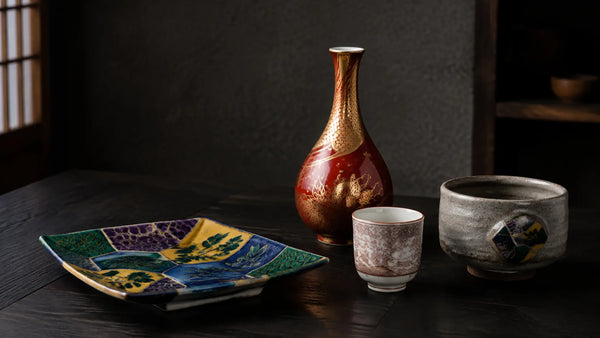
Kutani is strongly associated with overglaze colour in Ishikawa. Its gosai (五彩) palette is conventionally described as green, yellow, red, purple and deep blue. “Deep blue” describes the colour here, not the chemical pigment Prussian blue. For historical context, see our beginner’s guide to Kutani ware and aka-e overglaze red enamel.


The relationship between coloured grounds and unpainted space offers one way to compare works across the family. A work’s specific maker and date require its own record.
The Asakura legacy in living Kutani today
The second generation’s works can be studied through museums and documented collections, while the family kiln continues to make contemporary work. Availability and price depend on the particular artist, generation, object and seller.
Contemporary Kutani workshops use varied forming and decorating methods. For a piece intended for daily use, follow its specific care instructions; our guide to caring for Kutani and Arita porcelain offers general background.
The kiln’s official website lists the third-generation Isokichi alongside Asakura Kazuna (浅蔵一華) and Asakura Hiroaki (浅蔵宏昭). The romanisation Kazuna also appears in the 2026 craft exhibition catalogue. Consult the kiln’s own announcements for current exhibitions.

FAQ
Who was Asakura Isokichi?
Asakura Isokichi (1913–1998) was a Japanese ceramic artist regarded as the leading modern master of Kutani ware, the overglaze porcelain of Ishikawa Prefecture. He led his family’s Komatsu kiln, exhibited for fifty years at the Nitten national exhibition, and in 1996 became the first Kutani artist to receive Japan’s Order of Culture.
Is 'Asakura Isokichi' the same as the Isokichi kiln?
They share a romanized name but not the same kanji. The kiln’s founder was Asakura Iso-kichi (磯吉); the famous second generation took the art name 'Isokichi' written 五十吉. Both read 'Isokichi' in English. The kiln is called Isokichi Shinkō-gama (五十吉深香陶窯) and has run for four generations in Hachiman, Komatsu.
When did Asakura Isokichi win the Order of Culture?
He received the Order of Culture (文化勲章) in 1996, the first Kutani-ware artist ever to do so. It followed earlier honors including the Japan Art Academy Prize in 1981 and the title of Person of Cultural Merit in 1992. The Order of Culture is the highest distinction Japan awards for cultural achievement.
Where can you see Asakura Isokichi’s work?
His work is shown at the Asakura Isokichi Memorial Hall, part of the Nomi City Kutani Museum in Ishikawa Prefecture. The building was designed by architect Yoshiro Ikehara and has itself won architectural awards. The hall focuses on the second-generation Asakura’s representative pieces across his shifting styles.
What is Kutani ware known for?
Kutani is known for overglaze decoration and a five-colour vocabulary of green, yellow, red, purple and deep blue. Styles and production methods vary; the palette is not a chemical analysis or a single rule for every Kutani object.
Can you buy Asakura Isokichi pottery?
Distinguish the second-generation artist from other members of the family and from the kiln’s contemporary production. Ask for the generation, date, provenance and condition record of a particular work. The official kiln website provides information about current work and enquiries.
References: The Tokyo National Research Institute for Cultural Properties’ artist record supports the biographical chronology; the kiln’s website describes the family and current makers. Individual illustrated works require their own catalogue attribution.
This guide is part of ZenKiln's Kiln Studies series. For how Kutani fits among Japan's ceramic regions, see our overview of Japan's pottery regions.