Wajima-nuri: The Foundations of an Urushi Lacquerware Tradition
5 min readMuch of the work in a Wajima-nuri bowl is hidden beneath its finished surface. Cloth reinforcement and carefully built lacquer foundations support the smooth coating you see. This urushi tradition comes from Wajima on the Noto Peninsula in Ishikawa Prefecture.
Where Wajima-nuri comes from
Wajima lies in northern Noto, well north of Kanazawa. Sea trade, including the Kitamae-bune (北前船) routes of the Edo period, helped its lacquerware reach customers beyond the region. Its commercial history is part of the craft’s story alongside the work of individual workshops.
The Wajima Museum of Urushi Art’s guide identifies fifteenth-century bowls from Anamizu’s Odate Site, in the Nishikawashima Site Group, with a diatomaceous-earth underlayer. It also records a surviving lacquered door at Jūzō Shrine dated 1524 and recoated in 1768. These objects provide early evidence for the region’s lacquer work.
Wajima’s production system developed through the Edo period. Suitable woods, lacquer and locally obtained diatomaceous earth supported the work, while specialist makers divided the successive stages among them.
Ji-no-ko: the foundation beneath the finish
Ji-no-ko (地の粉) is powder made from fired diatomaceous earth. Mixed into lacquer-based ground coats, it forms part of Wajima-nuri’s characteristic foundation.
Cloth reinforcement and ground layers strengthen vulnerable areas, but the finished coating still needs protection from drops, chips, scratches and heat.
Building the hon-kataji foundation
Hon-kataji (本堅地) is the firm foundation built between the wooden core and the finishing coats:
- Wooden core, or kiji: a turner shapes a blank from green, unseasoned wood, such as zelkova (keyaki) or Japanese horse chestnut. The wood is then dried slowly before further work.
- Raw lacquer seal. Raw urushi is brushed into the wood to seal it and to bond what comes next.
- Cloth reinforcement. Fabric is attached with lacquer-based adhesive to vulnerable areas such as the rim before the ground is built up.
- Ji-no-ko coats. Successive lacquer-based ground layers are cured and levelled. Urushi curing depends on suitable environmental conditions; it is not simply solvent drying.
- Sealing the ground. A final raw-urushi coat closes the porous diatomite surface.
Next come the middle coat, naka-nuri, and the final coat, uwa-nuri, with levelling between stages. Some pieces receive roiro (呂色) polishing: finer lacquer is rubbed back using charcoal and tonoko powder to produce a mirror-like sheen.
Traditional bowls pass through more than a hundred procedures shared among specialist turners, ground-layers, coaters, polishers and decorators. An undecorated bowl can take several months; elaborate chinkin or maki-e work can extend the process to a year or more.
Plain lacquer, chinkin and maki-e
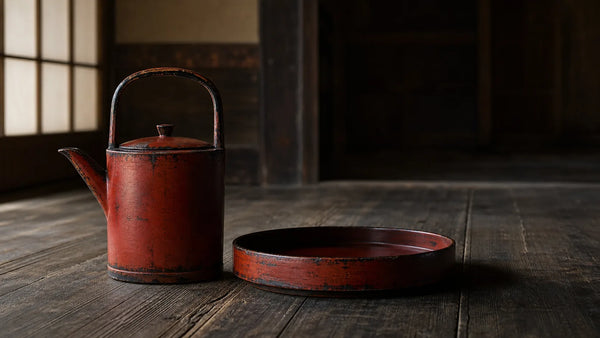
Ma-nuri (真塗) is a plain finish, usually black or vermilion. It was common on the everyday Wajima lacquerware traded around Japan during the Edo period, including kagu-zen (家具膳), fitted trays with matching bowls.
Two techniques brought further decoration to Wajima:
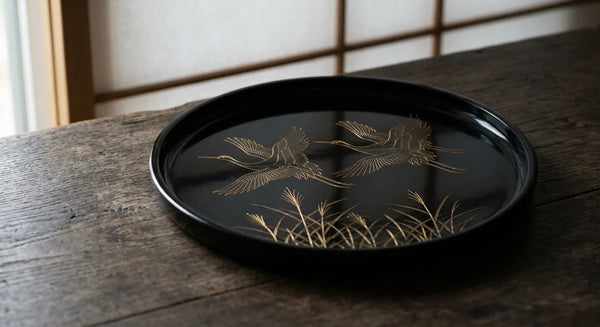
- Chinkin (沈金), “sunken gold”, begins with a design incised into cured lacquer. Lacquer worked into the cuts holds gold leaf or powder. The Wajima Museum places its local introduction in the Kyōhō era, 1716–1736.
- Maki-e (蒔絵), “sprinkled picture”, uses lacquer to hold sprinkled metal powder. The finish may be flat, polished or raised, depending on the method. Its introduction to Wajima is associated with the Bunsei era (1818–1830).
Choosing Wajima-nuri
A black or vermilion surface can be made with different materials and coatings. Ask how the piece was made and what it is intended for:
- Body and coating: ask for the materials in writing. Weight and gloss are not reliable substitutes for that information.
- Use and care: check suitable food temperatures and washing instructions. Wooden lacquerware handles differently from ceramic, but hot rims and contents can still burn; do not use hot soup as an authenticity test.
- Foundation: ask about reinforcement and ground layers. They are usually concealed by the finishing coats.
- Box and attribution: keep a signed box with the piece when their relationship is documented. An inscription or label on its own is not conclusive evidence of origin.
- Labels: the Consumer Affairs Agency’s guidance covers material and handling information for specified lacquered utensils. This differs from certification of origin or craft production; ask what a particular mark verifies.
Caring for Wajima-nuri
Follow the maker’s directions for the piece and its condition. For traditional wooden urushi tableware:
- Hand-wash only. Warm water and a soft cloth or sponge. No detergent stronger than a mild dish soap, and no scouring pad.
- Avoid the dishwasher and microwave for traditional wooden urushi ware. Heat and washing conditions can damage the body or coating, and metallic decoration needs particular care.
- Dry immediately after washing. Standing water can lift a lacquer edge over time.
- Store away from direct sunlight. UV slowly oxidises urushi and shifts the colour.
- Use bowls made for food within their intended limits. Fragile, historic or decorative pieces may need different care; the urushi lacquerware care guide covers everyday washing and storage.
Lacquerware alongside ceramics
For the ceramic traditions mentioned elsewhere in the Journal, including Arita, Kutani, Shigaraki and Tokoname, read our guide to Japan’s pottery regions. Wajima’s wood-and-lacquer construction belongs to a different craft tradition.
FAQ
Where can I see Wajima-nuri in person?
The Wajima Museum of Urushi Art, opened in 1991, presents lacquer history and techniques. Check the museum’s official information for current access before planning a visit.
This article is part of ZenKiln’s Urushi Studies series.