Lucie Rie at Teien: Form, Glaze and the East–West Exhibition
4 min readLucie Rie’s ceramic buttons offer a small-scale view of her experiments with clay and glaze. They also connect her pottery to the work that supported her in wartime London. This companion to our 2026 Teien exhibition guide explores those objects and the exhibition’s setting through published museum research.
Rie (1902–1995) trained and established a ceramics practice in Vienna before antisemitism forced her into exile in London in 1938. Kettle’s Yard’s biography introduces her life and work. The Teien exhibition brought together pieces from Japanese collections, including the Iuchi Collection, alongside work by Josef Hoffmann, Bernard Leach, Hans Coper and Hamada Shōji.
Ceramics within an Art Deco residence
The museum’s Main Building was completed in 1933 as Prince Asaka’s residence. René Lalique’s glass and Henri Rapin’s decorative designs form part of its Art Deco interiors, shaped by the prince’s time in 1920s Paris. He and the princess visited the 1925 exposition from which the term Art Deco later took its name.
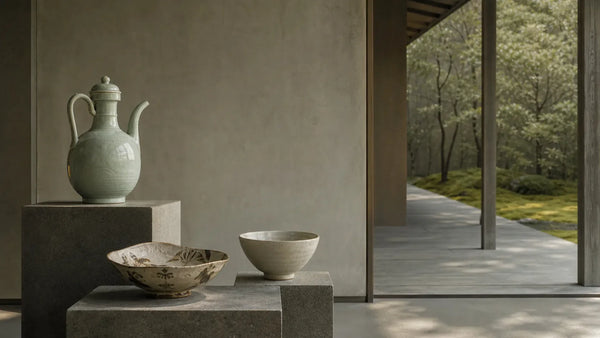
The museum connected Rie and the house through the decorative arts of 1920s Europe. Its exhibition outline proposed a dialogue between her restrained vessels and the ornate rooms. That setting suggests a question to bring to the published photographs: how do nearby patterns and proportions affect the way a ceramic form is seen?

From Vienna to London — by way of a button
Fashion work helped support Rie as she rebuilt her practice in London. Buttons gave her room to explore small forms and surfaces, while she continued making pots, as the V&A’s biography records.
Hans Coper joined the studio in 1946, initially helping with buttons, and became a lasting collaborator. Rie’s buttons later drew the attention of Issey Miyake, who used wartime examples in a 1989 collection.
The V&A’s button history distinguishes Fritz Lampl’s Vienna firm Bimini from its London operation, Orplid. Rie worked on glass buttons for Orplid before developing her own stoneware buttons at Albion Mews.
How to read a Lucie Rie vessel
When looking at a Rie vessel, compare its silhouette with the surface up close. Incised lines, inlaid colour, and glaze texture can alter the impression of a seemingly simple wheel-thrown form.
Sgraffito scratches through a surface layer to reveal a contrasting colour. Inlay fills an incised area with contrasting material. On Rie’s vessels, these methods appear alongside dark manganese, metallic bronze, pitted surfaces and fine pink lines. Follow how a line crosses the curve rather than looking only at the pattern in isolation.
The V&A records stoneware buttons from around 1940–45. Their material is a reason to consult the record for each object, rather than assign all work from a period to one clay body. Our stoneware and porcelain guide explains the terms.
Rie alongside Leach and Coper
Bernard Leach’s experience in Japan and his partnership with Hamada Shōji formed part of the wider studio-pottery world Rie encountered. Leach returned to England with Hamada in 1920 to establish the pottery at St Ives. Their work gives context to the exhibition’s exploration of connections with Japan.
Rie’s work developed independently of Leach’s aesthetic. The exhibition placed Leach’s slipware alongside Coper’s Cycladic forms and Rie’s vessels. Compare the proportions of foot, body and rim, then the relationship between decoration and the underlying shape.
Exhibition dates and image use
The Tokyo run ended on 13 September 2026. The official exhibition page records its programme and images. Permission to view or take a photograph does not establish permission to reproduce it commercially.

The museum lists a later presentation at Abeno Harukas Art Museum in Osaka from 26 December 2026 to 7 March 2027. Check that venue’s dates and visitor information before travelling.
Comparing other ceramic surfaces
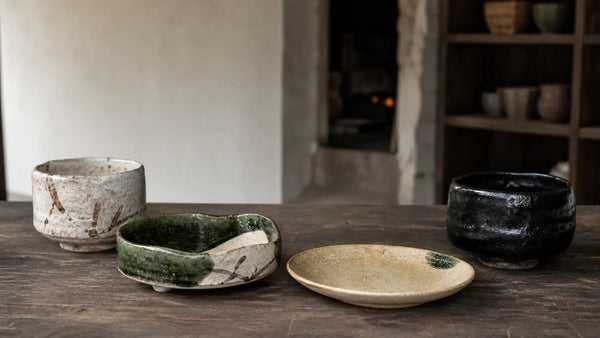
For everyday objects with different approaches to surface, compare a Kutani matcha bowl, a flowing-glaze porcelain vase and a Shigaraki bud vase with combed lines. These are separate works by their stated makers. The tea-lover’s collection and Drinkware provide product details.
Sources: the Teien Art Museum, V&A and Kettle’s Yard pages linked above. Updated 13 September 2026 after the Tokyo exhibition. This essay discusses published material and is not a record of a ZenKiln visit.