Calico and Orange Maneki Neko: Meanings and Differences
3 min readCalico Maneki Neko use the white, orange, and black coat of the Japanese mike-neko. The three-colour pattern is one of the most familiar and broadly auspicious lucky-cat designs. Orange on its own has a less fixed meaning and is usually interpreted through the maker’s particular motif and colour scheme.
This guide covers what calico and orange Maneki Neko mean and how to choose one. For every color at a glance, see our Maneki Neko color meanings guide.
What Does a Calico Maneki Neko Mean?
The calico Maneki Neko is modelled on the mike-neko (三毛猫, “three-fur cat”). Because many familiar lucky-cat figures use this coat, calico is commonly treated as a traditional, all-purpose pattern rather than one tied only to wealth, protection, or relationships.
Calico is a familiar, broadly auspicious pattern. It is useful to choose by the recipient’s taste and the figure’s inscription, since there is no universal ranking of luck between colours.
What Does an Orange Maneki Neko Mean?
Orange has a less settled symbolic meaning than black, white, or gold. It appears most often as part of the calico coat and is commonly described in contemporary product language as warm or lively. When a figure is predominantly orange, use the maker’s stated motif and inscription as the stronger evidence.
Calico vs. Other Lucky Cat Colors
The Tokoname Tourism Association’s guide links gold with financial luck and black with protection; our guide to black Maneki Neko explores the latter. Calico is usually discussed as a broader good-fortune pattern rather than one narrowly defined wish.
Why the Lucky Cat Is Often Calico
The tricolour pattern appears in many established depictions of the beckoning cat and became part of its standard visual identity. The history is not traced to one confirmed original figure; the overlapping legends and ceramic traditions are covered in Maneki Neko meaning and origins.
Choosing a Calico or Orange Maneki Neko
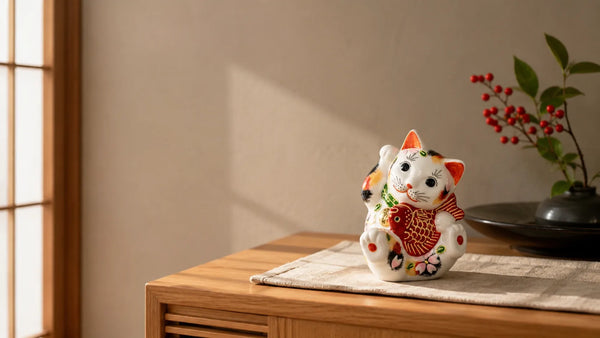
Compare the physical object before choosing by symbolism. The Kutani gold calico lucky cat uses gold with the three-colour coat; the Kutani tai calico cat adds a red sea-bream motif; and the Tokoname lucky cat statue offers a different regional form. Check size, paw position, material, box, and intended placement. For maintenance, use the maneki neko care guide, and compare other pieces in the Lucky Cats collection.
FAQ
What does a calico Maneki Neko mean?
A calico Maneki Neko is commonly associated with broad good fortune and is widely recognised as a traditional lucky-cat pattern. The design is based on the white, orange, and black coat of the Japanese mike-neko.
Which Maneki Neko color is the luckiest?
Calico is often described as broadly auspicious, while gold is associated more specifically with wealth and black with protection. There is no universal ranking that makes one colour objectively luckier than another.
What does an orange lucky cat mean?
Orange has no single fixed meaning. It most often appears within the calico pattern and may be described by contemporary makers as warm or lively; the individual motif and inscription provide better guidance than colour alone.
Is a calico Maneki Neko a good gift?
Calico can be suitable when a broad auspicious association is preferred over a specific meaning such as wealth or protection. Before giving one, check the recipient’s taste, available space, dimensions, and included packaging.
ZenKiln product pages record the maker or kiln, material, dimensions, decoration, and packaging where the available documentation supports them. Orders are packed in the Tokyo atelier and shipped from Japan.