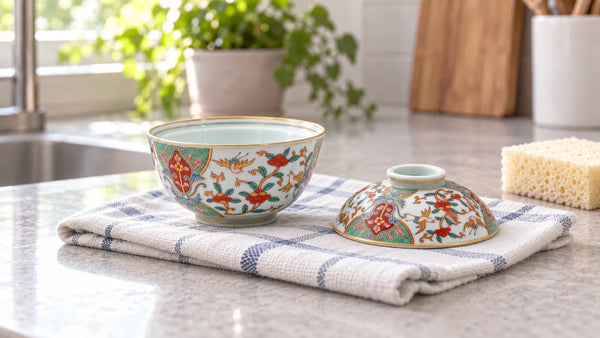
Cover and styled mug scene: AI-assisted illustrations based on supplier product photographs. Original supplier photographs are identified in the captions below.
A silver-colored detail on a ceramic cup can look quite different as you turn it toward a window. It may seem bright from one direction, then quieter beneath a wash of color. In Kutani ginsai, that layered appearance is part of the interest: silver and the translucent finish above it contribute to what the eye sees.
Two pieces provide a useful starting point for understanding the technique: a silver-decorated matcha bowl and a pair of mugs described as ginsai with gold-and-silver scattering. Looking at the process first helps make sense of their surfaces without assuming that every metallic detail is made in the same way.
What does ginsai mean here?
Ginsai refers to silver decoration. The Kutani technique discussed here places silver leaf beneath a transparent or colored glaze layer, which is then fired. The Kutaniyaki Cooperative Association's introduction to modern techniques describes this approach as yūri-ginsai, or underglaze silver decoration.
The order matters: silver is applied, a glaze layer covers it, and firing brings the materials into the finished surface. The glaze is part of the visual effect, rather than simply a clear window that can be ignored.
This also explains why the name alone cannot tell you everything about a piece. Different makers can use silver in different decorative processes. For example, Toide Katsuhiko's workshop identifies its own yūmen-ginsai as a distinct technique. A named maker's description is more useful than treating all silver-colored Kutani ware as one process.
For the broader context of these decorative traditions, read our introduction to the history of Kutani ware.
Looking through the color

Start with the broad areas of the surface. Notice where a color appears relatively opaque and where the silver remains visible through it. Then look at the edges and divisions in the metallic decoration. These details can make the surface feel layered even when the vessel itself has a straightforward shape.
Lighting changes the way reflective decoration appears in a photograph. To compare two views, keep the background and exposure consistent and change only the angle. This makes it easier to notice a shift in reflection without confusing it with a change in the object's actual color.
Words such as soft, luminous, or jewel-like can describe an impression. They become more useful when paired with a clear image showing what prompted that description. A close photograph of the surface should preserve bright highlights and the surrounding color, rather than turn the whole silver area into featureless white.
A matcha bowl and a pair of mugs

The supplier lists the K9-852 matcha bowl as ginsai. It offers one form through which to explore the decoration: the exterior curves around a bowl, while the opening allows a separate view of the interior.
The K9-1056 mug pair is named ginsai with gold-and-silver scattering. Its supplier describes silver leaf covered with transparent or colored glaze and fired. The additional scattering named in the product title deserves its own close look.
That wording should not be stretched into a claim that every gold or silver detail on the mugs sits at the same depth. A product photograph shows appearance; a precise account of each decorative layer requires the maker's information. Keeping that distinction clear makes an introduction to the craft more reliable.
The two forms also encourage different views. A bowl offers a continuous curve to follow. A mug adds a handle and a more definite orientation when it is set down. These are useful things to consider when choosing which part of a decorated piece will face you during everyday use.

Care belongs to the individual piece
A protective glaze layer is not, by itself, a guarantee of microwave or dishwasher compatibility. A vessel may include other metallic decoration, and its construction and finish also matter. Follow the instructions for the exact piece rather than transferring advice from another Kutani cup.
If those instructions are missing, ask the seller or maker before using an appliance. Avoid experimenting with abrasive cleaners or metal polish on the decorative surface. This article introduces a technique; it does not replace a product's care guidance.
The reward for looking closely is a more specific way to enjoy the object. Instead of seeing only a shining cup or bowl, you begin to notice the relationship between silver, color, and the curve beneath them. Ginsai gives that relationship a visible depth, one that is easiest to appreciate when the piece has room and light around it.