Kutani Ware History: Ko-Kutani, Yoshidaya, and Japan Kutani
10 min readKutani ware history is not one continuous story. It is a porcelain tradition that started in a mountain village in 1655, went silent for roughly a century, was rebuilt by merchants and painters in the early 1800s, and then reinvented itself again for Western export in the Meiji era. Almost every style you see on a modern Kutani piece, from the four-color aote palette to gold brocade and fine red line work, was born in one of those episodes.
This guide walks through the four chapters in order: Ko-Kutani, the revival kilns, "Japan Kutani" for export, and the tradition as it stands today. Our beginner's guide to Kutani ware covers what the ware is and how to recognize it. This article is about how it got here.
Chapter one: Ko-Kutani, 1655 to the early 1700s
Ko-Kutani (古九谷, "old Kutani") is the porcelain made in the village of Kutani, in the Daishōji domain of present-day Kaga City, Ishikawa, from 1655 until production stopped in the early 18th century. The domain's first lord, Maeda Toshiharu, opened the kiln after porcelain stone was found nearby; his retainer Gotō Saijirō is credited with bringing production techniques from Arita. Ko-Kutani is known for thick overglaze enamels in five colors (gosai): red, yellow, green, purple, and deep blue.
The Arita connection matters. Arita in Kyushu had been firing porcelain since the early 17th century, and it is the only place in Japan where a Kaga retainer could have learned the craft at the time. Our Arita ware guide covers that side of the story. What Kutani did differently was in the painting. Where Arita's export porcelain leaned toward fine cobalt underglaze and delicate Kakiemon-style enamels, Ko-Kutani was heavy-handed on purpose: enamel laid on thick, designs that cover the whole surface, and colors that read as bold from across a room.
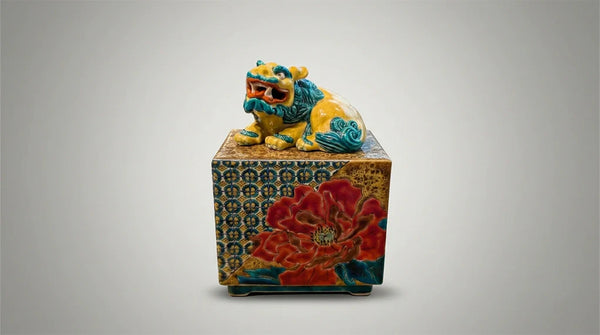
Two Ko-Kutani styles are distinguished today. Aote (青手, "green-hand") drops the red entirely and works in green, yellow, purple, and dark blue, usually coating the entire vessel so that almost no white porcelain shows. Iroe or gosai-te uses all five colors for landscapes, birds and flowers, and geometric patterns. The Ritsumeikan University Art Research Center notes that the modern ceramist Kitaōji Rosanjin praised Ko-Kutani as "terribly artistic," which is about the right register for how it is regarded by Japanese collectors today.

Then it stopped. After about fifty years the kilns in Kutani village went out, and the reason is still unclear. The KOGEI JAPAN reference mentions a theory involving suspicions of smuggling, but nothing is documented well enough to state as fact. For the next hundred years, almost no porcelain was made in Kaga.
Chapter two: the revival kilns, 1807 to the 1860s
The revival began in Kanazawa, the castle town of the parent Kaga domain, rather than in Kutani village itself. In 1807 the Kasugayama kiln opened there with the Kyoto painter and potter Aoki Mokubei brought in to guide it, producing a style now called Mokubei-fū. Other kilns followed, including Wakasugi in 1811 and Ono in 1819. None of these are what most people mean by "revived Kutani," but they re-established the craft in the region and trained the hands the next kiln would need.
The kiln that gets the credit is Yoshidaya. In 1824 Toyoda Den'emon, a wealthy Daishōji merchant trading under the name Yoshidaya, built a kiln in Kutani village right beside the old Ko-Kutani site with the explicit aim of reviving the aote style. According to the Kutani-yaki Kiln Museum in Kaga, the mountain location proved impractical and the kiln was moved to Yamashiro Onsen in 1826, where the climbing kiln remains stayed in use until 1940 and now form the museum. The Kutaniyaki Art Museum records that Den'emon pursued quality with little regard for profit, ran into financial trouble, and closed the business in 1831, seven years after it began.
Seven years was enough. Yoshidaya aote is considered the closest any later kiln came to Ko-Kutani in artistry, and it is more refined than the original: the same four-color palette without red, but with finer drawing and a more controlled hand. When a modern Kutani kiln describes a piece as Yoshidaya-fū (Yoshidaya-style), this is the idiom it means. A defining test is the absence of iron red anywhere on the piece.

What came after Yoshidaya
After the closure, the former kiln manager Miyamotoya Uemon reopened the Yamashiro kiln under his own name. The Miyamotoya kiln shifted toward akae, fine red line painting, under its chief decorator Iidaya Hachirōemon, and the style is known today as Iidaya-fū. The Daishōji domain later ran its own Matsuyama kiln, which kept aote production going until the feudal system was abolished under the Meiji government. Two further styles are usually listed in the standard Kutani lineage: Eiraku-fū, a red-and-gold idiom that arrived with the Kyoto Eiraku line of potters in the 1860s, and Shōza-fū, named for the painter Kutani Shōza, which combines several of the earlier techniques in one composition and became the base for the export period.
| Style | Japanese | Palette and character | Period |
|---|---|---|---|
| Ko-Kutani aote | 古九谷 青手 | Green, yellow, purple, dark blue; no red; whole surface covered | Mid-17th to early 18th c. |
| Ko-Kutani gosai | 古九谷 五彩手 | All five colors; landscapes, birds and flowers | Mid-17th to early 18th c. |
| Mokubei-fū | 木米風 | Five colors; the Kanazawa revival style guided by the Kyoto painter Aoki Mokubei | From 1807 |
| Yoshidaya-fū | 吉田屋風 | Aote revival; four colors, no red; refined drawing | 1824 to 1831 kiln; style continues |
| Iidaya-fū | 飯田屋風 | Akae: fine red line work covering the surface, gold accents | 1830s onward |
| Eiraku-fū | 永楽風 | Red ground with gold (kinrande) | 1860s |
| Shōza-fū | 庄三風 | Combines earlier techniques; dense, polychrome, gold; export base | Late Edo into Meiji |

Chapter three: "Japan Kutani" and the export era
The Meiji Restoration removed the domain that had sponsored Kutani, and it opened the country to trade. Kutani makers responded fast. The ware was shown at the Vienna World Exposition in 1873, then at Philadelphia in 1876 and Paris in 1878, and by the Kutani-yaki Kiln Museum's account this is when the name "Japan Kutani" spread abroad. Kiln owners across Ishikawa began branding all their overglaze porcelain as Kutani for export, which is why the tradition today covers Kaga, Komatsu, Nomi, and Kanazawa rather than one village.
The export period changed the look of the ware. Red and gold dominated. Western colorants and new techniques arrived. Designs became denser and more detailed than anything from the Edo kilns, and much of it was made to sit on European dining tables. This is the origin of the Kutani most Western antique collectors know: the gold-brocade vases, the akae teacups with hundreds of tiny figures, the "Japan Kutani" base marks. Our Kinrande article in the Color of Utsuwa series explains how gold brocade reached Japanese porcelain in the first place.

Not all of it was good. Export-period Kutani ranges from museum pieces to fast, thin decoration on mass-produced blanks, and the base mark alone tells you little. Condition, the weight of the enamel, and the quality of the drawing are what separate them.
Chapter four: Kutani today
Kutani ware was designated a Traditional Craft by the Japanese government in 1975, and the Ko-Kutani kiln site in Kutani village was designated a historic landmark in 1979. The Ritsumeikan survey counts roughly 300 people working in the craft today, from emerging professionals to master ceramists, across the southern Ishikawa production area. The porcelain stone is Hanasaka tōseki from Komatsu, and the enamels are still glass-based, colored with metal oxides and fired at a lower temperature over an already-glazed body. The saying "there is no Kutani without painting" is still the working definition.

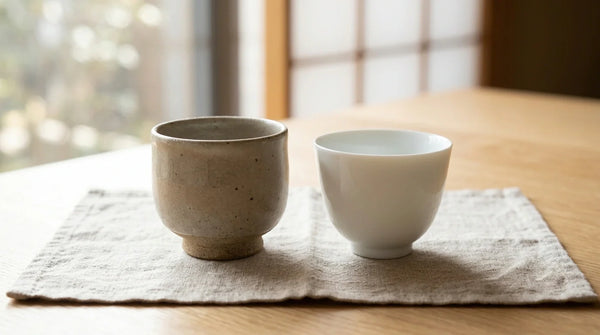
What is distinctive about contemporary Kutani is that the historical styles are all still in production at the same time. A single Ishikawa workshop may make aote plates in the Yoshidaya idiom, gold millefleur (hanazume) in the export idiom, and a fine-red akae line. Some kilns paint on stoneware rather than porcelain, especially for tea bowls, and some have moved toward wabi-sabi gray glazes with only a small area of enamel decoration. For the twentieth-century turn toward studio and art Kutani, see our profile of the Asakura Isokichi family.
Two practical notes for buyers. First, "Yoshidaya" on a modern piece means Yoshidaya-style, made by a present-day kiln in the aote idiom. It is not a piece from the 1824 to 1831 kiln, and any seller who implies otherwise without documentation should be treated with caution. Second, revival-style aote is often fired on earthenware rather than porcelain, because the porous body holds the thick four-color enamel better. That affects care: hand-wash only, and no microwave.
Kutani ware in the ZenKiln catalogue
We stock Kutani from several Ishikawa kilns, and between them they cover most of the chapters above. Everything ships from Japan.
- Hakuhō Kiln Yoshidaya wild-grape square plate set, five 13.7 cm plates in the aote palette with no red, on an earthenware body. The closest thing in our catalogue to the revival-era idiom.
- Tenzan Kiln kinhanazume bowl, a 19 cm serving bowl in gold-ground millefleur with raised slip flowers. This is the export-era gold tradition carried into a modern kiln.
- Eizan Kiln peacock and peony sake set, a tokkuri and two sakazuki in kinrande, the red-and-gold brocade idiom.
- Iroe Yū Workshop Hana matcha chawan, hand-painted overglaze florals on a gray stoneware tea bowl. The contemporary wabi-sabi direction, in a paulownia box.
- Seikō Kiln mejiro rice bowl, a 10.5 cm porcelain bowl with three white-eye birds. Everyday Kutani for daily use.

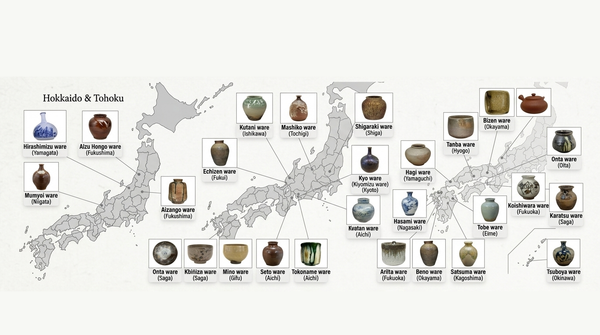
The full range is in the Kutani Ware collection. For the wider map, Japan's pottery regions places Kutani alongside Arita, Seto, and the Six Ancient Kilns.
FAQ
When did Kutani ware start?
Production began in 1655 in the village of Kutani, in the Daishōji domain of present-day Kaga City, Ishikawa Prefecture, under the domain's first lord Maeda Toshiharu. Techniques came from Arita in Kyushu. The porcelain from this first phase, which lasted roughly fifty years, is called Ko-Kutani.
What is the difference between Ko-Kutani and Yoshidaya?
Ko-Kutani is the original porcelain of 1655 to the early 1700s. Yoshidaya is the revival kiln opened in 1824 by the merchant Toyoda Den'emon, which set out to recreate the Ko-Kutani aote style and ran until 1831. Both use the four-color aote palette without red. Yoshidaya work is generally more refined in its drawing; Ko-Kutani is bolder. Modern pieces labeled "Yoshidaya" are made in the Yoshidaya style by present-day kilns.
Why is there no red on some Kutani ware?
Because it is aote. The aote (青手) style uses only green, yellow, purple, and dark blue, applied thickly enough to cover most of the surface. It began in the Ko-Kutani period and was revived by the Yoshidaya kiln in the 1820s. The other classic styles, including gosai, akae, and kinrande, all use red.
What does "Japan Kutani" mean on a base mark?
It is an export-era mark. After Kutani ware was shown at the Vienna World Exposition in 1873 and later expositions, Ishikawa kilns branded overglaze porcelain for the Western market as Kutani, and "Japan Kutani" became the name it traveled under. The mark indicates the export period, roughly Meiji onward, and does not on its own indicate a specific kiln or a level of quality.
Is Kutani ware porcelain or stoneware?
Historically porcelain, made from Hanasaka porcelain stone mined in Komatsu. Today the tradition is defined by its overglaze painting rather than its body, and some kilns work on stoneware or earthenware. Revival-style aote pieces are often earthenware because the porous body holds thick enamel well, and many tea bowls are stoneware with only partial enamel decoration.
Is Kutani ware still made today?
Yes. It was designated a Traditional Craft by the Japanese government in 1975, and roughly 300 makers work in the craft in southern Ishikawa. Historical styles including aote, akae, kinrande, and hanazume are all in current production alongside contemporary designs.
Editor's note: ZenKiln works directly with the Ishikawa kilns we stock, and every piece is inspected and hand-packed in Japan before it ships. The dates and kiln names above are drawn from the Kutani-yaki Kiln Museum, the Kutaniyaki Art Museum, the Ritsumeikan University Art Research Center, and KOGEI JAPAN, all linked in the text. Where those sources describe a cause as uncertain, we have said so rather than filled the gap.