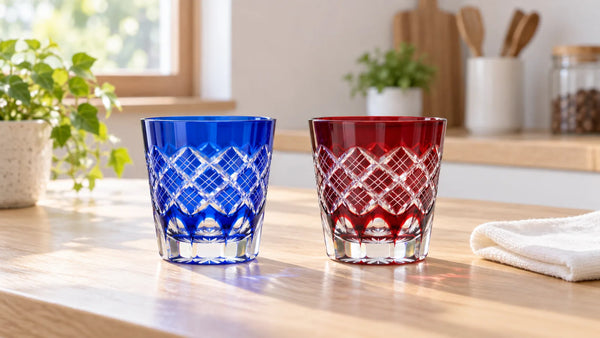
Edo Kiriko is Tokyo’s cut-glass craft. Geometric cuts catch the light in clear glass or reveal a clear body beneath coloured casing. Its regional history and inherited patterns make it a useful companion to the ceramic traditions in this Kiln Studies series.
What Edo Kiriko is
Edo Kiriko is a Japanese cut-glass craft made in Tokyo, in which geometric patterns are ground into the surface of a glass vessel using rotating metal discs and whetstone wheels. It was certified as a Traditional Craft of Tokyo on July 15, 1985, and designated a National Traditional Craft of Japan on January 30, 2002. Production centers on Kōtō, Sumida, and Edogawa wards, and the permitted raw materials are crystal glass and soda-lime glass.
Kiriko (切子) refers to cut glass. Edo Kiriko has regional production and technique requirements, described in the Tokyo Metropolitan Government's traditional crafts register. A coloured outer layer alone does not establish that designation.
From a Nihonbashi glass shop to a designated craft
The traditional origin account dates to 1834, when Kagaya Kyūbei began decorative glass cutting at his shop in Odenmachō, now part of Tokyo’s Nihonbashi area. He had trained in Osaka and sold glass instruments as well as other glassware.

Traditional Crafts Aoyama Square also records a story of cut-glass bottles presented to Commodore Perry. It is an anecdote within the craft’s history, not a basis for judging the quality or date of a surviving piece.
British instruction helped develop cutting and engraving methods during the Meiji period. The industry expanded through the Taishō and early Shōwa periods.
Clear glass and coloured casing
Irokise (色被せ), or cased glass, combines a clear body with an outer layer of coloured glass. Cutting through the casing creates areas of contrasting colour and clarity. Edo Kiriko is also made in clear glass, where the facets themselves shape the reflections.
The broad sequence is marking out, rough cutting, refining, and polishing. Guide marks help organise the pattern, while successive cutting and polishing stages establish its lines and light-catching surfaces. Tools and the amount of marking vary with the design and workshop.

Edo Kiriko compared with Satsuma Kiriko
In coloured examples, the thickness of the casing helps explain the different visual effects. The figures below are typical comparisons given by Tokyo’s craft register, not a measurement rule for every glass.
| Edo Kiriko | Satsuma Kiriko | |
|---|---|---|
| Region | Tokyo (Kōtō, Sumida, Edogawa) | Kagoshima, formerly Satsuma domain |
| Colored layer | Typically a little under 1 mm in coloured examples | Typically about 2–3 mm |
| Visual signature | Sharp, high-contrast edges between color and clear | Soft gradient where the cut passes through thick color |
| Historical footing | A commercial cut-glass tradition centred in Tokyo | Domain-sponsored production, later revived |

Satsuma Kiriko developed under domain patronage after the Edo glassmaker Yotsumoto Kamejirō was invited south. Production later ceased and was revived. Edo Kiriko developed through commercial workshops; these different histories complement the visual comparison above.
Reading the patterns
Around twenty traditional patterns draw on plants and familiar objects. Makers combine these with their own designs. A pattern name describes the decoration; workshop attribution needs the maker’s records or documentation.
| Pattern | Japanese | What it depicts |
|---|---|---|
| Nanako | 魚子 | Fish roe: a dense field of small round cuts that scatters light |
| Kiku | 菊 | Chrysanthemum, cut as radiating bursts of fine lines |
| Asanoha | 麻の葉 | Hemp leaf, a six-point star lattice |
| Kagome | 籠目 | Basket weave, an interlaced lattice of woven bamboo |
| Yarai | 矢来 | A bamboo palisade fence of crossed diagonals |
| Sasa-no-ha | 笹の葉 | Bamboo grass leaves, pointed and overlapping |
| Yaguruma | 矢車 | An arrow wheel, spokes radiating from a center point |

The hexagonal kagome pair combines roku-kaku kagome, a six-sided basket lattice, with sasa-no-ha and yaguruma. The kasane yarai pair uses layered fence lines and a twelve-point star cut into the base. Notice how the cuts change appearance as the glass is turned in the light.
Crystal or soda-lime, and how to care for it
Both crystal and soda-lime glass are used for Edo Kiriko. Check the material, dimensions, and weight on the individual product page; neither a ringing sound nor a heavier feel establishes certification. Handle either material carefully around hard sinks and other glassware.
Hand-wash cut glass gently with a soft sponge and mild detergent, and avoid abrupt temperature changes, microwaves, and dishwashers unless the maker expressly permits them. Do not pour boiling water into an ordinary drinking glass. Kagami’s glass-care guidance is a useful manufacturer reference. Dry with a soft cloth without forcefully twisting inside a narrow glass.

Store glasses separately without nesting them, so rims and cut surfaces do not rub against each other.
Edo Kiriko in the ZenKiln catalogue
The examples below are listed in ZenKiln’s glassware range. Refer to each product page for its brand, material, dimensions, and packaging.
- Edo Kiriko hexagonal kagome pair — red and blue old-fashioned glasses, listed at 8.3 cm and supplied with a paulownia box. Check the product page for the full dimensions.
- Edo Kiriko kasane yarai pair — compare the layered fence pattern and the packaging listed for this model.
- Edo glass sake cup with gold leaf — an 85 ml guinomi from a separate glassmaking tradition, rather than an example of Edo Kiriko cutting.
- Toyo Sasaki amber cold sake set, a 300 ml carafe with an ice pocket and two cups, for chilled sake in summer.

The full range sits in Sake Sets & Glassware. For drinking-vessel shapes, see choosing a Japanese sake cup; Japanese summer cooling explores glass and other seasonal objects. For the ceramic side of this series, start at Japan's pottery regions.
FAQ
Why is Edo Kiriko expensive?
Price reflects the glass blank, pattern complexity, skilled cutting and polishing, and the workshop. More intricate work can require additional time, but there is no single production-time figure that applies to every Edo Kiriko glass.
Sources: the Tokyo Metropolitan Government’s craft register and Traditional Crafts Aoyama Square, linked above, with glass-care guidance from Kagami. Certification and packaging should be checked against the documentation for the specific product. The historical workshop image is an editorial illustration, not a documentary photograph of 1834.