Five Tea-Bowl Traditions in Japanese Tea Culture
6 min readA matcha bowl is held, turned and brought to the lips as well as used for whisking. Shape and surface matter together. Here are five traditions encountered in Japanese tea culture: Raku, Hagi, Karatsu, Mino’s Shino and Oribe, and Korean-origin Ido.
These descriptions offer a starting point for looking. Individual bowls vary, and their makers and histories need more evidence than appearance alone.
1. Raku-yaki — Kyoto's hand-built chanoyu bowl
Where it's made: Kyoto, by the Raku family and a network of branch kilns (wakigama) founded by family members or apprentices.
Raku tea bowls are associated with hand-shaping and carving rather than wheel-throwing. Red and black are the classic glaze types, with weight, thickness and irregularity varying from bowl to bowl.

Raku’s early bowls are closely associated with Chōjirō and Sen no Rikyū in late-sixteenth-century Kyoto. The Raku family’s history is an important part of tea ceramics, alongside other traditions used in chanoyu.
Red and black Raku are fired differently
Raku studio Waraku describes black Raku firing at around 1,200°C and red at around 800°C, with its own kilns operating somewhat higher. Removal while hot is characteristic, while the temperature depends on the ware and workshop.
2. Hagi-yaki — Yamaguchi's pale crackled glaze
Where it's made: Hagi and the surrounding Yamaguchi Prefecture on the Sea of Japan coast, in former Nagato Province.
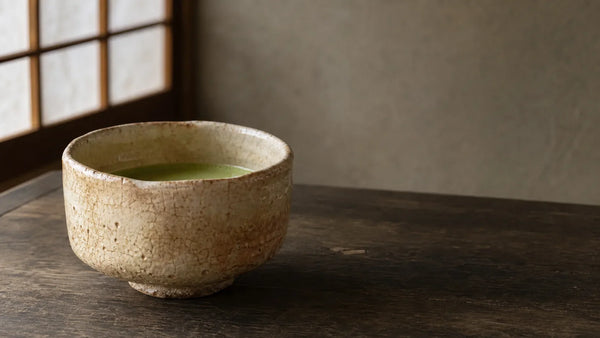
Many Hagi bowls combine orange-pink, ivory or biscuit-coloured clay with translucent beige or milky-white glaze. Fine glaze crackle, kannyū (貫入), forms as the glaze and body contract differently. Some tea bowls have a deliberately cut notch at the foot, while softly irregular rims are another familiar feature.

Hagi’s origins trace to Korean potters brought to Japan after the late-sixteenth-century invasions of Korea and settled by the Mōri clan. It became closely associated with tea. The saying ichi-Raku, ni-Hagi, san-Karatsu—Raku first, Hagi second, Karatsu third—expresses traditional esteem for these bowls, rather than an objective ranking.
The “seven changes” of Hagi
Hagi no nanabake describes changes as liquids enter a porous body and fine glaze crazing. Colour and pace vary; the phrase does not mean seven fixed stages. Rinse and dry the bowl as directed, and have structural cracks or leaks assessed.
3. Karatsu: painted pottery from Saga
Where it's made: The Karatsu region of Saga Prefecture in northern Kyushu, with related kilns in adjoining Takeo and Taku.
Karatsu’s iron-rich stoneware can have a slightly sandy texture. Climbing kilns, or noborigama, are part of its production tradition. In e-Karatsu (絵唐津), flowers, grasses, birds and other motifs are painted in iron beneath a semi-transparent grey glaze. Chōsen Karatsu combines dark iron glaze with flowing white straw-ash glaze.
Korean potters contributed to Karatsu’s development in the late sixteenth century. Its pottery became so familiar in western Japan that karatsu-mono served as a broad term for ceramics. Karatsu also holds a recognised place in tea’s appreciation of restrained, irregular wares.
4. Mino: Shino and Oribe
Where it's made: Mino, the historical kiln district of present-day Gifu Prefecture, particularly Toki and Tajimi.
Mino encompasses several styles. Shino and Oribe show two distinct approaches to the tea bowl:
- Shino often has a thick, creamy feldspar glaze with pinholes and reddish firing effects. Many examples also carry iron-painted motifs, distinct from those fire-colour areas.
- Oribe includes several styles. Green Oribe often combines copper-green glaze with iron-painted motifs on a white glazed ground, while other varieties use different palettes. Irregular or angular forms are characteristic of many examples.

Mino’s Momoyama wares widened the forms and decoration used for tea, within a ceramic world shaped by exchanges with China and Korea.
5. Ido — the Korean bowl at the heart of tea history
Ido is a Japanese tea-world name for a class of Korean bowls from the Joseon period. Their original uses and production circumstances remain subjects of research.
Many have a wide profile, pronounced foot and warm glaze tones. Rough, beaded areas where glaze has crawled, often near the foot, are called kairagi. Named bowls have their own forms and recorded histories.
Japanese tea practitioners prized these Korean bowls for their forms and surfaces. The Kizaemon Ido is a celebrated example and a designated National Treasure of Japan. Later potters in Hagi, Karatsu and elsewhere have made Ido-style bowls in response to the tradition.
What to look for in your first chawan
Choose for the tea you make and the way you hold the bowl:

- Room to whisk: a matcha chawan needs space for the chasen to move. Everyday bowls are often around 11–14 cm across, but shape and depth matter too; a tea cup or sake vessel may be too narrow.
- Comfort: when you can handle a bowl, support it with both hands. Notice the weight, the rim and whether the foot feels secure in your palm.
- The foot, or kōdai: look at the exposed clay, trimming and any marks. These reveal aspects of making, while an absent mark or rough finish alone tells you little about authenticity.
- Surface and condition. Fine crazing, flecks, and irregular glaze can be intentional features, while cracks, sharp chips, or flaking need separate assessment. Ask the seller to distinguish the two for the actual bowl.
- Your practice: follow your teacher’s guidance for formal tea. At home, choose a shape with room to whisk and a rim that is comfortable to drink from. The colour can be a personal choice; compare different ceramic bodies and glazes.
Contemporary bowls and further reading
The pieces below are contemporary examples, including Kutani bowls and a Hagi coffee form:
- Kutani Iroe Yū Hidamari Matcha Chawan — a cat-themed contemporary bowl.
- Kōzan Kutani Hane-Usagi Matcha Bowl — rabbit and moon decoration.
- Iroe Yū Hana Floral Matcha Chawan: floral overglaze decoration on a grey ground.
- Hagi-yaki Tsubakihide-gama Himetsuchi Coffee Pair: Hagi glaze on a coffee cup, for comparison with the tea bowls above.
- Gifts for Tea Lovers: bowls and other pieces for tea.
For a wider map, read Japan’s Pottery Regions. The Stoneware vs Porcelain guide explains the material terms.
FAQ
Are Raku tea bowls still made by the original Raku family?
Yes. The Raku family lineage in Kyoto has continued from the 16th century to the present, passing the name and seal down through successive generations — sometimes by direct descent and sometimes by adoption. In addition to the head family, a network of "branch kilns" (wakigama) founded by Raku-family members or former apprentices also produces work in the Raku tradition.
What evidence should I ask for when collecting?
Ask about the maker, region, age, technique and condition. A seal or signed box can contribute to a recorded history, but neither proves attribution alone. An unsigned bowl may still be worth considering for its making and use.
Sources and further reading: Waraku’s making and care information, Urasenke’s usucha guide, Japan House Los Angeles on Mino techniques, and the Nezu Museum’s Ido exhibition archive.