ZenKiln
Kutani Matcha Chawan by Kozan Kiln — Hane-Usagi Leaping Rabbit Moon Bowl
Low stock: 2 left
- 300 ml
- Stoneware
- Not microwave-safe
- Hand-wash only
- Made in Japan
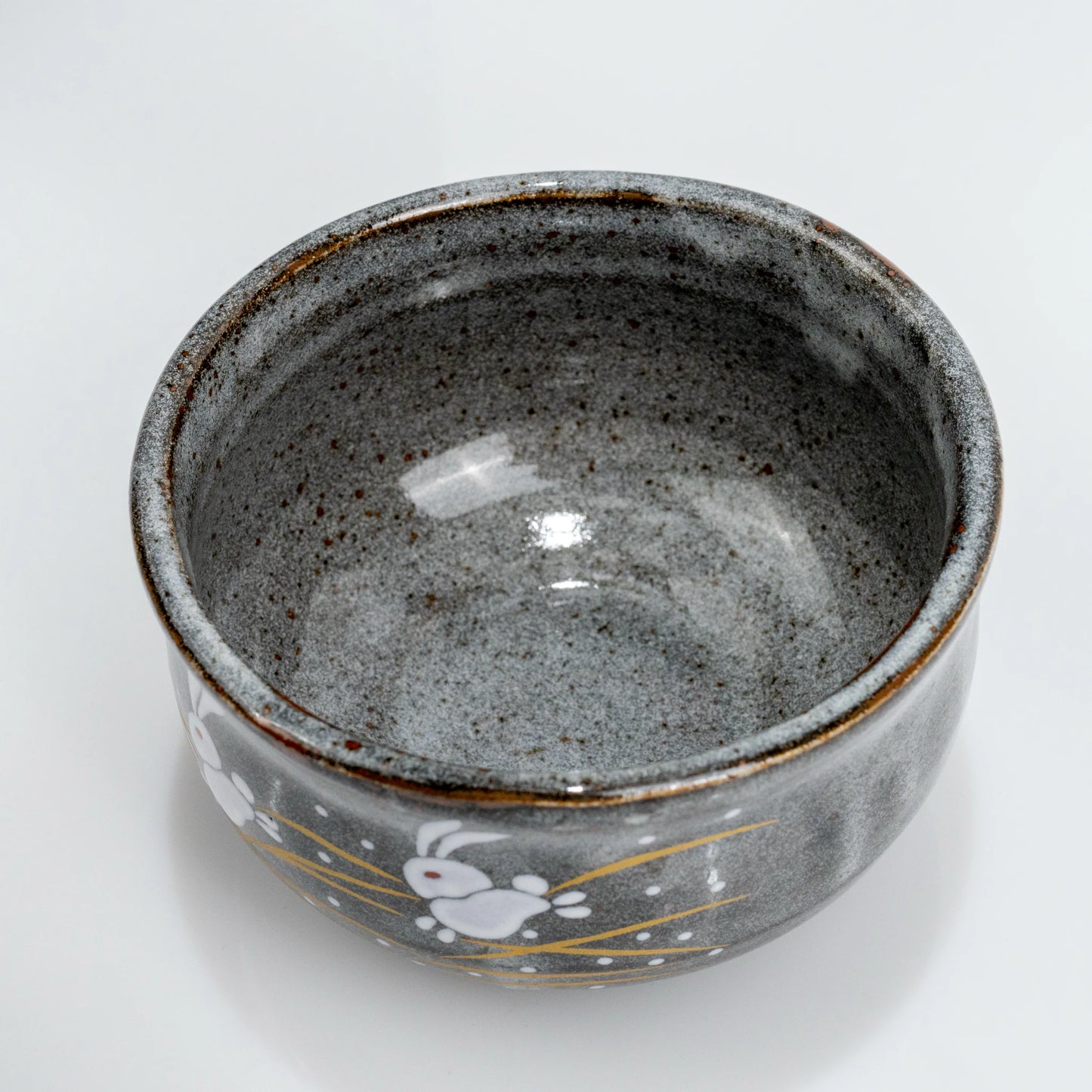
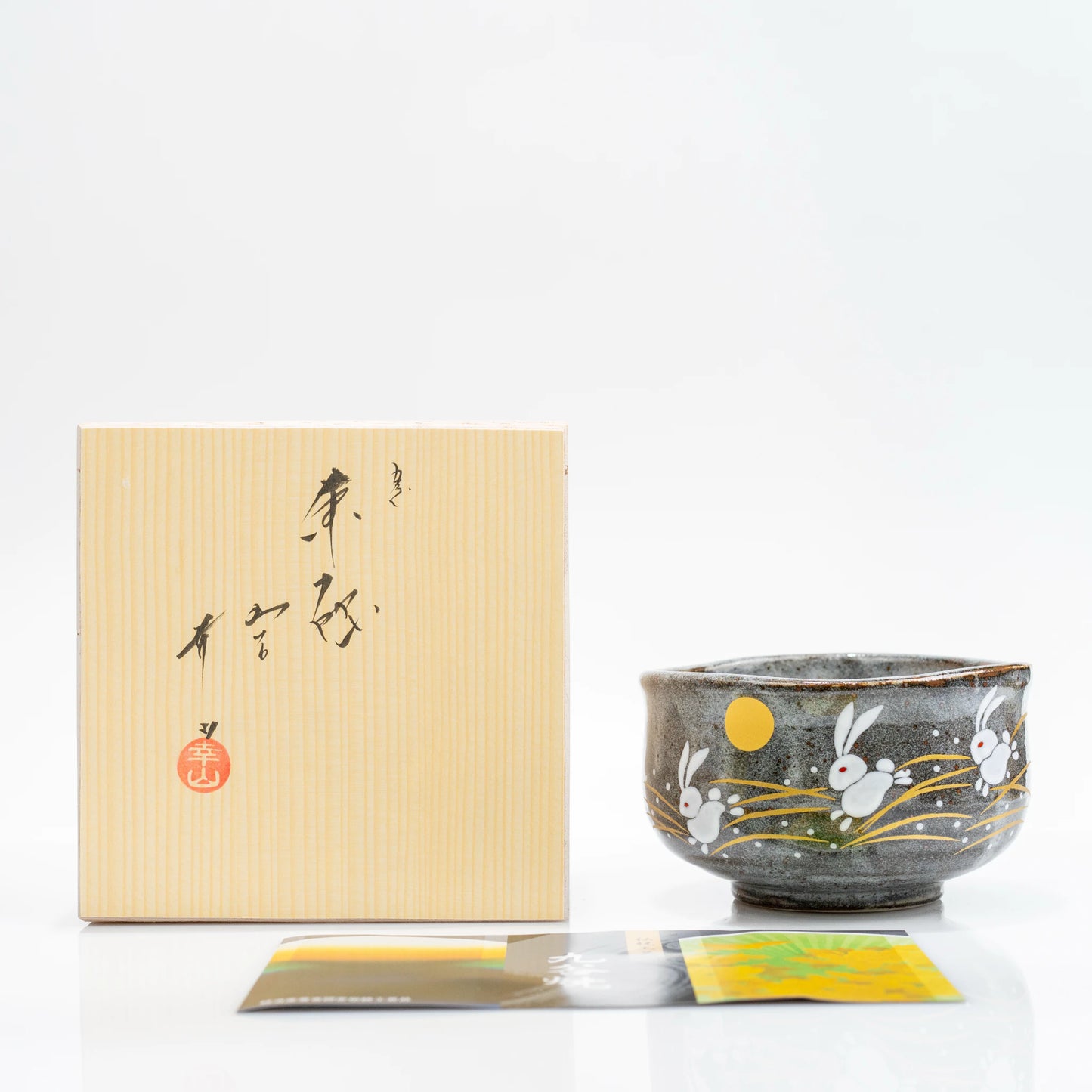
A modern Kutani matcha chawan from the Kōzan (幸山) kiln in Ishikawa Prefecture — three raised-white rabbits hop across a speckled gray ash-glaze body beneath a gold full moon and gold susuki (pampas grass) blades streaming with the wind. The supplier names this pattern simply はねうさぎ (Hane-Usagi / "Leaping Rabbits"). Look at it for a moment and the older Japanese imagery surfaces: the jade rabbit (玉兎 gyokuto) pounding mochi on the moon, the autumn moon-viewing field (月見 tsukimi) where wild pampas grass catches the September light, the contemplative wabi-sabi aesthetic of softly speckled stoneware. The foot ring carries the gold-transfer 九谷 幸山 kiln seal as definitive maker attribution.
Made by Kozan Kiln (幸山) / Kutani-yaki (九谷焼) in Ishikawa Prefecture, Japan, curated by ZenKiln
Maker: 幸山 (Kōzan) — Ishikawa Prefecture, Japan (Kutani kiln) — foot-ring kiln seal verified
About the design
The 月夜野ウサギ (moonlit-field rabbits) motif sits inside one of Japan's deepest cultural threads. In ancient folklore, the rabbit lives on the moon — the dark patches we see are the silhouette of the 玉兎 (gyokuto / jade rabbit) pounding mochi. Pair that mythology with pampas grass (susuki / 薄・芒), the autumn-grass companion of the September full moon, and you have the iconic 中秋の名月 (Chūshū no Meigetsu) Mid-Autumn moon-viewing aesthetic — though Japanese ceramic design enjoys this imagery year-round. The Kōzan kiln renders it here in the modern Kutani idiom: rather than the bold 五彩手 (gosaide / five-color polychrome) of classical Kutani, this piece uses a quieter contemporary palette — a nezumi-iro gray ash-glaze body, raised-white painting, gold-leaf accents — which sits comfortably in wabi-sabi-leaning Japanese interiors.
Use
- Functional matcha-whisking chawan — the speckled glossy gray interior whisks matcha cleanly with a chasen bamboo whisk
- Equally usable as a small bowl for nuts / wagashi tea sweets / individual rice / dessert serving
- A meaningful tea-altar piece for daily chadō practice; pairs naturally with a chasen, chashaku tea scoop, and chakin tea cloth
- Display-worthy when not in use — the rabbit-and-moon motif rewards close looking
Gifting
The included wooden gift box (kibako) with calligraphic lid + 2 color-printed Kutani info inserts make this gift-ready as received. Well-suited for matcha practitioners, tea-ceremony students, Japanese-pottery collectors, autumn moon-viewing tsukimi gatherings, housewarmings (with a new tea-corner), Father's Day, anniversaries, and client / mentor / teacher thank-yous.
Details & dimensions
Diameter: 11.0 cm (~4.3″).
Height: 6.8 cm (~2.7″).
Foot ring (kōdai): ~5.0–5.5 cm (~2.0–2.2″) estimate.
Capacity: ~250–350 mL vessel / ~100–150 mL practical matcha pour — to be confirmed on first-unit dispatch.
Weight: ~250–380 g (~8.8–13.4 oz) estimate — to be confirmed on first-unit dispatch.
Material: Ceramic — stoneware (陶磁器 tōjiki, cream-buff clay body).
Glaze: nezumi-iro (鼠色 mouse-gray) ash glaze with iron-rich firing flecks; reddish-brown unglazed firing rim.
Decoration: hand-thrown body; raised-white (shiromori 白盛) rabbit painting; gold-leaf (kinsai 金彩) full moon + susuki blades; oxidation firing speckle.
Foot mark: 九谷 / 幸山 gold-transfer square seal on foot ring (Kutani / Kōzan).
Manufacture year: 2023.
Each piece slightly varies due to hand-throwing and hand-painting.
Shipping, duties & delivery
Ships from Japan within 1–3 business days as in-stock inventory.
International delivery typically 5–14 business days after dispatch.
Hand-packed in the original kibako plus outer protective carton with cushioning for safe international transit.
Buyers outside Japan are responsible for any local customs duties, VAT, and import taxes.
Packaging & gifting
Packaging & gifting
Original wooden gift box (kibako) with sumi-brush calligraphic lid + red rakkan seal + 2 Kutani info inserts — gift-ready as received.
The kibako doubles as long-term storage for tea-practice use — traditional Japanese tea practitioners keep chawan in their tomobako/kibako between sessions.
Care instructions
Care instructions
Hand-wash only with mild soap and a soft sponge or chakin cloth; rinse and dry completely before storing.
Not dishwasher safe; not microwave safe (the gold-leaf kinsai is heat-sensitive).
Store in the original kibako for protection.
Whisk matcha with a wooden chasen (not metal) to preserve the glaze; the rim is hand-formed stoneware.
Returns / damage support
Returns accepted within 30 days for unused items in original kibako packaging. Buyer pays return shipping. If your item arrives damaged in transit, contact us within 7 days of delivery with clear photos of the item and packaging for replacement or refund.

THE MAKER
Kōzan Kiln
幸山 · Ishikawa
Kōzan (幸山) is a modern Kutani-yaki kiln in Ishikawa Prefecture working in a contemporary nezumi-iro (鼠色 mouse-grey) / kinsai-shiromori (gold + raised-white) idiom — distinct from the historical gosai-de palette. Signature: gold-transfer 九谷幸山 foot seal. Distributed through Tōjudō.
Independent Kutani kiln; tradition METI-designated 1975
PAIRS WELL WITH
FEATURED IN