Matcha Bowl, Chasen, and Chashaku Care: The Complete Set
9 min readA matcha bowl, bamboo whisk, tea scoop and tea container do different jobs and need different care. Rinse the chasen after whisking and let it dry in the open air. Wipe a traditional bamboo chashaku dry. For the bowl and container, follow the maker’s instructions for their material and finish.
This guide explains how to clean and dry a matcha set, when to replace a worn whisk, and why a serving container is different from an airtight tea-storage tin.
The complete matcha set
These are common utensils for preparing and serving matcha; the equipment used in formal practice varies with the tea and school:
| Component | Japanese | Material | Care frequency |
|---|---|---|---|
| Chawan | 茶碗 | Clay or porcelain | After every use |
| Chasen | 茶筅 | Bamboo (single node) | After every use; replace when prongs break or lose their shape |
| Chashaku | 茶杓 | Bamboo or wood | Usually dry-wipe; follow the scoop maker’s instructions |
| Natsume / Cha-ire | 棗 / 茶入 | Lacquer or ceramic | Dry-wipe for routine care; cleaning depends on material and finish |
| Chakin | 茶巾 | Linen | Hand-rinse after each use |

Do not put a damp chasen back into a closed case. Let air reach the bamboo, and support the whisk without crushing its tips.
Chasen care — the bamboo whisk
A chasen is made from bamboo split into fine tips. Whisks differ in tip count, shape and stiffness; tip count alone does not assign a whisk exclusively to thick or thin tea. Choose the form recommended for your preparation or school, and replace it according to wear.

First use
- Put clean water in a stable bowl. Holding the chasen by its handle, dip the tips in the water for about 1–2 minutes before use, as recommended in Ippodo’s chasen care guide. Do not pour hot water over a whisk resting in your hand.
- Lift the whisk by its handle. Do not force the tips apart or bend them into a new shape.
- Check that no tips are broken before whisking.
After each use
- Rinse the chasen promptly in clean water after whisking. You can use the bowl once it has been rinsed clean; refresh the water until the matcha is removed.
- Rinse without detergent, following the whisk maker’s instructions.
- Remove remaining powder gently, without squeezing or pulling the fine tips.
- A suitable kusenaoshi, or whisk holder, can help support the shape during drying. Set the whisk on it gently and allow it to dry completely in the open air.
- Once fully dry, store on the kusenaoshi or in an open container. Never store in a closed box or plastic bag while still damp. Trapped moisture encourages mold between the fine bamboo prongs.
The kusenaoshi rule
A whisk holder supports the tips as they dry. Without one, stand the whisk on its handle end on a clean, stable surface with the tips free, following the maker’s storage instructions.
Replacement signals
- Several prongs are broken or visibly snapped.
- The tips have worn or bent enough to interfere with whisking.
- A musty odor, persistent discoloration, or visible mold develops.
Replace a chasen according to its condition, not a fixed calendar. A whisk used frequently will wear sooner, while careful rinsing and complete drying help it last longer. Replacement is normal; a chasen is a consumable tea tool.
Chawan care — by bowl type
Chawan range from Raku and Hagi to glazed porcelain. A regional name is not a complete care specification: the clay, glaze, decoration and condition of the particular bowl matter.

Raku-yaki chawan (楽焼) require careful handling. Red and black Raku can have different firing processes; do not assign every Raku bowl a single firing-temperature range or assume that colour alone establishes its porosity.
- Avoid sudden changes of temperature. Follow the bowl maker’s directions for pre-wetting or warming.
- Use the maker’s cleaning method, especially for absorbent or crackled bowls; do not leave them soaking in detergent.
- Let the bowl dry thoroughly in a ventilated place before storage. A fixed one-hour wait does not establish that it is dry.
- Never dishwasher, never microwave.
- Do not pour boiling water into a cold bowl or place it directly on a heat source unless its maker explicitly permits that use.
Hagi-yaki chawan (萩焼) are made in Yamaguchi Prefecture. Many have glaze crackle, or kannyū (貫入), that takes up colour through use. This changing appearance is associated with Hagi no nanabake, “the seven changes of Hagi.” A structural crack or leak is a separate condition that needs assessment.
- Clean according to the maker’s instructions and rinse away tea promptly.
- If the maker recommends pre-wetting, follow that method. Water does not permanently seal glaze crackle.
- Dry completely before putting the bowl away.
Mino-yaki chawan in Shino, Oribe or Kiseto styles vary in clay and glaze. Check the particular bowl’s care instructions rather than treating all Mino bowls as equally absorbent.
Glazed porcelain chawan (Arita, Hasami) can usually be gently hand-washed with a soft sponge and mild dishwashing detergent, then rinsed and dried. Decoration and repairs may require extra care. See our Japanese porcelain care guide for the full porcelain rules.
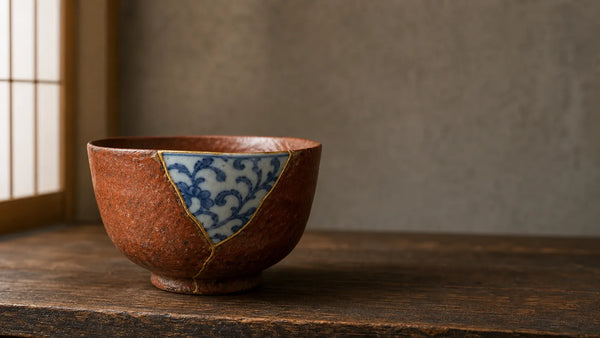
Stop using a chipped or structurally cracked bowl for tea until its condition has been assessed. Kintsugi is one repair approach, but return to food use depends on the repair materials, curing and the repairer’s instructions.
Chashaku care: the bamboo scoop
A traditional bamboo chashaku (茶杓) is normally wiped clean with a dry cloth. Its thin curved end deserves light handling; avoid soaking it or trying to reshape it.

Chashaku care
- After each use, hold the chashaku over a folded chakin or fukin (Japanese kitchen cloth).
- Wipe the scoop end gently from the curve outward to remove any matcha residue.
- Place flat on a soft cloth or in its original paulownia box.
Avoid rinsing or soaking a traditional bamboo scoop unless its maker specifically permits it. Gently remove dry powder without scraping the surface.
Do not extend the scoop’s dry-wipe routine to every bamboo utensil: a chasen is intended to be rinsed with water after use.
Natsume tea container care
A natsume (棗) is a lidded container used to present matcha for serving. A cha-ire is a different tea container, associated with thick tea. Their care depends on the construction of both jar and lid:
Lacquerware natsume hold matcha for serving. For routine care, remove the powder with a soft dry cloth. Whether washing is appropriate depends on the container’s construction and finish; see the urushi lacquerware care guide and the maker’s directions.
Ceramic cha-ire are associated with thick tea. Handle the jar and lid separately and follow their care instructions; do not assume that every lid can be washed like glazed ceramic.
For both types:
- Keep serving containers clean and dry before adding matcha. A fitted lid is not necessarily an airtight seal.
- Use a natsume for the tea you are about to serve. Keep the remaining matcha in suitable sealed storage away from heat, light and strong odours.
- Ippodo recommends opaque, tightly sealed storage and enjoying its matcha within a month of opening for best flavour. Follow your tea supplier’s guidance rather than applying a fixed two- or three-week limit to every tea.
Seasonal chawan
Tea ceremony tradition uses different chawan shapes by season:
- Shallow, open bowls are often chosen for summer; their form allows the tea to cool more readily.
- Winter chawan (tsutsu-gata, 筒形) — tall, narrow, cylindrical. The closed shape conserves heat, desirable in winter.
These are seasonal choices rather than requirements for drinking matcha at home. Care still depends on the particular bowl.
What never to do
- Never store a chasen damp in a closed container. Trapped moisture encourages mold between the fine bamboo prongs.
- Do not press or bend the whisk tips during drying.
- Do not soak a traditional bamboo chashaku or use force on its curved end.
- Keep bamboo tools out of the dishwasher. For a porcelain bowl, check its own dishwasher rating rather than applying the whisk’s care rules to it.
- Clean a chasen promptly with water, without detergent, as directed by its maker.
- Do not microwave bamboo tools. A bowl’s microwave compatibility must be confirmed for that specific bowl, including its decoration and any repairs.
- Never store a natsume open. Matcha absorbs ambient moisture and stales rapidly.
- Avoid sudden temperature changes when warming a tea bowl.
FAQ
How often should I replace my chasen?
There is no fixed replacement calendar. Replace the chasen when several prongs break, the center no longer holds its shape, or you notice visible mold or a persistent musty odor. Frequency of use, whisking technique, rinsing, and drying all affect its working life.
Why does my chasen smell musty?
A musty odor usually points to moisture retained between the fine bamboo prongs. If visible mold appears or the odor remains after complete drying, replace the chasen. Going forward, rinse it well, support it upright on a whisk holder, and let it dry completely before storage.
Can I wash my chasen with soap?
Ippodo recommends rinsing a chasen with water, without soap, soon after use. Remove remaining matcha gently and let the whisk dry in the open air. Do not force the tips apart to clean them.
Do I need a kusenaoshi to take care of my chasen?
A kusenaoshi can support the shape while the chasen dries. It is helpful, but drying in open air is the essential step. Without one, follow the maker’s guidance for standing the whisk without compressing its tips.
How do I store my chashaku?
Wipe a traditional bamboo chashaku gently with a dry cloth, let it remain dry, and keep it protected from pressure and damp storage. Use its original box if available; do not close a damp utensil inside any container.
How is matcha set care different from kyusu teapot care?
A kyusu brews leaf tea; a chasen works directly through a suspension of matcha and needs prompt rinsing. Both should be cleaned and dried according to their own materials and construction. Tea staining is not something every kyusu needs to develop; see our Japanese kyusu teapot care guide.
Editor’s note: This guide separates care by utensil. For the maker, origin, material and included accessories of a piece in the shop, consult its product page and supplied instructions.