Kintsugi: The Japanese Art of Gold-Repaired Pottery
Kintsugi (金継ぎ, "golden joinery") is the Japanese craft of mending broken pottery with urushi lacquer dusted with gold, silver, or tin powder. Instead of disguising the break, kintsugi traces it in metal — a deliberate, luminous scar that says: this bowl has a history, and the history is part of the bowl. Five centuries after it took shape inside the tea ceremony, the practice remains one of the most quietly radical ideas in Japanese aesthetics: that a vessel can be more valuable broken and repaired than it ever was whole.
This article is a primer for collectors who own a chipped antique chawan, a cracked Imari plate, or a Wajima lacquer bowl that has finally given up after thirty years of use — and want to understand what kintsugi actually is before deciding what to do about it.
What "Kintsugi" Literally Means
The word breaks into two characters: 金 kin (gold) and 継ぎ tsugi (joinery, succession, mending). A second name, kintsukuroi (金繕い, "golden repair"), appears in older texts and museum labels. Both terms describe the same family of techniques: the structural work is done by urushi — the raw, sap-based lacquer harvested from the Toxicodendron vernicifluum tree — and the gold is a final flourish, dusted onto the cured lacquer ridge so the seam reads as a vein rather than a wound.
The choice of word matters. Tsugi (継ぎ) is the same character used for inheriting a family name or continuing a lineage. The repair is framed as continuation, not restoration. The bowl is not being returned to a previous state; it is being moved forward to a new one.
The Philosophy — Wabi-Sabi, Mottainai, and the Broken Tea Bowl
The origin story most often told runs through Ashikaga Yoshimasa, the 15th-century Muromachi shogun whose retreat at Higashiyama gave us much of what we now call Japanese tea culture. According to a frequently repeated account, Yoshimasa sent a beloved but damaged Chinese tea bowl back to China for repair. It returned stapled together with metal clamps — functional, but ugly to his eye. The story holds that this disappointment prompted Japanese craftsmen to develop a more aesthetically considered method, and kintsugi was the result. Historians note the anecdote is difficult to date precisely, and competing accounts exist; the safe statement is that the practice traces to the Muromachi period (1336–1573) and matured alongside the tea ceremony.
The philosophy that grew up around it draws on three older Japanese ideas:
- Wabi-sabi (侘寂) — the aesthetic that finds beauty in the imperfect, the impermanent, and the incomplete. A chipped rim is not a flaw to hide; it is a register of time.
- Mottainai (勿体無い) — a regret at waste, the sense that things have value and should not be thrown away lightly. Kintsugi is mottainai made visible: the bowl is too meaningful to discard.
- Mono no aware (物の哀れ) — a gentle, melancholic awareness of the passing of things. The gold seam is a small monument to the moment the bowl broke.
A repaired bowl is read as a keshiki (景色, "landscape") — a term tea practitioners use for the totality of marks, drips, kiln scars, and now repairs that give a piece its individual character. A kintsugi seam is the most legible chapter in that landscape.
The Three Classic Repair Styles
Most kintsugi work falls into one of three categories, defined by what is missing from the original vessel:
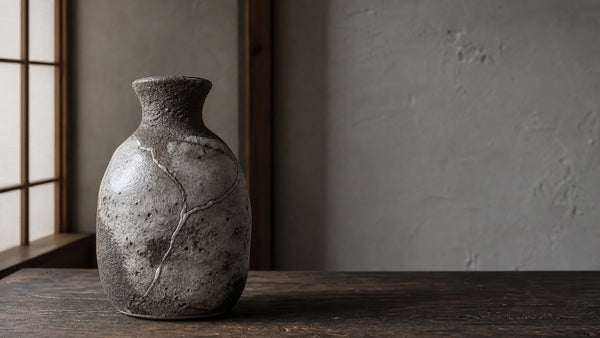
- Hibi (ひび) — crack repair. A clean break or hairline fracture is bonded with urushi, the seam is leveled and polished, and gold powder is fixed onto the still-tacky topcoat. The fragments interlock; little or no material is added. This is the most common form and the closest to what most Western audiences picture when they hear "kintsugi."
- Kake (欠け) — chip or missing-fragment repair. When a chip is gone — a piece of rim, a sliver of foot — the void is filled with a putty made from urushi mixed with rice flour, wood powder, or fine clay (sabi urushi). The filler is sculpted to the missing contour, cured, smoothed, and gilded. The repair becomes a small golden island where the chip used to be.
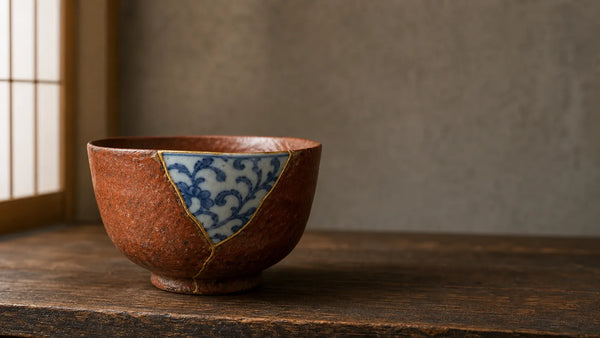
- Yobitsugi (呼継ぎ) — joining fragments from different pieces. The character 呼 means "to call" or "to invite"; yobitsugi is literally "invited joining." When a fragment is lost permanently and no putty fill will do, a shard from another, visually different vessel is shaped, lacquered, and gilded into place. The result is a deliberate patchwork — a blue-and-white shard inside a celadon bowl, joined by gold. Yobitsugi is the most visually dramatic style and is prized by collectors precisely because it refuses to pretend the bowl was ever whole.
How the Process Actually Works
The romance of kintsugi can obscure how slow and exacting the real work is. A traditional repair has roughly four stages:
- Cleaning and dry-fitting. The break is examined, edges cleaned, fragments dry-assembled to confirm the puzzle.
- Adhesion with mugi urushi. Urushi mixed with wheat flour (mugi urushi) is applied to the broken edges and the piece is reassembled under gentle pressure. The bonded vessel then rests in a humidity chamber — traditionally called a furo (風呂, "bath") — kept around 75–90% humidity, because urushi cures by absorbing moisture, not by drying out.
- Filling, leveling, and undercoat. Gaps are filled with sabi urushi (urushi + clay), then progressively finer coats are applied and sanded smooth. Each coat takes days to weeks to cure properly in the furo before the next can go on.
- Metal application. A thin final coat of red or black urushi is applied to the seam; while it is still tacky to the touch, gold powder (or silver, tin) is dusted on with a soft brush or cotton ball, then burnished once cured.
End to end, a properly executed traditional kintsugi repair takes roughly 30 to 60 days minimum, and complex multi-fragment work runs to several months. The cure schedule is set by the urushi, not by the artisan's preference — there is no rushing it.
Silver Repair, and Lacquer Without Metal
Gold gets the headlines, but it is not the only finish.
- Gin-tsugi (銀継ぎ, "silver joinery") uses silver powder in place of gold. The seam reads cooler, more restrained, and over time silver tarnishes to a deep grey-black — a slow second act in the life of the repair. Gin-tsugi is often chosen for pieces whose palette would clash with bright gold, particularly Shino, Karatsu, and other earthy stoneware.
- Suzu-tsugi (錫継ぎ, tin) gives a soft pewter-grey line and is the most affordable of the metal finishes.
- Urushi-tsugi (漆継ぎ) — sometimes simply called urushi-only repair — skips the metal entirely. The seam is finished in black or red lacquer and left as-is. This is the oldest form of the repair tradition and the most quietly beautiful on many pieces; it predates the decision to gild seams at all.
"Is My Piece Worth Repairing?" — A Buyer's Decision Framework
Not every broken bowl is a kintsugi candidate. A useful way to think about it:
- Repair if the piece has provenance you care about (a kiln you collect, an inherited bowl, a tomobako-signed work), if the break is clean and the fragments are present, and if you accept that traditional repair costs are commonly comparable to or greater than the value of an unbroken mid-tier piece.
- Reconsider if the piece is high-volume commodity ware (mass-produced rice bowls, late-Showa export plates) with no provenance, if many fragments are missing or pulverized, or if the body is severely water-damaged or contaminated.
- Don't repair if the piece is structurally unsound for the use you want — kintsugi can hold a tea bowl, but a teapot that has lost a spout or a vessel with hairline cracks running through its base is rarely worth restoring to wet-use.
The honest test is: do I want this object back in my life, even imperfect? If yes, kintsugi makes sense. If the answer is "I want the object I had before it broke," kintsugi will disappoint, because the repair is meant to be visible.
Modern Kintsugi Kits vs. Traditional Urushi Repair
The last decade has seen a flood of "kintsugi kits" sold online — small boxes containing epoxy or synthetic resin, gold-coloured mica powder, and a brush. These kits make the technique accessible to anyone, and there is real value in that. They are also not the same craft as traditional kintsugi, and it is worth being clear about the difference:
- Epoxy/resin kits bond chemically in hours, not weeks. The "gold" is usually mica or brass powder, not pure gold. The result is decorative and reasonably durable for display, but synthetic resin is generally not rated for hot liquid or food contact, and the seam will look different from a traditional urushi repair under close inspection — slightly plasticky, less luminous as it ages.
- Traditional urushi-based kintsugi uses natural lacquer that cures into a stable, food-safe surface, finished with real gold leaf or pure gold powder. It takes weeks to months and costs accordingly, but the repair is structural, food-safe once fully cured, and ages gracefully across decades.
Neither approach is wrong. A resin kit is a fine way to rescue a sentimental but inexpensive mug. A century-old chawan deserves urushi.
Where ZenKiln Sits in All This
ZenKiln is a curator of Japanese ceramics and lacquerware, not a kintsugi studio — we do not offer repair commissions, and we do not currently carry kintsugi-repaired pieces as a standing category. We have written this article because customers ask, regularly, what kintsugi is and whether the urushi-tradition pieces we sell are related to it. The answer is yes — they share the same lacquer technology. The urushi that binds a kintsugi seam is the same urushi that finishes a Wajima bowl or a Kishū-shikki plate. If you want to feel kintsugi's parent craft in your hand, an urushi piece is the most direct way.
If you are looking to commission an actual repair, we recommend searching for a local conservator with formal urushi training rather than booking the first listing that appears online — kintsugi is a slow craft, and competent practitioners are happy to explain their timelines and materials in detail before quoting.
Further Reading on ZenKiln
- Wajima-nuri: Japan's Premier Urushi Lacquerware — the urushi base that makes kintsugi possible.
- Vintage Wajima Lacquer Meoto-wan (Showa 1985) — a bowl pair finished in the same urushi technology used in traditional kintsugi.
- Vintage Kishū-shikki Urushi Plate Set of 5 — Wakayama's lacquer tradition, a different regional voice in the same craft family.
- Shop all antiques & vintage Japanese pieces — heritage pieces, occasionally arriving with sympathetic historical repairs.
- Antique Imari & Arita — porcelain that, in higher collector grades, often shows yobitsugi work in the wild.
FAQ
Is kintsugi food-safe?
Traditional urushi-based kintsugi is generally considered food-safe once the lacquer has fully cured — a process that takes weeks to months. Conservative practice for any kintsugi-repaired piece is to hand-wash only, avoid the dishwasher, and never microwave (the metal seam will arc). Epoxy-kit repairs are not rated for food contact and should be treated as display-only.
How long does a kintsugi repair take?
A traditional urushi-based repair takes roughly 30 to 60 days at minimum, and complex multi-fragment work runs to several months. Urushi cures by absorbing moisture in a humid chamber, and each coat must fully harden before the next can be applied. There is no shortcut.
What's the difference between kintsugi and yobitsugi?
Kintsugi (金継ぎ) is the umbrella term for gold-finished lacquer repair. Yobitsugi (呼継ぎ, "invited joining") is one specific style within that family — used when a missing fragment is replaced with a piece from a different vessel, creating a deliberate patchwork joined by gold seams.
Why gold? What does the metal actually do?
The gold is decorative, not structural. The structural bond is the urushi lacquer itself — natural sap that cures into one of the strongest organic adhesives known. The gold powder is dusted onto the cured lacquer ridge as the final layer, which both highlights the seam and gives kintsugi its name (金 kin = gold).
Can I do kintsugi at home with a kit?
Yes, with caveats. Resin-based home kits will let you reassemble a broken piece and finish the seam with metallic powder; the result will look like kintsugi and is fine for display or dry use. It is not equivalent to traditional urushi repair, will not be food-safe in the traditional sense, and will age differently over decades. For sentimental but low-value pieces, kits are a reasonable choice. For valuable antiques, commission a trained conservator.
Does ZenKiln sell kintsugi-repaired pieces?
Not as a standing category. ZenKiln is a curator of Japanese ceramics and lacquerware, not a kintsugi studio. We occasionally see sympathetic historical repairs on antique pieces that pass through our hands and will always disclose them in the listing when they are present.
Editor's note. ZenKiln curates Japanese ceramics, lacquerware, and metalwork from Japan-based suppliers, kilns, and estate sources. We are not a kintsugi studio and do not offer repair commissions. This article is an educational primer for collectors; specific repair decisions on valuable pieces should be made in consultation with a trained conservator. Published 2026-05-27 by ZenKiln Editorial.