How to Hold a Chawan: Etiquette, Grip, and Why It Matters
Written by Team ZenKiln · from our Tokyo atelier
Pick up a chawan (茶碗, literally "tea bowl") for the first time and the questions arrive all at once: which way is up, where do the hands go, and is there a wrong way to do it? This guide walks through how to hold a chawan — the everyday two-hand grip, why you turn the bowl before you drink, and how its foot, weight, and painted "face" are meant to be read in the hand. None of it is hard, and once the logic clicks, a matcha bowl stops feeling fragile and starts feeling like what it is: an object designed, very deliberately, to be held.
The setting that shaped these gestures is chanoyu, the Japanese tea ceremony — a phrase that literally means "hot water for tea" but stands for a whole choreography of preparing and sharing matcha. You do not need to study tea for years to handle a bowl respectfully. You need a few principles, and the willingness to slow down for ninety seconds.
First, what a chawan is built for
A chawan is a wide, shallow bowl made for whisking and drinking matcha (抹茶), powdered green tea. It is broader and lower than a mug, with an open mouth that gives a bamboo whisk (chasen) room to move. Crucially, it has no handle. That absence is the whole point: you are meant to cradle the body of the bowl in both hands, which is how you feel its warmth, its weight, and the slight irregularities a maker left in the clay.
In a formal gathering the chawan is the one utensil a guest actually holds — the kettle, caddy, and scoop stay with the host. So the way you receive and hold the bowl carries most of the etiquette, worth practicing at home long before you ever sit in a tea room.
How to hold a chawan: the basic grip
The standard hold is simple and stable, and it is the same whether the bowl is a museum-grade Raku piece or the everyday matcha chawan on your kitchen shelf.
Place the bowl flat on the open palm of your left hand, and steady it with your right hand on the side. Your left hand carries the weight from underneath; your right hand guides and turns. Lift from the surface in front of you to about chest height — never grip the rim from above like a coffee mug, and never hook fingers inside. This two-hand cradle keeps a hot, full bowl secure and signals that you are giving the object your attention.
Receiving the bowl
When a bowl is passed to you, take it with both hands and set it down on the mat or table in front of you before doing anything else. A small bow and a quiet word of thanks is customary. The pause matters: it resets the moment and keeps you from rushing.
The drinking hold
Lift the bowl onto your left palm and wrap your right hand around the side. Raise it in a brief gesture of appreciation, then drink in a few measured sips rather than one long pull. Because matcha is whisked, not steeped, the last mouthful is meant to be taken with a final, slightly audible sip — a sign the bowl has been finished and enjoyed, not a breach of manners.
Setting it down
Lower the bowl with both hands and place it down gently in front of you. If you are at home, wipe the rim where you drank with a fingertip or a clean cloth. In a formal setting this is done with a folded chakin (茶巾), the small linen cloth used to wipe the bowl clean.
Why you rotate the bowl before drinking
This is the gesture that puzzles newcomers most, and it is the heart of chawan etiquette.
Every chawan has a "front" — its shōmen (正面), the most striking face of the decoration. When a host serves tea, the bowl is placed down with that front deliberately turned toward the guest, as a gift of its best side. Out of humility, the guest does not drink from that face. Instead you rotate the bowl a small amount clockwise so your lips meet a plain side, drink, then turn it back so the front again faces outward when you return it. The exact number of turns varies from one tea school to another, so treat "a couple of small clockwise turns" as the spirit of the rule rather than a fixed count.
The logic is quietly generous in both directions. The host shows you the bowl's finest view; you decline to put your mouth on it. At home, the same move keeps a hand-painted bowl looking its best to whomever you are sharing it with — and it gives you a reason to actually look at the thing before you drink.
Reading the bowl in your hands
Holding a chawan well includes knowing what to notice while you hold it. Tea practice treats the bowl as something to be examined slowly, turning it to discover its glazes, its asymmetries, and the marks the kiln left behind.
Turn the bowl over and you reach the kōdai (高台), the carved foot ring — the single most studied part of a Japanese tea bowl. The foot is where a potter's hand is least disguised by glaze, so collectors read it closely; tea literature catalogs dozens of named foot shapes, from the plain ring foot (wa-kōdai) to the split foot (wari-kōdai) and the bamboo-node foot (takenofushi-kōdai). You do not need the vocabulary to appreciate it. Just tip the bowl and look: the foot tells you how the piece was thrown, trimmed, and stood to dry.
While the bowl is in your hands, feel three more things. Its weight and balance — a good matcha bowl feels lighter than it looks and sits naturally on the palm. Its lip, or kuchi-zukuri (口造り), the shaped rim your mouth will meet, sometimes thinned, sometimes left thick and soft. And its interior, where the well is shaped to let a whisk reach the bottom cleanly. These are not abstract details — they separate a bowl that whisks a good cup from one that merely looks the part.
Shapes, seasons, and the right bowl for the moment
Chawan come in many named forms, and the choice is often seasonal. A tall, narrow cylinder bowl — tsutsu-gata (筒形) — has a small mouth that holds heat, so it is favored in the cold months. A wide, shallow bowl — hira-gata (平形) — lets tea cool and breathe, so it suits high summer. Between those extremes sits the everyday rounded wan-nari form that most people picture when they hear "matcha bowl," and that most home drinkers will reach for year-round.
If you are buying one bowl to start, a medium rounded chawan is the most forgiving — easy to whisk in, comfortable in two hands, and unbothered by the seasons.
A short history you are holding
The gestures make more sense when you know where the bowl came from. The chawan originated in China, and the earliest examples used in Japan were imported across the 13th to 16th centuries. For a long stretch the prized bowl was the dark, lustrous tenmoku — the Japanese name for Chinese Jian ware — and Japanese kilns in Seto began making their own versions as tea drinking spread.
The shift to the rough, quiet bowls many people now think of as quintessentially Japanese came with the wabi tea of the 16th century. The tea master Sen no Rikyū (1522–1591) prized plain Korean rice bowls and locally made wares for their unforced simplicity over imported perfection. A saying still used in the tea schools ranks the most esteemed Japanese tea-bowl wares in order: "Raku first, Hagi second, Karatsu third." When you cradle a modern matcha bowl, you are holding the far end of that long argument about what beauty in a tea bowl actually is.
Matcha chawan from the ZenKiln catalogue
Every bowl below is a contemporary Kutani-yaki matcha chawan from a working kiln or workshop in Ishikawa Prefecture — hand-painted, sized for daily whisking, and packed in Japan. They are good first bowls precisely because they are made to be used, not shelved.
- The Iroe Yū "Hidamari" cats matcha chawan (Ø 11 × H 6.7 cm / 4.3" × 2.6") is a hand-painted Kutani stoneware bowl from the Iroe Kōbō Yū workshop, with two cats curled in a wildflower meadow and a paulownia kiri-bako gift box.
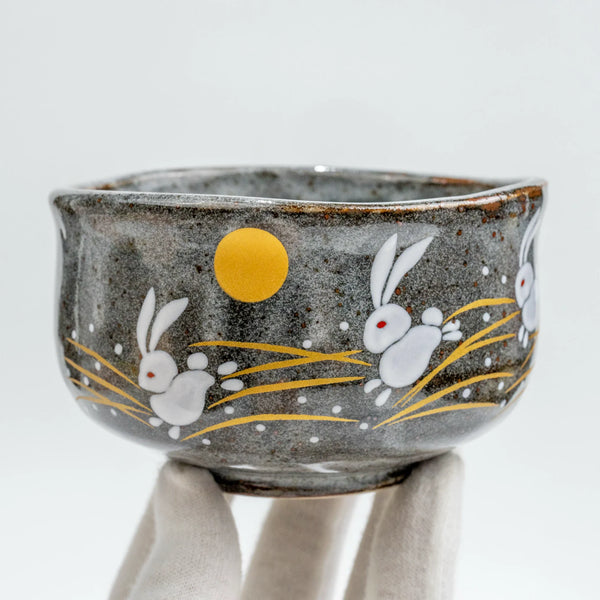
- The Kōzan kiln Hane-Usagi rabbit bowl sets three raised-white rabbits leaping across a speckled gray ash-glaze body with a gold moon — a moon-viewing (tsukimi) motif, boxed and ready to give.
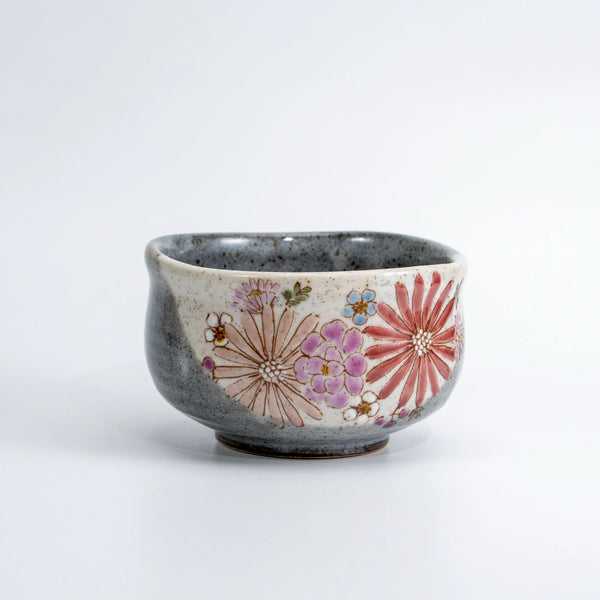
- The Iroe Yū "Hana" floral chawan is the most affordable way into a hand-thrown Kutani bowl, with a multi-flower hand-painted band over a soft wabi-sabi gray ground.
- The Iroe Yū "Hidamari" rabbit chawan pairs an amber and a white rabbit against a cream kohiki slip — a quiet, autumn-leaning bowl from the same workshop.
For more from the same tradition, browse the full Kutani Ware collection or the broader Gifts for Tea Lovers edit. For wider context, our companion piece on the five Japanese tea bowls every collector should know maps the major traditions, and the beginner's guide to Kutani ware explains the porcelain and stoneware behind every bowl above.
FAQ
How do you hold a matcha bowl when drinking?
Rest the bowl flat on your open left palm and steady it with your right hand on the side, lifting it to about chest height. Do not grip the rim from above or hook your fingers inside. The two-hand cradle keeps a hot, full bowl secure and is the standard hold in Japanese tea practice, whether the bowl is formal or everyday.
Which way do you turn a chawan before drinking?
Rotate the bowl a small amount clockwise so you do not drink from its decorated front, or shōmen, then turn it back before setting it down. The host places the bowl with its best face toward you as a courtesy, and turning it is the guest's way of declining to put their lips on that side. The exact number of turns varies by tea school.
Why do Japanese tea bowls have no handle?
A chawan is meant to be held in both hands around its body, so a handle would defeat its purpose. Cradling the bowl lets you feel its warmth, weight, and texture, and keeps a wide, full bowl of whisked matcha stable. The handleless form also reflects the tea aesthetic of direct, unfussy contact between drinker and object.
Is it okay to use a chawan every day at home?
Yes. Most matcha chawan sold today are made for daily use, not display, and whisking a bowl of matcha at home is the best way to get comfortable holding one. Rinse it by hand with warm water, avoid soaking or the dishwasher, and dry it fully before storing. A rounded, medium bowl is the most forgiving for everyday whisking.
What is the foot of a chawan called?
The carved foot ring on the underside is the kōdai (高台). It is the part of the bowl where the potter's hand is least hidden by glaze, so it is studied closely by collectors. Tea literature records dozens of named foot shapes, including the plain ring foot, the split foot, and the bamboo-node foot.
Editor's note: ZenKiln works directly with the kilns and workshops featured in our shop, each disclosed in our About section, and hand-packs every piece in Japan for delivery worldwide. The matcha chawan above are contemporary Kutani-yaki from Ishikawa Prefecture.