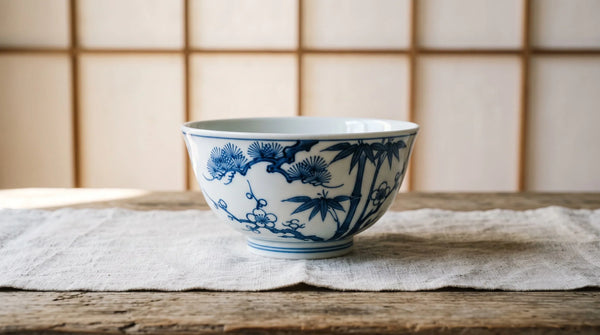
Hasami ware (波佐見焼, Hasami-yaki) is a porcelain tradition centred in Nagasaki Prefecture. Its history includes large-scale production of everyday bowls and export bottles. That practical heritage remains an important part of its appeal, alongside contemporary designs.
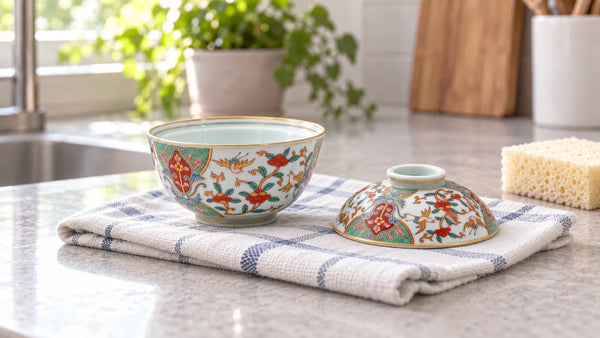
Image note: Historical forms and regional comparisons in this guide are editorial illustrations, not documented artifacts or photographs of a specific workshop. The catalogue product photograph is identified separately in its caption.
Where Hasami ware is made
Hasami is in Nagasaki Prefecture near the Saga border on Kyushu. The designated craft’s production area includes Hasami, Kawatana and Higashisonogi towns.
The Nakaoyama district retains brick chimneys, narrow alleys, and a climbing-kiln ruin about 160 metres long, described by Nagasaki Prefecture as one of the world’s largest. Its scale helps explain the town’s history of mass production.
Hasami porcelain received national Traditional Craft designation on February 6, 1978. The standard allows Amakusa or Mimata pottery stone and includes white porcelain with underglaze cobalt decoration. Contemporary production extends beyond blue-and-white designs.
A kiln town built on ordinary tables
The region’s ceramic industry developed at the end of the sixteenth century with Korean potters brought to Japan during Hideyoshi’s invasions. Climbing kilns were established at sites including Hatanohara under the Ōmura domain.
Early production was pottery; porcelain followed in the early Edo period as suitable stone became available. Two products show the range of its markets:
Kurawanka bowls are associated with food and drink sold to travellers on the Yodo River. Hirakata City describes the vendors’ boats approaching passenger boats with calls offering sake and food. These sturdy, affordable bowls helped make porcelain part of everyday life.
Konpura-bin, or compra bottles, were porcelain flasks used for sake and soy-sauce exports through Dejima in Nagasaki. They travelled to the Netherlands and Southeast Asia.

Hasami became a major producer in the Edo period and remains an important tableware centre. For another major production region, see our Mino ware guide.
What Hasami ware is made of
Amakusa pottery stone is a principal material, with Mimata stone also permitted by the traditional-craft standard. The body’s composition and firing affect its whiteness and translucency; appearance alone cannot establish the source of the stone.
A typical sequence begins with a biscuit firing at roughly 900°C. Underglaze pigments, including cobalt blue and iron brown, are applied before the clear glaze and a higher firing around 1,300°C. Overglaze enamels or gold require a later, lower-temperature firing, often around 700–800°C. Exact schedules vary by material and workshop.

Underglaze cobalt is protected by the glaze, making it well suited to tableware. That protection is not a promise that decoration or glaze can never wear or be damaged. Follow the individual item’s care instructions, especially for additional enamel or metallic decoration.
Hasami, Arita, or Mikawachi?
Hasami, Arita, and Mikawachi are neighbouring ceramic centres across the Nagasaki–Saga border. Their materials and techniques overlap, so appearance alone often cannot establish the production site. Each has produced a wider range of objects than a simple everyday-versus-luxury division suggests.
- Hasami is particularly associated with affordable tableware such as kurawanka bowls, as well as export bottles.
- Arita supplied both domestic and export markets. Imari was a regional shipping port; overseas trade passed through Nagasaki. Export fashions helped shape styles, but were not the sole purpose of Arita production. Our Arita ware guide covers that story.
- Mikawachi developed as the Hirado domain’s official kiln, producing porcelain for tribute and gifts. It also became associated with Amakusa stone.

Hasami porcelain has historically circulated under the Arita name. For a contemporary purchase, look for a named maker and a stated production location. A combined Arita–Hasami catalogue category groups neighbouring traditions; it does not establish where a particular object was made.
What to check when buying
Because Hasami is a production region rather than a single look, the useful signals are about the object.
- Check the stated material first. White colour and translucency can offer clues, but thick porcelain may be opaque. Weight, warmth, and a ringing sound do not reliably identify Hasami or rule it out. Our guide to telling Japanese stoneware from porcelain explains these limits.
- Look at the decoration and glaze in good light. Blue beneath a clear glaze is consistent with underglaze decoration, but colour and surface texture alone do not establish the exact technique or place of production.
- Compare the finish across a set. Small differences may be appealing, but variation alone does not prove hand painting. Ask the maker or seller how the pieces were formed and decorated.
- Look for a documented maker and production location. Our guide to telling handmade Japanese pottery from factory work explains why appearance alone cannot establish the process.
- Check care per piece. Use a microwave or dishwasher only when the maker approves that use. Metallic decoration needs particular caution; porcelain and blue-and-white decoration alone do not establish appliance compatibility.

To place Hasami on the wider map, see our overview of Japan's pottery regions.
Hasami ware in the ZenKiln catalogue
The examples below show different forms and decorative designs. Their product pages provide the current specifications and attribution; a shared collection name should not substitute for an individual maker or production location.

- Arita Hasami Faceted Bowl, Blue and White Sometsuke Arabesque, 14 cm — a faceted bowl with blue arabesque decoration. Consult the listing for material, technique, and care.
- Tokushichi-gama Cherry Soba Choko, 8 cm — a small cup with cherry decoration. Confirm the attribution and dimensions on the product page.
- Leaf Plate with Thrushes on a Berry Branch, 15 cm — a leaf-shaped plate with bird and berry decoration. See the listing for the documented techniques and care.
- Hexagon Demitasse Cup and Saucer, Floral, 100 ml — a six-sided cup and saucer in the Hana-e Madori Midori pattern.
- Indigo Camellia Tea Set, 410 ml Kyusu and Two Cups — white and red camellias painted over a ruri blue ground, boxed for gifting.
Browse the full shelf in Arita & Hasami Ware.
Editor’s note: This guide draws on the craft and regional-history sources below. Product specifications and maker attributions should be checked on the individual listing.
Sources: Traditional Crafts Aoyama Square, HASAMI Yaki (Porcelain) · Discover Nagasaki, Nakaoyama District of Hasami Town