Wajima-nuri: The Foundations of an Urushi Lacquerware Tradition
7 min readWajima-nuri (輪島塗) is the urushi lacquerware tradition of Wajima on the Noto Peninsula in Ishikawa Prefecture. Its reputation for durability rests on careful preparation, reinforced foundations and specialist work beneath the finished surface. A bowl can be made for everyday use and still need protection from drops, heat and scratches.
Where Wajima-nuri comes from
Wajima lies in northern Noto, well north of Kanazawa. Sea trade, including the Kitamae-bune (北前船) routes of the Edo period, helped its lacquerware reach customers beyond the region. Its commercial history is part of the craft’s story alongside the work of individual workshops.
The Wajima Museum of Urushi Art’s guide identifies fifteenth-century bowls from the Nishikawashima Site Group’s Odate Site in Anamizu as evidence of a diatomaceous-earth underlayer. It also records a surviving Jūzō Shrine lacquered door from 1524, recoated in 1768. These are more specific historical anchors than treating all earlier Noto lacquer as modern Wajima-nuri.
Wajima’s production system developed through the Edo period. Suitable woods, lacquer and locally obtained diatomaceous earth supported the work, while specialist makers divided the successive stages among them.
The ingredient that makes a Wajima bowl a Wajima bowl
One defining feature is the foundation beneath the visible lacquer.
Ji-no-ko (地の粉) is powder prepared from fired diatomaceous earth. It is mixed into lacquer-based foundation coats; the local material and its use are characteristic of Wajima-nuri. This is a lacquer foundation, not a ceramic body.
Cloth reinforcement and built-up ground layers help strengthen vulnerable areas. They do not make a bowl unbreakable or justify testing it by dropping it. A finished piece can chip, crack or suffer damage to its coating.
How a Wajima bowl is actually built: the hon-kataji process
Hon-kataji (本堅地), the firm foundation process, includes work that is largely hidden once the coating is complete. It belongs to a sequence involving wood preparation, reinforcement, ground layers and finishing.
- Wooden core (kiji). A turner shapes a green-state bowl from zelkova (keyaki), Japanese horse chestnut, or another hardwood appropriate to the form. The blank is dried slowly to settle the grain.
- Raw lacquer seal. Raw urushi is brushed into the wood to seal it and to bond what comes next.
- Cloth reinforcement. Fabric is attached with lacquer-based adhesive to vulnerable areas such as the rim before the ground is built up.
- Ji-no-ko coats. Successive lacquer-based ground layers are cured and levelled. Urushi curing depends on suitable environmental conditions; it is not simply solvent drying.
- Sealing the ground. A final raw-urushi coat closes the porous diatomite surface.
The bowl is now structurally complete but cosmetically rough. Only after this is the middle coat (naka-nuri) applied, again sanded smooth, and only then the final lustrous top coat (uwa-nuri). For high-grade pieces, an additional polishing stage called roiro (呂色) is performed — coats of finer lacquer rubbed back with charcoal and tonoko powder until the surface reaches a deep mirror sheen with no visible brushwork.
A single Wajima bowl typically passes through more than one hundred separate procedures, distributed across specialist artisans for turning, base-building, ground-laying, coating, and polishing. Even fairly plain pieces are usually months in the making.
Ma-nuri, chinkin, and maki-e: three Wajima finishes worth knowing
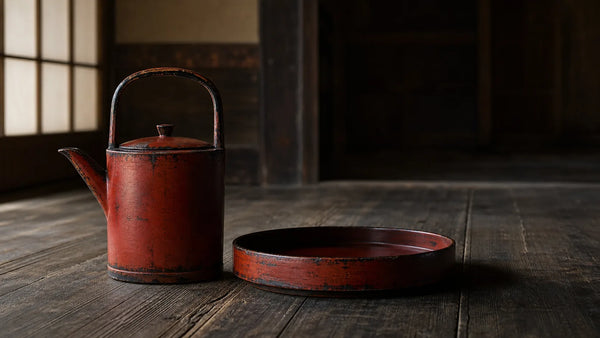
Most of the everyday Wajima lacquerware that travelled around Edo-period Japan was undecorated. The mainstream style is called ma-nuri (真塗) — literally "true coating" — a plain, deeply polished surface in black or vermilion that lets the light of the urushi itself do the work. The classic Wajima dining set called kagu-zen (家具膳) — a fitted tray of matched bowls — was traditionally finished this way and sold to households across Japan.
Two decorative techniques arrived later and put Wajima on the map for collectors:
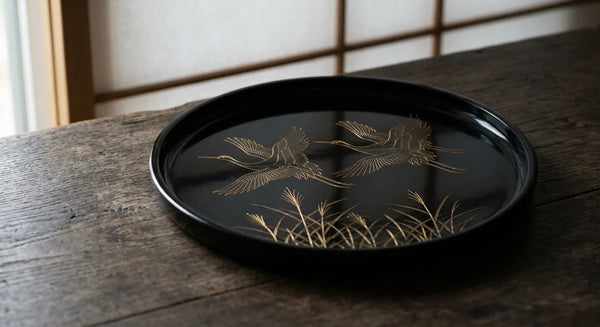
- Chinkin (沈金), “sunken gold”, begins with a design cut into cured lacquer. Lacquer is worked into the incisions to hold gold leaf or powder. The Wajima Museum of Urushi Art places its local introduction in the Kyōhō era (1716–1736). The recessed work remains a surface decoration that needs gentle care.
- Maki-e (蒔絵), “sprinkled picture”, uses lacquer to hold sprinkled metal powder. The finish may be flat, polished or raised, depending on the method. Its introduction to Wajima is associated with the Bunsei era (1818–1830).
What to check when buying Wajima-nuri
A similar black or vermilion appearance can be achieved using different bodies and coatings. Price and appearance alone do not establish a piece’s materials or origin.
Ask for a clear description and supporting records:
- Body and coating. Confirm the base material and surface coating in writing. Weight depends on size, construction and materials; lightness does not authenticate Wajima-nuri.
- Intended use. Ask about suitable food temperatures and care. A wooden body can feel different from ceramic, but a hot rim or hot contents can still burn. Do not test authenticity with hot soup.
- Construction. Ask how the foundation was made. The reinforcement is often concealed by later layers, so its absence from view at the foot does not disprove authenticity.
- Box and attribution. A signed accompanying box can contribute to provenance when its relationship to the object is documented. A box, signature or label on its own does not authenticate the contents.
- Labels and certification. The Consumer Affairs Agency’s labelling guidance covers material and handling information for specified lacquered utensils. Such disclosure is distinct from a craft association’s origin or production certification; ask which scheme a mark represents.
Caring for Wajima-nuri
Follow the individual maker’s instructions and take condition into account. For general cleaning and storage, see our urushi lacquerware care guide:
- Hand-wash only. Warm water and a soft cloth or sponge. No detergent stronger than a mild dish soap, and no scouring pad.
- Avoid the dishwasher and microwave for traditional wooden urushi ware. Heat and washing conditions can damage the body or coating, and metallic decoration needs particular care.
- Dry immediately after washing. Standing water can lift a lacquer edge over time.
- Store away from direct sunlight. UV slowly oxidises urushi and shifts the colour.
- Use food-use bowls within their maker’s guidance. Display pieces and fragile or historic objects may need different treatment. Regular use is not inherently better preservation than suitable storage.
Where Wajima-nuri sits in the Japanese craft landscape
If you want a broader map of where Wajima sits inside the Japanese craft landscape — alongside Arita, Kutani, Shigaraki, Tokoname and the rest — start with our guide to Japan's pottery regions.
FAQ
What does Wajima-nuri mean?
Wajima-nuri (輪島塗) means Wajima lacquerwork or coating. Nuri derives from nuru, to coat. The name identifies the lacquerware tradition centred on Wajima in Ishikawa Prefecture.
What contributes to Wajima-nuri’s durability?
Cloth reinforcement and lacquer-based foundation layers containing ji-no-ko help strengthen the construction. This supports its reputation for durable tableware without proving it stronger than every other lacquer tradition. Drops, scratches, heat and poor storage can still cause damage.
How long does it take to make a Wajima-nuri bowl?
A traditionally made Wajima bowl passes through more than one hundred separate procedures spread across several specialist artisans — turners, ground-layers, coaters, polishers, and decorators. Even an undecorated piece typically takes several months to complete, and high-grade decorated bowls with chinkin or maki-e can take a year or more from the first wood-cut to the final polish.
What is the difference between chinkin and maki-e?
Chinkin (沈金) places metal leaf or powder in lacquer-lined incisions. Maki-e (蒔絵) sprinkles metal powder onto a lacquer design, with different techniques producing flat, polished or raised finishes. Wajima’s adoption of chinkin is associated with the Kyōhō era and maki-e with the Bunsei era.
Can Wajima-nuri go in the microwave or dishwasher?
Avoid them for traditional wooden urushi ware. Hand-wash gently according to the maker’s instructions, dry and store away from strong light and extremes. Good care supports longevity but cannot guarantee a fixed lifespan.
Where can I see Wajima-nuri in person?
The Wajima Museum of Urushi Art opened in 1991 and presents lacquer history and techniques. Check its official information for current access before travelling. Museum collections and exhibitions can provide documented objects to study, rather than a shopping checklist based only on touch.
Editor’s note: This article belongs to our Urushi Studies series. For a shop item’s maker, production location, materials and condition, use its individual record. A general introduction to a region does not establish a direct workshop relationship for every item.