Arita Ware: The Story of Japan's First Porcelain
8 min readMost of Japan’s celebrated pottery towns are old — some of them a thousand years old. Arita ware is not. When potters in the hills of what is now Saga Prefecture pulled the first true Arita porcelain from a climbing kiln in the early 1600s, they did something no one in Japan had managed before: they made porcelain. Hard, white, ringing, translucent at the rim — the material that had made China famous for centuries finally had a Japanese home. Four hundred years later, Arita is still firing, and the blue-and-white bowls and gold-rimmed cups it sends around the world trace an unbroken line back to that first discovery.
This guide walks through where Arita porcelain came from, how to tell its major styles apart — blue-and-white, Kakiemon, Ko-Imari, and Nabeshima — and why the same ware is sometimes called “Imari.” It sits alongside our wider guide to Japan’s pottery regions and our explainer on Japanese stoneware versus porcelain, where Arita is the porcelain everyone points to.
A Korean potter, a white stone, and Japan’s first porcelain
Porcelain production developed in Hizen after the Japanese invasions of Korea in the 1590s, during which Korean potters were forcibly brought to Japan. Their skills contributed to the region’s ceramic industry and kiln technology. Suitable porcelain stone was another essential part of the later development.
By tradition, the breakthrough is credited to a Korean potter known in Japan as Kanagae Sanbee — often called Ri Sanpei (Yi Sam-pyeong). Around 1616 he is said to have found porcelain stone in the Arita district, and by about 1630 the discovery of abundant, high-quality stone at Izumiyama put full-scale porcelain production within reach. The infrastructure was already in place; what the potters had lacked was the stone. Once they had it, Hizen became the porcelain heartland of Japan.

In one paragraph: Arita ware (有田焼) is porcelain made in and around the town of Arita in Saga Prefecture, on the island of Kyushu. It is widely regarded as the first porcelain produced in Japan, beginning in the early 1600s after Korean potters found suitable white porcelain stone at Izumiyama. Unlike the older stoneware kilns, Arita was a seventeenth-century newcomer — and it is the tradition that taught Japan to make white porcelain.
Why Arita is not one of the “Six Ancient Kilns”
The Six Ancient Kilns are a historical grouping of medieval production centres. Arita’s porcelain developed later. The distinction is chronology and production history, not a division between rustic tea objects and refined tableware: Seto made applied glazes, and the regions have produced many kinds of vessels. Read Japanese ceramics and our Shigaraki ware guide for comparison.
Blue-and-white first, then color: sometsuke, Kakiemon, and Ko-Imari
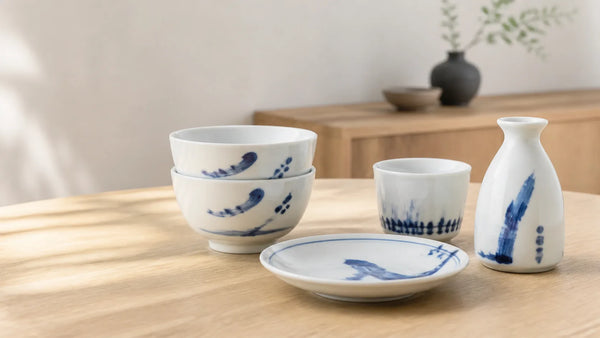
Early Arita included sometsuke (染付), cobalt decoration beneath a clear glaze. Firing sequences vary, so this should not be defined as always fired only once. The Arita sometsuke oval platter uses the shōchikubai motifs of pine, bamboo, and plum in a contemporary example.
Then came color. Potters developed overglaze enamel — iroe (色絵) or akae (赤絵) — in the 1630s, painting a second layer of red, green, yellow, blue, and black over the fired glaze and firing again at a lower temperature to fix it. Two overglaze styles became world-famous:
Kakiemon takes its name from the Kakiemon kiln in Arita, which perfected a warm, sparing style: a few well-placed birds, flowers, or figures floating on a milky-white ground called nigoshide. The restraint is the point — empty space is part of the design. Modern potters still work in this idiom; our Kakiemon-style cup and saucer carries a ume-kachō (plum blossom and bird) motif in the same five-color palette.

Ko-Imari (“Old Imari”) is a historical umbrella for older porcelain, not just a gold-rich decorative style. Some examples are blue-and-white; others use enamels and gilding. Kinrande names gold-brocade decoration. Compare the contemporary Ko-Imari lidded bowl and red-and-gold kinrande chrysanthemum cup and saucer as style references.

Glossary: hakuji is white porcelain; sometsuke is underglaze blue; iroe is coloured enamel decoration; akae emphasises red enamel; nigoshide is the characteristic milky-white porcelain body associated with Kakiemon; kinrande is gold-brocade decoration; Ko-Imari is a broader historical term.
Nabeshima: the porcelain the lords kept for themselves
Nabeshima ware was made for the domain’s official gift-giving rather than ordinary commercial sale. Production became associated with Okawachiyama, now in Imari City. It includes blue-and-white, celadon, and enamelled work, with carefully controlled designs; it is not solely an overglaze style.
Imari: the port that gave the ware its export name
Historically, Arita-area porcelain travelled through Imari before overseas shipment from Nagasaki. This trade helped establish “Imari” as a name in collecting and export markets. Today Imari is also a production location, so the two place names should not be treated as interchangeable on every modern listing.
And it sailed a long way. After Japan closed itself to most foreign contact in 1639, Dutch traders on the island of Deshima, near Nagasaki, kept a narrow channel open. When political turmoil in China disrupted the porcelain that had dominated the world market, the Dutch East India Company turned to the young Japanese industry to fill the gap. Through the latter half of the 1600s, huge quantities of Arita porcelain flowed to Europe, where blue-and-white and gilded Imari became prized decoration in aristocratic homes and palaces — and shaped European ceramics that tried to imitate it.
How to recognize — and start collecting — Arita porcelain
Start with the maker or production record, then compare body and decoration. Colour, translucency, and sound alone do not authenticate Arita. A Kakiemon-style label describes an influence; it does not establish production by the Kakiemon kiln or use of nigoshide. For everyday use, check the item’s appliance and care guidance, especially where gold is present.

Arita never stopped evolving, either. Historic houses still work in Saga alongside contemporary studios, and the same white porcelain that carried seventeenth-century blue-and-white carries thoroughly modern work today. That range is exactly what makes Arita such a rewarding tradition to collect.
Arita ware in the ZenKiln catalogue
The catalogue includes contemporary Arita and neighbouring Hasami porcelain. Product pages should distinguish maker, brand, material, and decorative style. Examples include:
- Arita Sometsuke Oval Platter — Shōchikubai: classic cobalt blue-and-white in the pine-bamboo-plum pattern, the oldest Arita idiom.
- Arita Kakiemon-Style Cup & Saucer — a plum-blossom-and-bird design on a pale ground. The style name does not establish that its body is nigoshide or that it was made by the Kakiemon kiln.
- Arita Ko-Imari Lidded Bowl: phoenix, peony, and birds in the dense blue-red-and-gold Old Imari palette.
- Arita Red & Gold Kinrande Cup & Saucer: gold-brocade chrysanthemums, the “white gold” look at teacup scale.
- Arita Hakuji Wind Chime: a hand-painted white-porcelain furin, a seasonal way to bring Arita’s ringing body into summer.
Browse the full Arita & Hasami Ware collection to see what’s currently in stock. If you’re new to Japanese porcelain more broadly, our beginner’s guide to Kutani ware makes a good companion — Kutani is Arita’s colorful cousin from the other side of Japan.
Frequently asked questions
What is Arita ware?
Arita ware is porcelain made in and around the town of Arita in Saga Prefecture, Japan. Beginning in the early 1600s, it is generally considered the first porcelain produced in Japan. It is known for a bright white body decorated with cobalt blue-and-white (sometsuke) and colorful overglaze enamel styles such as Kakiemon and Ko-Imari.
What is the difference between Arita ware and Imari ware?
The names overlap in historical trade and collecting: Arita-area porcelain was shipped through Imari and onward via Nagasaki. Modern Imari and Arita are also distinct production places, so check the stated maker and location.
Is Arita ware porcelain or stoneware?
Arita is known for porcelain. Thin sections can be translucent, but appearance, weight, or a ringing sound alone cannot reliably establish the body or region. Use the maker’s material specification.
What are Kakiemon, Ko-Imari, and Nabeshima styles?
Kakiemon refers to a named kiln and a related decorative style, often with sparse enamels on a pale ground. Ko-Imari is a broader historical category of older porcelain. Nabeshima describes domain-kiln production, including enamelled, blue-and-white, and celadon work. They are not three equivalent overglaze techniques.
Is Arita ware safe for everyday use?
Much modern Arita porcelain is made for daily use, and many pieces are dishwasher- and microwave-safe. Pieces decorated with gold or delicate hand-painted enamel are best hand-washed and kept out of the microwave, since gilding can scorch and wear over time. Always follow the care note included with an individual piece.
Where is Arita ware made?
Arita ware is made in the town of Arita and the surrounding area of Saga Prefecture, on the island of Kyushu in southwestern Japan. The neighboring town of Hasami, just over the Nagasaki border, produces closely related porcelain in the same tradition.
Editor’s note: This guide draws on the history of Arita and Imari porcelain as documented by The Metropolitan Museum of Art and the Saga Ceramics Industrial Association, the official body of the Imari and Arita porcelain kilns. Where early history is traditional rather than firmly documented — such as the potter Kanagae Sanbee — we’ve said so rather than inventing detail. Written from our atelier in Japan by the ZenKiln editorial team.