Shigaraki Ware: Fire, Clay, and Japan's Six Ancient Kilns
Écrit par l'équipe ZenKiln · depuis notre atelier de Tokyo
Few Japanese ceramics wear their making so openly as Shigaraki ware (信楽焼, Shigaraki-yaki). Fired from the coarse, sandy clay of the Shiga hills, a Shigaraki pot carries the whole memory of the kiln on its surface — a scorched orange flank, a run of glassy green where wood ash melted and pooled, white grains of feldspar bursting through the clay like grit turned to light. Almost nothing is painted on; what you see is a record of fire. This guide covers what Shigaraki ware is, where its clay comes from, how the kiln itself does the decorating, why tea masters prized it five centuries ago, and how the tradition continues today.
What is Shigaraki ware?
Shigaraki ware is high-fired, largely unglazed stoneware made in and around the town of Shigaraki, in Kōka, Shiga Prefecture. It belongs to a small, storied group of kilns known as the Rokkoyō, or Six Ancient Kilns.
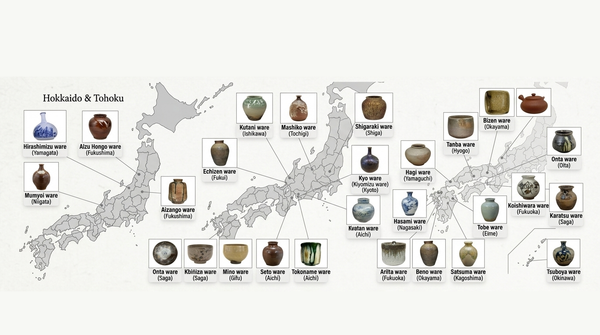
The Six Ancient Kilns (Rokkoyō) are the six Japanese ceramic centers that have produced pottery continuously since the medieval period: Shigaraki, Bizen, Tamba, Echizen, Seto, and Tokoname. The grouping was named in the twentieth century by the ceramic scholar Koyama Fujio, and in 2017 the six were jointly designated a Japan Heritage site. Of the six, Shigaraki sits closest to Kyoto — barely forty kilometers of hills separate them — and that nearness shaped everything about its history.
Because it is yakishime (焼き締め, high-fired unglazed stoneware), Shigaraki is dense, hard, and rings when tapped — closer in body to stoneware than to porcelain. Japan's traditional-crafts association KOGEI JAPAN lists it among the country's designated traditional crafts, and for where it sits among the regional traditions, see our overview of Japan's pottery regions.
A clay born from an ancient lake
Shigaraki's character begins underground. Over millions of years, granite in the region weathered into a sediment now called the Kobiwako — the “old Lake Biwa” formation, the ancestral bed of the lake that still lies to the north. That sediment yields a coarse, pale clay unusually rich in feldspar and quartz, and unusually resistant to heat.
The white flecks that stipple a Shigaraki surface are not decoration but geology. Grains of feldspar in the local clay melt at kiln temperature and push to the surface, some bursting through the wall in what potters call ishihaze (石爆, “stone bursts”). The same iron-bearing clay turns a warm reddish-brown in the fire. Both effects come from the raw material, not from any applied glaze.
Fire as the decorator
In an unglazed wood firing, the kiln does the painting. Over days of stoking, wood ash is carried through the chamber and settles on the shoulders and rims of the ware, where it melts into a natural glass. The potter can set the stage — where a pot stands, which side faces the flame — but the finish is a negotiation with fire.
Four named effects are especially prized on Shigaraki: shizen-yū (自然釉, natural ash glaze), the green-to-amber skin that forms where ash melts; biidoro, pools of that glaze gone glassy and translucent as a marble; hi-iro (火色, “fire color”), the flushed orange-red of flame-touched clay; and koge (焦げ), the smoky char on the side that faced the firebox.
You can read the whole vocabulary on a single medieval pot. The Metropolitan Museum of Art's late-fifteenth-century Shigaraki storage jar shows it at once — a reddish body, feldspar speckle, and a curtain of dark-green ash glaze running from neck to base. The museum calls the surface a “landscape,” a collaboration among the clay, the wood-fired kiln, and the potter's hand.
Shigaraki and the way of tea
By the Muromachi and Sengoku periods, a new sensibility was taking shape in nearby Kyoto and Sakai — wabi, the beauty of the plain and imperfect. Shigaraki's rough, honest surfaces were exactly what its practitioners wanted.
The tea master Murata Jukō, an early voice of wabi-cha, is said to have advised newcomers to keep Bizen or Shigaraki wares close for their unaffected character. A generation later, Takeno Jōō famously took a humble Shigaraki onioke — a “devil's bucket,” originally a well pail — and set it on the mat as a fresh-water jar. Turning a farm vessel into a tea treasure is the wabi gesture in miniature, and Shigaraki supplied the vessels.
From storage jars to tanuki
What kept Shigaraki alive for a thousand years was its refusal to specialize. In the Edo period, the arrival of the noborigama (climbing kiln) and of applied glazes let the town mass-produce — including koshijiro tea-leaf jars made to carry Uji tea to the Tokugawa court. The Meiji and Taishō eras brought industrial wares: acid-resistant vessels, charcoal braziers, and the kisha-dobin teapots sold on station platforms across Japan.
The rotund, sake-flask-toting tanuki (raccoon-dog) statue is a modern Shigaraki icon, not an ancient one. The figure became a national symbol of the town in the early Shōwa era; its popularity is often traced to a 1951 imperial visit, after which the cheerful “welcoming” tanuki became a fixture outside shops and homes as a token of good fortune.
Shigaraki today — and at ZenKiln
Since the late twentieth century, Shigaraki has led two lives at once: an industrial ceramics town whose clay still roofs buildings and lines garden pots, and a studio-pottery center where makers turn the old clay and firing effects toward contemporary forms.
The Shigaraki pieces we carry come from the Marui Seitō pottery, which releases its studio line under the name Hechimon — work that keeps the coarse clay and ash-glaze language while shaping it for a modern table. A hand-built bud vase streaked with an ash-glaze drip shows the raw idiom at its most direct; the black-and-gold Banju ikebana vase pushes the same clay toward the dramatic; and an olive-green mosaic coffee cup and saucer brings the texture into daily use. The full range lives in our Shigaraki ware collection.
Living with Shigaraki ware
Shigaraki stoneware is tough and made to be used. Pieces intended for food or flowers are usually glazed where it counts — inside a cup, along a vase's water well — while unglazed exteriors keep their raw texture. Rinse by hand, dry fully, and let any unglazed foot breathe between uses. Should a favorite piece ever chip, the same wabi tradition that prized Shigaraki also gave us kintsugi, the art of mending a break with lacquer and gold — a repair the Met's own Shigaraki tea jar wears with pride.
FAQ
Is Shigaraki ware stoneware or porcelain?
Shigaraki ware is stoneware — specifically yakishime, high-fired and usually unglazed. Its coarse, feldspar-rich clay produces a dense, hard body with a rough, warm surface, quite unlike the smooth white translucence of porcelain. The texture and “stone burst” speckling are hallmarks of the tradition.
What are the Shigaraki tanuki statues?
They are ceramic figures of the tanuki, or Japanese raccoon-dog, made in Shigaraki as good-luck charms. Although the town is over a thousand years old, the tanuki figure is a modern icon that rose to national fame in the early-to-mid twentieth century, and today it stands outside shops and homes as a welcoming symbol of prosperity.
Why is Shigaraki ware linked to the tea ceremony?
As wabi tea culture developed in the Muromachi and Sengoku periods, tea masters near Kyoto sought vessels with rustic, unaffected character. Shigaraki's rough, unglazed surfaces fit that ideal, and figures such as Murata Jukō and Takeno Jōō brought its jars and water containers into the tea room.
What gives Shigaraki ware its colors and speckles?
Its effects come from clay and fire rather than paint. Iron in the local clay turns reddish-brown in the kiln (hi-iro), feldspar grains melt and burst through the surface as white flecks, and wood ash settling on the pot melts into a natural green glaze (shizen-yū), sometimes pooling into glassy biidoro.
Where is Shigaraki ware made?
In and around Shigaraki, part of the city of Kōka in Shiga Prefecture, central Japan. The area sits on the clay-rich sediment of the ancient Lake Biwa basin and lies close to Kyoto, which shaped its long role in the tea trade. It is one of Japan's Six Ancient Kilns.
A note from ZenKiln: we're a Tokyo studio that works directly with Japanese kilns and makers — the Shigaraki pieces above come from the Marui Seitō (Hechimon) pottery — and we ship from Japan. We describe traditions in our own words and link to museums and heritage sources for the historical record.