What Is Washi? A Guide to Japan's Handmade Paper
Écrit par l'équipe ZenKiln · depuis notre atelier de Tokyo
Some Japanese paper is built to last a thousand years. Conservators at the Louvre and the British Museum reach for it when they repair centuries-old prints and manuscripts. That paper is washi — and understanding what it is, and why it behaves so differently from the paper in your printer, is the quickest way into one of Japan's most quietly remarkable crafts. This guide explains what washi is made of, why it lasts, how it differs from ordinary Western paper, and where it still turns up in daily Japanese life.
What is washi?
Washi (和紙) simply means "Japanese paper" — wa (Japanese) plus shi (paper) — and it refers to paper made by hand in the traditional Japanese way, as distinct from yōshi (洋紙), machine-made Western paper. The difference isn't only the handwork. It's the raw material.
Washi is traditional Japanese paper made by hand from the long inner-bark (bast) fibers of plants — most often kozo (paper mulberry), along with mitsumata and gampi. Those fibers are far longer than the wood-pulp fibers in ordinary paper, and when they interlock they produce a sheet that is thin, translucent, and unusually strong for its weight. The technique was developed in Japan over more than a thousand years.
That single fact — bast fiber instead of wood pulp — is the root of almost everything distinctive about washi: its strength, its softness, its longevity, and the reason it is made slowly and by hand rather than by machine.
The three fibers: kozo, mitsumata, and gampi
Traditional washi is built from one or more of three plant fibers, each with its own character:
- Kozo (楮, paper mulberry) — the workhorse of washi. Kozo has the longest, strongest fibers of the three, giving paper that is tough and resilient. It is a fast-growing shrub, harvested each winter and regrown, which makes it the most sustainable and widely used source. The three washi traditions recognized by UNESCO all use kozo exclusively.
- Mitsumata (三椏) — a softer, finer fiber with a gentle sheen and a smooth surface. It yields a more refined sheet historically prized for printing and fine stationery.
- Gampi (雁皮) — the most lustrous of the three, producing a smooth, faintly translucent, almost silky paper. Gampi resists cultivation and is largely wild-harvested, so gampi paper has always been the rarest and most prized.
Because these are bast fibers — the flexible inner bark of the plant — they are stripped, cleaned, and cooked rather than pulped. Very little is added and very little is stripped away, which is why washi can be made astonishingly thin while remaining strong.
Washi versus Western paper
The clearest way to understand washi is to set it beside the paper most of the world uses. Western (machine) paper is made from wood pulp — short fibers, broken down mechanically and chemically, formed at speed into uniform, inexpensive, stable sheets. Washi trades that uniformity and low cost for strength, character, and longevity.
| Quality | Washi (Japanese handmade paper) | Western machine paper |
|---|---|---|
| Main material | Long bast fibers (kozo, mitsumata, gampi) | Wood pulp (short fibers) |
| Made by | Hand, sheet by sheet | Machine, at scale |
| Strength | High for its weight; can be very thin | Lower; tears more easily thin |
| Longevity | Can last centuries | Often decades; can yellow and grow brittle |
| Cost & volume | Higher cost, low volume | Low cost, high volume |
| Character | Individual — texture, deckle edge, translucency | Uniform and even |
Neither is "better" in the abstract — they are built for different jobs. You would not print a newspaper on washi, and you would not repair an antique scroll with newsprint. What washi offers is a sheet with the strength and stability to be trusted for a very long time.
Why washi lasts
Washi's longevity comes from its long, intact bast fibers and its gentle traditional processing. The fibers are separated and cooked rather than aggressively pulped, so they stay long and strong and interlock into a durable sheet with a near-neutral chemistry that resists yellowing and brittleness. This is why traditional Japanese paper is used in art and document conservation — including at institutions such as the Louvre and the British Museum — to mend and back fragile works on paper.
It's a useful thing to know if you own anything on paper. The same properties that make washi a conservator's material — flexibility, strength, and stability over time — are why lampshades, sliding screens, and letters made from it hold up through decades of ordinary use.
How washi is made (in brief)
The heart of traditional washi is a sheet-forming method called nagashizuki. The papermaker suspends the cooked, beaten fibers in a vat of water together with neri — a natural mucilage traditionally drawn from the root of the tororo-aoi plant — which thickens the water and keeps the fibers evenly floating. Using a bamboo screen (su) set in a frame, the maker scoops and rocks the slurry back and forth, building the sheet in thin, crossing layers. The wet sheets are pressed, then dried, and finally sorted and trimmed.
It is cold, deliberate, largely winter work, and every step is done by hand. We walk through the full sequence — from harvesting kozo to the finished sheet — in our companion piece on Hosokawa-shi, the UNESCO paper of the Ogawa valley.
Where washi shows up in daily life
For most of Japanese history, washi wasn't precious — it was infrastructure. It filtered light through shoji (sliding paper screens) and fusuma (room partitions); it softened the glow of andon lamps and lanterns; it became fans, umbrellas, and letter paper. Much of that is still around, and washi has found new roles too:
- In the home: shoji and lampshades, where its job is to diffuse light beautifully.
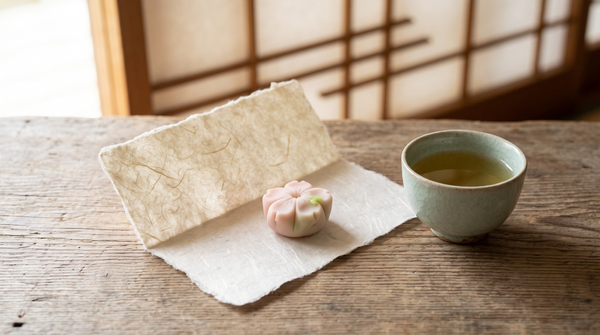
- In writing and gifts: letter paper and envelopes, gift wrap, and kaishi (the small folded papers used at tea).
- In craft and art: origami, calligraphy, printmaking, and dyed decorative papers.
- In conservation: as backing and repair paper for prints, books, and paintings the world over.
That range — humble and everyday on one end, museum-grade on the other — is exactly what makes washi worth knowing.
Is washi still made today?
Yes. Handmade washi is a living craft, not a historical one. In 2014, UNESCO added washi, craftsmanship of traditional Japanese hand-made paper to its Representative List of the Intangible Cultural Heritage of Humanity, recognizing three kozo-paper traditions still practiced by their communities: Sekishu-banshi in Shimane, Hon-minoshi in Gifu, and Hosokawa-shi in Saitama. In several of these towns you can still watch paper being made — and make a sheet yourself. That's the subject of the next article in this series.
FAQ
What is washi made of?
Washi is made from the long inner-bark (bast) fibers of plants — most commonly kozo (paper mulberry), and also mitsumata and gampi. These fibers are stripped, cleaned, and cooked rather than pulped like wood, which keeps them long and strong. That fiber length is what gives washi its characteristic thinness, strength, and durability.
Is washi the same as rice paper?
No. "Rice paper" is a loose, misleading nickname; washi is not made from rice. It is made from plant bast fibers such as kozo, mitsumata, and gampi. The confusion comes from Western shorthand for East Asian papers, but authentic washi contains no rice — the mulberry fiber is what does the work.
Why is washi so strong?
Washi is strong because its bast fibers are much longer than the short wood-pulp fibers in ordinary paper, and because traditional processing keeps those fibers intact. When long fibers interlock during hand-forming, they create a thin sheet that resists tearing and stays flexible for a very long time.
What is washi used for?
Traditionally, washi was used for shoji screens, sliding doors, lanterns, fans, umbrellas, and letters. Today it is also used for stationery and gift wrap, origami and other crafts, calligraphy and printmaking, and — because of its strength and stability — for conserving and repairing artworks and documents in museums worldwide.
How long does washi last?
Well-made washi can last for centuries. Its long, intact fibers and gentle, near-neutral processing resist the yellowing and brittleness that shorten the life of ordinary paper. This archival quality is exactly why conservators use traditional Japanese paper to repair and back fragile works on paper.
Is washi still made by hand today?
Yes. Handmade washi remains a living tradition. In 2014 UNESCO recognized three surviving kozo-paper crafts — Sekishu-banshi (Shimane), Hon-minoshi (Gifu), and Hosokawa-shi (Saitama) — and workshops in these regions still make paper by hand and offer visitors hands-on papermaking experiences.
Editor's note: ZenKiln writes about Japanese craft from the source — including firsthand visits with makers in Japan — and ships from Tokyo. This guide draws on materials from Japan's washi-producing regions and on UNESCO's record of the craft.