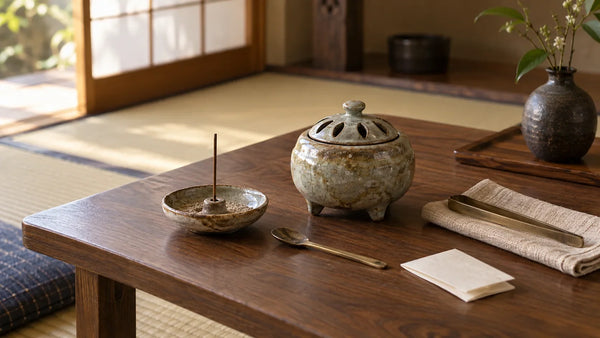
A line of powdered incense can show how much time has passed. In a jōkōban (常香盤), that line is folded into a compact path across a bed of ash. Light one end, and the ember follows the path slowly enough for someone to read its progress. The incense is the fuel; the pattern makes the burn readable.
We picked up issue no. 29 of Rekishikan Dayori (歴史館だより), the newsletter of the Minato City Local History Museum, at the museum itself. Its lead article, by one of the museum's curators, is titled Kaori de toki o shiru, "Knowing Time by Scent," and takes one surviving example as its subject: a jōkōban held by Jissōji temple in Tokyo's Minato ward.
What the Jissōji jōkōban is
Minato City lists the object as "Jōkōban (incense clock) associated with the Aizu Matsudaira family," owned by Jissōji and designated a city cultural property (historical material) on 27 October 2009. It is not open to the public. The city's record says the vessel is thought to have been offered to Jissōji with the Aizu Matsudaira family as patron. Minato City cultural property record.
Calling it an "incense clock" describes one use. In a temple, a jōkōban is first a vessel for keeping incense burning over a long period; the measurable burn is what makes it a timekeeper as well.
How the incense marked time
The working surface begins with ash. A mould presses a continuous, angular groove into it, and powdered incense, or makkō (抹香), fills the groove. Once lit at one end, the incense burns along the turns. The spent path shows how far the burn has travelled; the remaining path shows how far it has to go.
The Seiko Museum Ginza groups incense clocks with candle and oil-lamp clocks as combustion clocks. Because incense burns at a nearly steady speed, the length that has burned can be read as elapsed time. It is a way to follow a span of time, not a dial that simply tells you the hour.
Minato City's record adds a second method. Incense with different scents could be placed at even intervals along the path, so a change in fragrance would signal that time had passed. That idea gives the newsletter article its title. It does not show that the Jissōji vessel was always used this way.
Why the preparation matters
The newsletter shows the vessel and photographs its preparation: the ash is levelled, a mould is pressed into it, and powdered incense is added to the groove. Those photographs make the folded path easier to understand than a view of the closed vessel alone. Before a burn could mark time, someone had to prepare the ash, press the path, add incense and light one end.
A stick holder or cone burner is made for its specified form of incense. A jōkōban uses a prepared ash bed and a continuous line of powdered incense. The difference is in the working surface, not the size or shape of the container. If you use a contemporary ceramic burner, follow its maker's instructions rather than trying to recreate a historical clock inside it. For daily use and cleaning, see our guide to Japanese incense burner and holder care.
FAQ
What is a jōkōban?
A jōkōban (常香盤) is a Japanese vessel for burning powdered incense over a long period. A groove is pressed into a bed of ash and filled with incense, which is lit at one end. Because the ember moves along the path at a fairly steady pace, the burned length can be read as elapsed time, which is why it is also called an incense clock.
Could an incense clock tell time by smell?
It could. Minato City's cultural-property record notes that incense with different scents could be placed at even intervals along the path, so a change in fragrance marked the passing of time. This was one possible method; the record does not say every jōkōban, or the Jissōji example, was used that way.
Can you see the Jissōji incense clock?
Not in person at present. Minato City lists the Jissōji jōkōban as a designated cultural property that is not open to the public. The Minato City Local History Museum's newsletter, Rekishikan Dayori no. 29 (18 September 2026), describes and illustrates it.
Written by ZenKiln Editorial from Tokyo. Sources: Rekishikan Dayori no. 29 (Minato City Local History Museum, 18 September 2026), the Minato City cultural property record and the Seiko Museum Ginza. Cover illustration by ZenKiln; it does not depict the Jissōji object. Browse our incense holders.