Lucie Rie in Tokyo: A Guide to the 2026 Teien Museum Show
This summer, Tokyo gives lovers of ceramics a rare chance to spend time with Lucie Rie (1902–1995), one of the twentieth century’s quietly influential potters. Lucie Rie: Elegant Vessels Fusing East and West runs at the Tokyo Metropolitan Teien Art Museum from July 4 to September 13, 2026 — her first large retrospective in Japan in nearly a decade. We stopped by the museum’s garden in Shirokanedai just before the opening, and this guide covers who Rie was, why “East and West” is the right frame for her work, what the exhibition includes, and how to plan a visit.

Who was Lucie Rie?
Lucie Rie was born in Vienna in 1902 and first met the potter’s wheel as a student at the Kunstgewerbeschule, Vienna’s school of applied arts. By the 1930s she had already established herself as an artist, but in 1938 she was forced into exile and moved her practice to London, where she worked for the rest of her life. Her vessels are known for their delicacy and strength at once: graceful forms thrown on the wheel, patterns cut and laid in through sgraffito (scratched-through decoration) and inlay, and a deep vocabulary of glazes — bronze, manganese, pitted white, and volcanic surfaces among them.
Rie is usually described as a British studio potter, though her sensibility was shaped first in Austria. That double root — Viennese modernism reworked in a London studio — is part of why her bowls and bottles still feel both rigorous and warm.
Why “East and West”?
The exhibition’s subtitle is not marketing; it reflects the company Rie kept. The show places her work beside that of artists she was connected to: Josef Hoffmann, whom she met in Vienna, and — from her London years — Bernard Leach, Hans Coper, and the Japanese potter Hamada Shōji. Leach and Hamada are central figures of the Anglo-Japanese mingei (folk-craft) exchange, and seeing Rie among them reframes her cool European forms as part of a longer conversation with East Asian, and especially Japanese, ceramics.
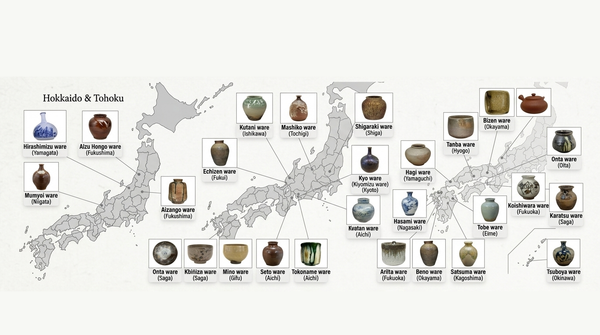
That conversation runs both ways. Rie’s work has been admired in Japan since the first full introduction of her ceramics at Sogetsu Kaikan in 1989, followed by major exhibitions in 2010 and 2015. If you want a sense of the Japanese side of that dialogue first, our guide to Japanese stoneware versus porcelain and our overview of Japan’s pottery regions are useful background.
What’s in the exhibition
This retrospective gathers Rie’s work from collections across Japan, including the Iuchi Collection now deposited at the National Crafts Museum in Kanazawa. The range is wide: an early bowl from around 1926; mature footed bowls, some with the inlaid pink lines and bronze “running” rims she became known for; fluted vases with pitted white glaze; a marbled vase; and a brown-glazed coffee set. The show also includes her ceramic buttons — made to earn a living during the war years, and now small, sought-after objects in their own right — alongside works by Hoffmann, Leach, Coper, and Hamada that set her practice in context.

The setting: an Art Deco residence from 1933
Half the pleasure here is the building. The Teien Art Museum’s Main Building was completed in 1933 as the residence of Prince Asaka, and it is one of Tokyo’s finest pieces of Art Deco architecture; the museum’s name, teien (庭園), simply means “garden.” The exhibition uses both the Main Building and the newer Annex, so Rie’s vessels are shown partly within actual rooms — mantelpieces, parquet, and Art Deco light fittings — rather than only in white galleries. The effect the museum is after is a dialogue between the quiet of her vessels and the quiet luxury of the house.
The grounds are worth arriving early for. On our visit the garden was at its mid-summer green: a stone lantern half-swallowed by maple, a black pine trained low over the lawn, and the calm modern lines of the building beyond. It is an unusually restful approach to a museum, and a fitting overture to ceramics that reward slow looking.

How to visit: dates, tickets, and photography
Lucie Rie: Elegant Vessels Fusing East and West runs July 4 – September 13, 2026 at the Tokyo Metropolitan Teien Art Museum, 5-21-9 Shirokanedai, Minato-ku. Hours are 10:00–18:00 (last admission 17:30), with extended Friday evenings on August 7, 14, 21, and 28 until 21:00 (last admission 20:30). The museum is closed on Mondays and on July 21, but open on Monday July 20. Entry is by timed slot, and tickets can be booked in advance through the museum’s official exhibition page.
Admission is ¥1,400 for adults, ¥1,120 for college students, and ¥700 for high-school students and visitors 65 and over; admission is free for middle-school students and younger. Photography is permitted in both buildings during this exhibition (with some works excepted), but only without flash, tripods, selfie sticks, or telephoto lenses, and for personal, non-commercial use — so enjoy shooting the rooms and garden, but plan to buy the catalogue for the pots.
If you can build a day around it, the related program is generous: a hands-on ceramic button-making workshop (August 22), a tactile tea program in the Kōka teahouse that includes a tea bowl by Rie (July 12), curator-led mini-lectures, and a lecture on Rie’s development from Vienna to London (July 19). The exhibition is also touring: after Tokyo it travels to the Abeno Harukas Art Museum in Osaka (December 26, 2026 – March 7, 2027), so a later viewing is possible if summer in Tokyo doesn’t suit.
Seeing Lucie Rie with Japanese eyes
For anyone who already loves Japanese ceramics, a Rie bowl needs no translation. The lift of a wheel-thrown foot, a glaze that pools and breaks over an edge, the honesty of an unglazed rim — these are the same pleasures a good chawan (茶碗, tea bowl) offers. Her bridging of European form and East Asian feeling is, in miniature, what a lot of contemporary Japanese studio work is doing too.
If the show sends you looking, a couple of our pieces make good companions: how tea pairs with glaze color, and what to look for when you handle a bowl. And if you want to live with that quality rather than only visit it, our hand-thrown work in the same spirit includes a Kutani matcha chawan, a wabi-sabi glazed tea bowl, and a lustered Mino-yaki cup — or browse the wider tea-lover’s collection.
FAQ
When and where is the Lucie Rie exhibition in Tokyo?
Lucie Rie: Elegant Vessels Fusing East and West runs from July 4 to September 13, 2026 at the Tokyo Metropolitan Teien Art Museum in Shirokanedai, Minato-ku. It uses both the Main Building and the Annex, and entry is by advance timed ticket. The exhibition is Lucie Rie’s first large retrospective in Japan in nearly ten years.
Who was Lucie Rie?
Lucie Rie (1902–1995) was a Vienna-born British studio potter regarded as one of the twentieth century’s most important ceramic artists. She trained in Vienna, went into exile in London in 1938, and became known for delicate wheel-thrown bowls and bottles, sgraffito and inlay decoration, and distinctive bronze, manganese, and pitted glazes.
How much are tickets, and do I need to book?
Admission is ¥1,400 for adults, ¥1,120 for college students, and ¥700 for high-school students and visitors aged 65 and over; it is free for middle-school students and younger. The museum uses a timed-entry system, so tickets are best purchased in advance from the official website.
Can you take photographs at the exhibition?
Yes, for this exhibition photography is allowed in both the Main Building and Annex, with some individual works excepted. Flash, tripods, selfie sticks, and telephoto lenses are not permitted, and photography is for personal, non-commercial use only; commercial use requires advance application to the museum.
Why is the exhibition held at the Teien Art Museum?
The museum’s Main Building was completed in 1933 as the Art Deco residence of Prince Asaka. Showing Rie’s vessels within these residential rooms, rather than only in plain galleries, lets the architecture and the ceramics speak to each other — both prize quiet, proportion, and surface over spectacle.
Is the exhibition traveling to other cities?
Yes. The exhibition tours Japan; after the Tokyo run it is scheduled at the Abeno Harukas Art Museum in Osaka from December 26, 2026 to March 7, 2027. Dates and details for each venue are confirmed by the organizing museums, so check the official listings before traveling.
Editor’s note: ZenKiln is a Tokyo-based studio focused on Japanese ceramics and the people who make them. We visit the shows we write about; exhibition details here follow the Tokyo Metropolitan Teien Art Museum’s official listing and should be confirmed there before you travel.