Kishu Lacquerware: Wakayama’s Everyday Craft Tradition
6 min readKishu lacquerware, or Kishu-shikki (紀州漆器), is a regional craft centred on Kuroe in Wakayama Prefecture. Its history includes practical wooden bowls and urushi finishes, while the modern industry also makes resin-based products with synthetic coatings. This entry in Urushi Studies follows our guide to Wajima-nuri and looks at the materials, finishes, and everyday uses behind the regional name.
Where Kishu lacquerware comes from
"Kishu" is the old provincial name for the region that today covers Wakayama Prefecture and the southern edge of Mie. The heart of the craft is Kuroe, a historic district now part of Kainan City, with related production across Wakayama City, Kimino Town, and the wider Kaiso district. Kishu is counted among Japan's major lacquerware centers, alongside Aizu in Fukushima and Yamanaka and Wajima in Ishikawa.
The craft's roots reach back roughly 600 years to the Muromachi period (1336–1573), when woodworkers settled in the Kishu area and began turning bowls from the cypress that grew there in abundance. A second, decisive wave arrived at the end of the 16th century. After warlord Toyotomi Hideyoshi burned down Negoro-ji temple in 1585, the lacquer craftsmen who had decorated the temple were scattered, and many resettled in Kuroe. They brought with them the technique that still defines the region.
Kishu lacquerware received Japan’s national Traditional Craft designation on February 6, 1978. The designation’s material and technique requirements should be distinguished from the full range of modern products sold by the region’s businesses.
Negoro-nuri: the technique that wears beautifully
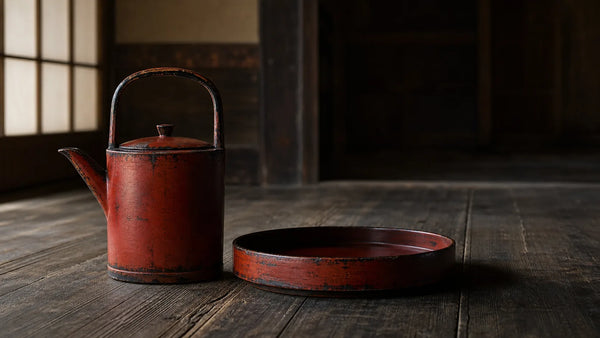
Negoro-nuri is associated with vermilion lacquer over a black base. Wear exposing black beneath red became an appreciated feature of older pieces, and contemporary makers may create the contrast deliberately. Expected wear is different from lifting lacquer, exposed damaged wood, or a crack that needs repair.

A red-over-black surface can change through handling, but not every finish develops in the same way. Tame-nuri offers another layered effect, using translucent lacquer over an undercolour. Read the maker’s finish description to understand how a particular piece was intended to look and age.
Kuroe-nuri, Shibuji bowls, and the persimmon undercoat
Before the name "Kishu-shikki" became standard, the craft was simply called Kuroe-nuri, after the town. Its historic mainstay was the Shibuji bowl — a wooden bowl finished with a tannin-based undercoat that made it sturdy and affordable enough for ordinary families. Kishu became known across Edo-period Japan as the country's major source for these practical bowls.

One groundwork method is genuinely a Kishu specialty: the persimmon-tannin undercoat (kaki-shibu). It seals the wood so it won't drink up the expensive top lacquer, improving the final finish while keeping the piece durable and reasonably priced. That balance of practicality and beauty is the through-line of the whole tradition.
The wood itself matters. Traditional Kishu bases are turned or joined from cypress (hinoki), horse chestnut (tochi), camphor, zelkova, and sen — woods chosen for stability under repeated coating and drying.
How a Kishu piece is actually made
Urushi is a coating made from the sap of the lacquer tree. It cures through chemical reactions under suitable humidity and temperature, rather than simply by evaporation. Traditional Crafts Aoyama Square uses a round tray as an example of a process involving 50–70 steps and about three months including curing; that is an example, not a timetable for all Kishu products.

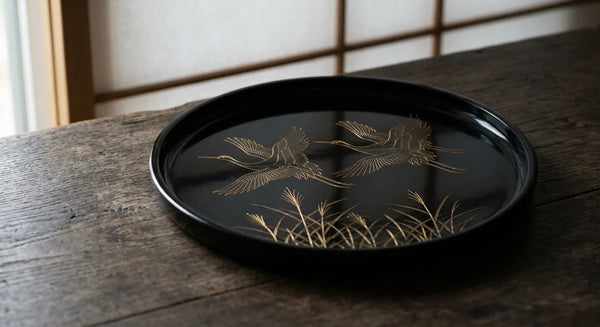
That work is traditionally divided among specialists: a woodworker, an undercoat maker, a lacquerer, and a maki-e artisan, each mastering one stage. Decoration, when applied, draws on a defined set of techniques — maki-e (sprinkling gold or silver powder onto wet lacquer to build a picture), chinkin (incising a design and rubbing gold into the cut lines), and shell inlay (raden and aogai-zaiku).
The Kishu Lacquerware Cooperative was established in 1947. Its official overview describes both traditional wooden lacquerware and modern resin products, including some designed for appliance use.
How to recognize and care for Kishu lacquerware
Check the base material and surface coating on the label or maker’s description. Weight, warmth, gloss, and visible grain can be enjoyable qualities, but they do not prove a natural-urushi finish. A Kishu regional name does not mean every object is wooden or coated with natural lacquer.

For traditional wooden urushi, wash gently by hand with a soft sponge or cloth, then dry promptly. Avoid prolonged soaking, abrasives, direct sunlight, and unapproved microwave, dishwasher, or oven use. Some modern resin-based Kishu products have different ratings: follow the specific product instructions. Our urushi lacquerware care guide explains the traditional-care routine. Repair may be possible, depending on materials and condition.
Frequently asked questions
What is Kishu lacquerware?
Kishu-shikki is lacquerware associated with Kuroe in Kainan City, Wakayama. Traditional examples use wood and natural urushi, while modern regional production also includes resin bases and synthetic coatings. Kishu’s traditional craft received national designation in 1978.
What is Negoro-nuri?
Negoro-nuri is associated with red lacquer over black. Black showing through worn red became an admired feature, and modern makers may create that effect intentionally. Flaking, damaged wood, or new cracks should be assessed separately from the intended finish.
How is Kishu lacquerware different from Wajima-nuri?
Both are major Japanese lacquer traditions, but they aim at different things. Wajima-nuri (Ishikawa) is famed for an exceptionally robust cloth-reinforced groundwork and high-grade decorative work. Kishu (Wakayama) is historically the home of practical, affordable everyday lacquerware — Shibuji bowls and the Negoro red-over-black finish.
Is Kishu lacquerware safe to use for food?
Use a product for food only when its intended use and maker’s instructions support it. Kishu products include different bases and coatings, so the regional name alone does not establish food or appliance suitability. Older, decorative, or damaged pieces need particular care before food use.
How long does a piece of Kishu lacquerware take to make?
It depends on the object and process. Traditional Crafts Aoyama Square gives a round-tray example with about 50–70 steps and roughly three months including curing. Simpler modern products and elaborate traditional work can have different schedules.
What woods are used for the base?
Traditional Kishu bases use cypress (hinoki), horse chestnut (tochi), camphor, zelkova, and sen — woods that stay stable through repeated lacquering and drying.
Sources: Kishu Lacquerware Cooperative describes the region’s history and modern product range; Traditional Crafts Aoyama Square explains the designated craft’s materials and processes. Japan Travel provides additional visitor context. For use and cleaning, follow the instructions supplied with the particular object.