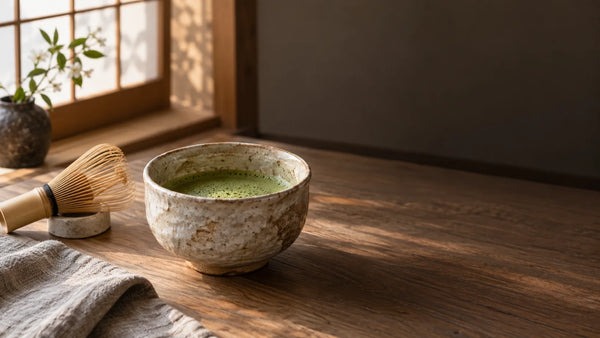
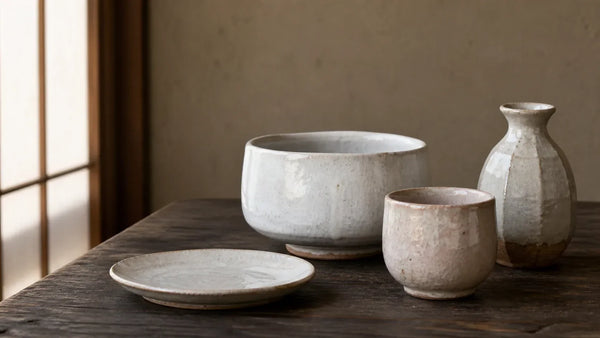
Fine crackle in a Hagi bowl may darken with use as tea and moisture enter its absorbent body. Hagi no nanabake (萩の七化け), the “seven changes”, names this developing appearance. Some bowls change noticeably; others show subtler differences.
What Is Hagi no Nanabake?
“Seven” is figurative here, rather than a fixed number of stages. The changes depend on the clay, glaze, use and care. A pale surface may become warmer or its crackle more visible, but there is no required colour sequence or timetable.

Porous clay and kannyū crackle
The Hagi ware cooperative describes how an absorbent body and fine glaze crackle, kannyū (貫入), allow components from use to enter. Clay composition, glaze fit and firing all contribute; the process cannot be explained by firing temperature alone.

Hagi includes loquat-toned transparent glazes and straw-ash white glazes, as well as other colours. Kogei Japan, the traditional-crafts directory, describes its material character. Modern workshops offer varied surfaces, so a new Hagi bowl need not be uniformly pale or matte.
Hagi's Place in Tea: “First Raku, Second Hagi, Third Karatsu”
“Ichi-Raku, ni-Hagi, san-Karatsu” (一楽二萩三唐津) means “first Raku, second Hagi, third Karatsu”. This familiar tea-world saying expresses a tradition of appreciation, not a universal quality ranking or price scale. See our Raku ware study for that tradition.

Hagi ware developed in present-day Yamaguchi under Mōri patronage after Korean potters were brought to Japan during the late-sixteenth-century invasions. Kilns were established in Matsumoto on the edge of Hagi’s castle town, distinct from Matsumoto in Nagano.
Some Hagi bowls have a deliberately cut or notched foot, kirikōdai (切り高台). Its shape is another feature to compare, but should not be used alone to identify the maker or date. Our foot-ring guide explains how to look safely at the underside.

Surface change and cleaning
Residue on the surface differs from changes within the glaze and body, though both can occur together. Enjoying nanabake does not mean leaving food deposits or mould uncleaned.
Follow the maker’s first-use and washing instructions. The Hagi cooperative advises washing off dust before use, using water or household detergent after use, and drying thoroughly before storage. Pre-wetting and any treatment for initial seepage depend on the situation. See our guide to tea stains and cha-shibu, while keeping the individual maker’s care directions first.

Tea Bowls at ZenKiln
The following Kutani bowls offer other surfaces to compare. They are not Hagi ware, and their decoration does not imply that they will develop nanabake:
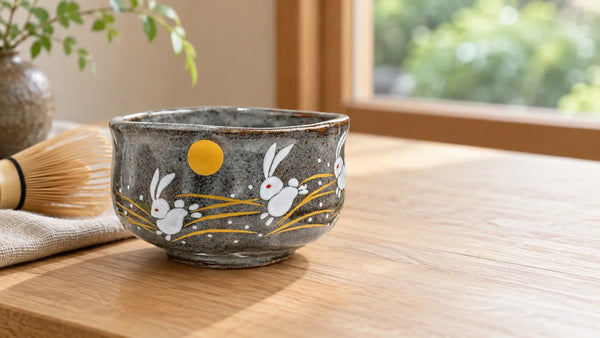
- Kōzan Hane-Usagi Chawan — white rabbits on a speckled grey surface.
- Iroe Yū Hana Floral Chawan — a painted floral design; check its stated body and finish.
- Iroe Yū Hidamari Cats Chawan — cat motifs on a Kutani bowl.
Browse Matcha Bowls for current availability. For context, read five tea-bowl traditions and the Hagi ware reference entry.
FAQ
Should you soak a new Hagi tea bowl before using it?
Use the maker’s instructions. The cooperative describes washing before first use and pre-wetting in particular serving situations. Do not apply a rice-water treatment to every bowl. Ask the maker about unexpected seepage, a new crack or other damage.
Can you put Hagi ware in the dishwasher or microwave?
Use the individual maker’s appliance ratings. If they are unavailable, wash gently by hand and dry thoroughly. Do not use a microwave to test an uncertain piece or to accelerate surface change.

Reference: the Hagi ware cooperative’s history and use guidance. Each product should be identified by its own maker, origin and care instructions.