Raku Ware: The Hand-Molded Tea Bowl of the Japanese Tea Ceremony
6 min readRaku ware is closely associated with hand-shaped tea bowls and the development of chanoyu in sixteenth-century Kyoto. Its forms invite attention to the rim, foot, and feel in the hand. This article introduces the tradition and distinguishes black and red Raku making, rather than defining all pieces by one firing temperature.
What Makes Raku Ware Different
Raku bowls are shaped and pared by hand. The maker controls the curve, wall thickness, rim, and foot with fingers and tools. Neither extreme irregularity nor one fixed thickness is required to recognise the hand-shaping tradition.
Removal from the kiln while hot is characteristic of traditional Japanese Raku making, but firing and cooling vary. Raku studio Waraku describes black Raku at around 1,200°C and red at around 800°C. Its specific kiln settings vary further. This is why “all Raku below 1,000°C” is misleading.
The Origins: Chōjirō, Sen no Rikyū, and Wabi Tea
Raku belongs to the sixteenth century — the Momoyama period — when the tea master Sen no Rikyū was refining a stripped-down, contemplative style of tea known as wabi-cha. Rikyū wanted a bowl that matched this aesthetic: humble, quiet, and free of ornament. According to long-standing tradition, he turned to a tile-maker remembered as Chōjirō, who produced hand-molded tea bowls suited to Rikyū's ideal. The Metropolitan Museum of Art describes Chōjirō as the figure "believed to be the founder of Raku ware," whose bowl-making was, by legend, supervised by Rikyū himself.
The name came later and from above. These early bowls were first called ima-yaki ("contemporary ware") and were also linked to the Juraku district clay they used. The warlord Toyotomi Hideyoshi is said to have granted the workshop a seal bearing the character for raku — meaning "enjoyment" or "ease" — and that character became the family name. The Raku lineage that grew from this moment still makes tea bowls today, generations later, making it one of the longest continuous ceramic families in Japan. We name only the figures that the historical record consistently supports — Rikyū, Chōjirō, Hideyoshi — and leave precise dates and generational claims to the museums and the family's own records.
Kuro-Raku and Aka-Raku: Black and Red
Kuro-raku and aka-raku are the classic black and red types. Black is generally fired hotter than red. Recipes and cooling methods vary by maker; “rapid cooling” should not automatically be read as immersion in water. For tea use, follow the piece’s purpose and your school’s practice rather than assign black only to thick tea and red only to thin.
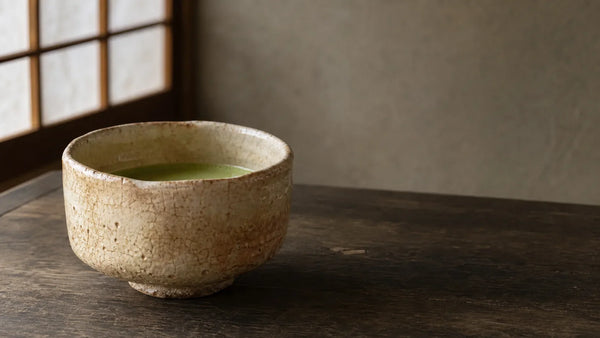
Neither color is decorative in the usual sense. There are rarely painted motifs on a classic Raku bowl; the interest lives in the silhouette, the way the glaze pools and crawls, the trimmed foot, and the marks left by the potter's hands and tongs. A Raku bowl asks to be turned slowly and read, not admired from across a room.
How Raku Embodies Wabi-Sabi
Raku offers a distinct feel through form, body, and glaze. A porous body can influence heat transfer, but any bowl containing hot liquid can become too hot to hold. Check carefully and use a comfortable temperature rather than relying on the word Raku as protection against burns.
Subtle changes in a curve, a trimmed foot, or the glaze surface can make close looking rewarding. These qualities are not exclusive to one ceramic tradition or proof of a particular manufacturing method.
Bringing the Raku Spirit Home: ZenKiln Matcha Bowls
For a contemporary matcha bowl, the Kutani examples below offer different forms and decorated surfaces. They are a separate tradition from Raku; choose using the individual maker, material, dimensions, and care information.
Compare the Kutani Matcha Chawan by Kōzan Kiln — Hane-Usagi Leaping Rabbit Moon Bowl with the Hidamari Rabbit Kutani Matcha Chawan by Iroe Yū Workshop, Iroe Yū Hana Floral Wabi-Sabi Chawan, and Iroe Yū "Hidamari" Cats Tea Bowl. Each has its own materials and decoration. Nezumi-iro is a grey colour description; it does not by itself identify an ash-glaze recipe.
You can browse all of them in the Matcha Ritual collection. None of these is Raku, and we would never call them that — but each one rewards the same slow, in-the-hand attention that Raku first taught the tea world to value.
For related reading, explore Five Tea-Bowl Traditions in Japanese Tea Culture, How to Hold a Chawan, and Reading a Chawan's Foot Ring.
Frequently Asked Questions
What is Raku ware?
Raku is a Japanese ceramic tradition closely associated with hand-shaped tea bowls and sixteenth-century Kyoto tea culture. Black and red wares have different firing approaches, and the name should not be reduced to one low-temperature definition.
Why is Raku not thrown on a wheel?
Hand-shaping was a deliberate aesthetic choice. The wabi style of tea that Raku was made for valued humility, irregularity, and the visible touch of the maker. Building a bowl by hand produces subtle asymmetry and a record of the potter's fingers that a perfectly thrown bowl cannot, which is exactly what tea practitioners wanted.
What is the difference between kuro-raku and aka-raku?
Kuro-raku is the black type and aka-raku the red type. Black is generally fired hotter: Waraku cites roughly 1,200°C and 800°C respectively. Exact recipes and cooling processes depend on the maker; colours do not impose a universal thick-tea or thin-tea rule.
Is Raku ware safe to use for everyday matcha?
Choose a specific bowl made and sold for drinking matcha, with clear care instructions. Age, condition, glaze, and intended use matter; “authentic Raku” alone is not a food-use guarantee. Handle hot tea carefully, wash as directed, and dry fully. Our matcha bowl and whisk care guide gives general guidance; decorative studio-raku pieces may be unsuitable for drinking.
Does ZenKiln sell Raku tea bowls?
The Kutani bowls linked in the Matcha Ritual collection are not Raku. Check the current product’s stated tradition and maker if you are looking specifically for a Raku bowl.
Sources: the Raku Museum’s history and Waraku’s making and care information, linked above. The contemporary Kutani bowls linked here are separate products, not Raku-family works.