Japanese Wedding & Newlywed Gifts: Ideas and Etiquette
5 min readWhen choosing a gift for a wedding in Japan, first check the couple’s plans and whether you are attending. Cash gifts are customary at many receptions; a physical gift can be a separate gesture or something agreed with the couple. These ceramic and glass ideas focus on objects they can use together.
Why paired ceramics suit a wedding
Meoto (夫婦, “married couple”) sets pair related cups or bowls, sometimes in different sizes. They can make a thoughtful wedding or anniversary gift. Choose the capacities and colours that suit both people rather than assigning them by gender.
Two cups, a glass pair, or a teapot with cups can suit a shared routine. A single serving piece can be just as appropriate when it matches the couple’s interests and space.

What to give: seven pieces couples actually use
Check the product pages for current prices, available options, and included boxes. Presentation packaging varies by item.
A pair of cups, for the everyday toast
Compare the Kutani wine-cup pair from Bizan kiln with the Edo Kiriko cut-glass pair in red and blue. They offer different materials and decorative effects for a shared drink; choose by both recipients’ preferences.
A tea set, for the quiet mornings
The Arita and Hasami tea set features takarazukushi (宝尽くし), an auspicious treasure motif. Check the product page for the pieces and box included. Our beginner's tea set guide explains the equipment and a starting recipe for sencha.
A sake set, for the celebrations
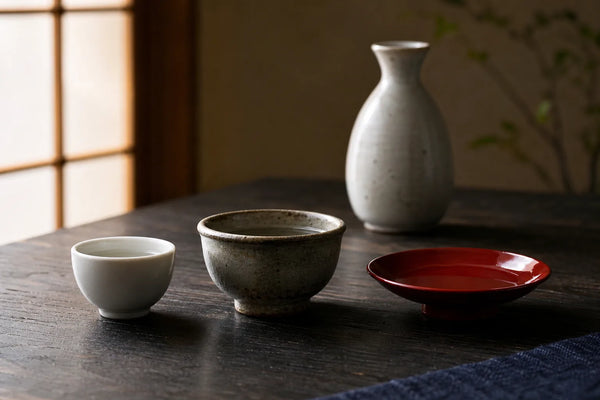
The Kutani sake set from Eizan kiln offers a decorated serving option. Compare its included pieces and care with the glass set shown below, especially if the couple prefers chilled sake.

A donabe, for the shared table
A rose-decorated donabe can suit a couple who enjoys shared cooking. Confirm its actual capacity, stove compatibility, weight, and care. A numbered size alone does not establish how many people it will serve.

A cup-and-saucer or mug pair, for the desk and the kitchen
The Kutani mug pair offers another everyday option. Browse the Wedding & Anniversary Gifts collection for pieces to compare by use, budget, and presentation.
Japanese wedding gift etiquette: the money question
If you are invited to a wedding in Japan, the expected gift is usually money, and the object is a separate, optional gesture. Here is the part guests ask about most.
Goshūgi (ご祝儀) is a congratulatory cash gift, usually presented in a shūgi-bukuro envelope for a wedding. The All Japan Ceremonial Mutual Aid Association’s guidance cites its 2017 survey, in which ¥30,000 was the most common amount for friends, with different patterns for relatives. This is a dated reference, not a universal current tariff. Family expectations, region, attendance, and the couple’s arrangements matter; there is no rule that relatives simply double a friend’s amount.
The envelope matters too. A wedding shūgi-bukuro is tied with mizuhiki (水引), cords of stiffened washi paper, in a musubikiri knot, one tied so it cannot be pulled undone. That "cannot be retied" is the point: a wedding is a once-in-a-lifetime wish, not something you hope to repeat. Save the easily-retied bow for gifts you are happy to give again.

If you are attending, do not assume a physical gift replaces customary goshūgi. Check with the couple or family. If you are not attending or are sending from abroad, ask what would be welcome and arrange an object or another form of congratulations accordingly.
Gifts for a Japanese wedding anniversary
The same pieces carry anniversaries well, and Japanese decoration gives you a vocabulary of good wishes to choose by. Look for longevity and fidelity motifs: the crane and tortoise (tsuru-kame), and pine-bamboo-plum (shō-chiku-bai), all standard on celebratory ware. A paired set for a first anniversary, a finer gold-painted Kutani piece for a tenth: the couple reads the intention in the motif, not only the note.

Buying Japanese gifts from outside Japan
For a dated occasion, check stock, included packaging, dispatch information, and the delivery estimate for the destination before ordering. Tell us the occasion and budget if you would like help comparing the listed pieces.

FAQ
What is a good Japanese wedding gift for a couple?
A pair of cups, glasses, or a tea set can suit a shared routine. A donabe or another serving piece can also work if it fits the household’s cooking equipment and space. Check the couple’s preferences and any gift arrangements first.
How much goshugi money should I give at a Japanese wedding?
¥30,000 is a commonly cited friend’s gift in the association’s 2017 survey, but appropriate amounts vary by relationship, family, region, and attendance. Do not calculate a relative’s gift by doubling that figure. Ask the family or another guest if you are unsure, and follow the couple’s stated arrangements.
Can I give a physical gift instead of goshugi money?
Only if it suits the couple’s arrangements. At a reception where cash gifts are customary, an object should not automatically replace goshūgi. For a gift sent separately or from abroad, ask what they would welcome.
Why are paired cups a traditional wedding gift in Japan?
Matched pairs made in slightly different sizes are called meoto (夫婦, "married couple"). Giving a meoto set at a wedding expresses two people joining one household and sharing a table daily. The pair is used together, so the gift is felt every day rather than displayed once.
What Japanese gift suits a wedding anniversary?
Choose by motif. Longevity and fidelity designs such as the crane and tortoise (tsuru-kame) or pine-bamboo-plum (shō-chiku-bai) are traditional for celebrations. A paired set suits an early anniversary; a finer gold-painted Kutani piece suits a landmark year like a tenth or twenty-fifth.
Source: the All Japan Ceremonial Mutual Aid Association’s wedding guidance, linked above. Its monetary examples refer to a 2017 survey. The objects here are gift suggestions; they do not determine the etiquette of a particular wedding.