Lucie Rie at Teien: Form, Glaze and the East–West Exhibition
7 min readLucie Rie: Elegant Vessels Fusing East and West brings her ceramics to the Tokyo Metropolitan Teien Art Museum for July 4–September 13, 2026. This companion to our guide to the show considers the exhibition’s themes through published museum material. It is a source-based reading of her work and the setting, rather than an account of a personal visit.
Rie (1902–1995) was born in Vienna, trained at its arts-and-crafts school, and by her thirties was an established artist. Then, in 1938, antisemitism forced her into exile in London (the University of Cambridge's Kettle's Yard tells her story well). The exhibition — her first large-scale retrospective in Japan in nearly a decade — gathers her work from Japanese collections, led by the Iuchi Collection deposited at the National Crafts Museum, and sets it alongside the people she was bound to: Josef Hoffmann in Vienna; Bernard Leach, Hans Coper, and Hamada Shōji in Britain. The result is less a monograph than a map of one artist's East–West coordinates.
A house and a potter, both born of the 1920s
The museum's Main Building was completed in 1933 as the residence of Prince Asaka, and it is one of Tokyo's great Art Deco interiors — glass reliefs by René Lalique, decorative schemes by Henri Rapin, the whole vocabulary the prince absorbed during his years in Paris in the 1920s. The very phrase "Art Deco" comes from the 1925 Paris International Exposition of Modern Decorative and Industrial Arts, which the prince and princess visited.
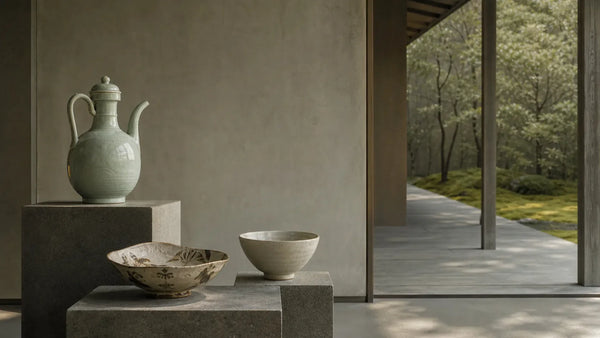
The museum connects Rie and the former residence through the decorative arts of 1920s Europe, including the 1925 Paris exposition. Its stated approach places the artist’s restrained vessels in dialogue with the Art Deco architecture. That contrast offers a useful question for looking: how does an elaborate room change the way a simple ceramic form is seen?

From Vienna to London — by way of a button
The button story reveals how Rie adapted to wartime London. As she rebuilt her career, fashion work provided income and a setting for experiments in small forms and glazes. The V&A’s biographical account also notes that she continued making pots alongside buttons.
Rie worked on glass buttons and developed her own ceramic button production. Hans Coper joined her studio in 1946 and became a lasting friend and collaborator. Her buttons later attracted Issey Miyake, who used wartime examples in a 1989 collection.
The V&A’s button history distinguishes Fritz Lampl’s Vienna firm Bimini from its London name, Orplid. Rie worked for Orplid before developing her own stoneware buttons at Albion Mews. Small shapes offered room for varied colour, texture, and ways of forming clay.
How to read a Lucie Rie vessel
When looking at a Rie vessel, compare its silhouette with the surface up close. Incised lines, inlaid colour, and glaze texture can alter the impression of a seemingly simple wheel-thrown form.
Sgraffito is decoration made by scratching through a surface layer to reveal a contrasting color beneath. Inlay is its inverse — incising lines into the clay and filling them with a slip of another color. Rie combined both with her glazes: manganese for near-black, a metallic bronze, a pitted "volcanic" surface that bubbles as it fires, and fine pink lines banded around white.
The V&A catalogues stoneware buttons dated around 1940–45, so Rie’s London work before 1948 cannot all be described as low-fired earthenware. Materials and firing histories should be checked object by object. Our guide to stoneware versus porcelain explains the terms without turning them into a simple chronology of her career.
The East–West thread — Leach, Coper, and Japan
Why show a British-Austrian potter in Japan, and why fold in Japanese ceramics? Because Rie stood inside a conversation that was already crossing oceans. The pivot is Bernard Leach, who spent his early career in Japan from 1909, befriended Yanagi Sōetsu and the Shirakaba literary circle, learned raku under the sixth Ogata Kenzan, and in 1920 returned to England with Hamada Shōji to build a Japanese-style climbing kiln at St Ives. The studio-pottery world Rie entered in London was already thinking with Japan's Mingei (folk-craft) movement in the back of its mind.
Rie was never Leach's disciple — their sensibilities differed sharply — but the show's inclusion of Leach's slipware and Coper's austere "Cycladic" forms lets you triangulate her position: warmer and more architectural than Coper, cooler and more urban than Leach. There is even a Western bookend to the Eastern one: in the early 1960s, Wedgwood invited Rie to design jasperware cups and saucers, setting her modern hand against the firm's neoclassical cameo tradition. Fusing East and West, the exhibition's subtitle promises — and it means the phrase literally.
If you go
The Tokyo exhibition’s published run is July 4–September 13, 2026. Its August late openings are now past. Consult the official exhibition page for the dated schedule and images to view. Permission to view or photograph an image is not permission to reproduce it commercially.

The July lecture and August button workshop have passed. The museum lists an Osaka presentation at Abeno Harukas Art Museum for December 26, 2026–March 7, 2027. Our preview guide records the Tokyo arrangements; check the Osaka museum for that venue’s current details.
Holding the idea at home
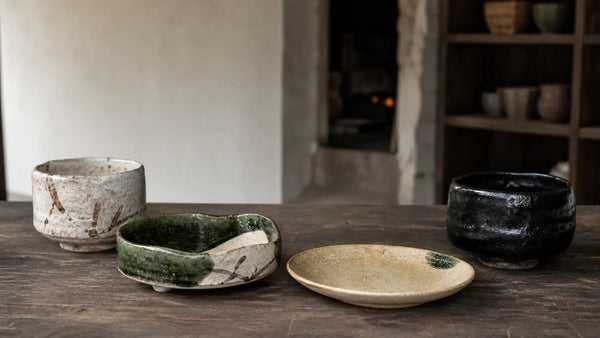
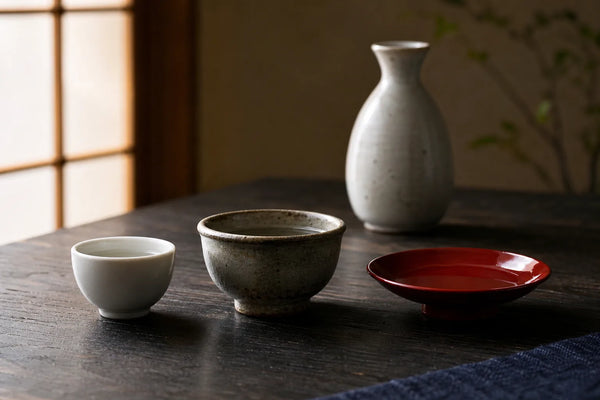
The exhibition’s themes invite attention to form, glaze, and incised line in other objects too. A Kutani matcha bowl in a soft, wabi-sabi grey glaze, a porcelain vase in a flowing colored glaze, and a Shigaraki bud vase raked with fine kushi-me lines offer visual comparisons across different traditions. They are not works by Rie or evidence of a direct lineage. Browse gifts for tea lovers or drinkware for their individual product details.
FAQ
Where and when is the Lucie Rie exhibition in Tokyo?
Lucie Rie: Elegant Vessels Fusing East and West runs at Tokyo Metropolitan Teien Art Museum (Main Building and Annex, Shirokanedai, Minato-ku) from July 4 to September 13, 2026. It is open 10:00–18:00, closed Mondays except July 20 and also closed July 21, with late openings until 21:00 on the four Fridays of August. Entry is by timed reservation.
Why is the show held in an Art Deco house?
The museum's Main Building was completed in 1933 as the residence of Prince Asaka, an Art Deco interior inspired by his time in 1920s Paris. The exhibition frames Rie's spare modern vessels in deliberate dialogue with these ornate rooms — and notes that both the house and the young Rie trace back to the same 1920s European decorative-arts moment, including the 1925 Paris exposition that named Art Deco.
What techniques is Lucie Rie known for?
Rie threw her forms on the wheel and decorated them mainly with sgraffito (scratching through a surface to reveal a contrasting layer) and inlay (filling incised lines with colored slip). She is celebrated for distinctive glazes — manganese, bronze, pitted "volcanic" surfaces, and fine pink banded lines — and for flaring bowls and bottle forms of extreme economy.
Who were Bernard Leach and Hans Coper to Lucie Rie?
Bernard Leach was a leading British potter, shaped by years in Japan and the Mingei folk-craft movement, whom Rie met after reaching London. Hans Coper was a fellow refugee who joined her studio in 1946 to help make buttons, learned pottery there, and became her lifelong creative partner. The exhibition shows work by both alongside Rie's.
Can you take photos in the exhibition?
The museum’s policy for this exhibition allows personal, non-commercial photography with exceptions for certain works and displays, and prohibits specified equipment including flash and tripods. Follow staff instructions. Commercial photography requires advance application; online exhibition images also require appropriate permission for reproduction.
Sources: the Teien Museum’s exhibition page and the V&A’s research on Rie’s buttons, linked above, alongside Kettle’s Yard’s biographical account. Updated September 13, 2026. This article analyses published material and does not claim a documented personal visit.