Kutani history at a glance
- 1655: the traditional date for the Kutani village kiln. Ko-Kutani-style porcelain was also produced in Arita.
- 1807: the Kasugayama kiln opened in Kanazawa as part of the nineteenth-century revival.
- 1824–1831: Yoshidaya revived aote decoration; its style continues in contemporary work.
- Meiji era: international exhibitions and overseas trade widened Kutani’s audience.
Shop the pieces from this guide ↓ · Kutani Ware
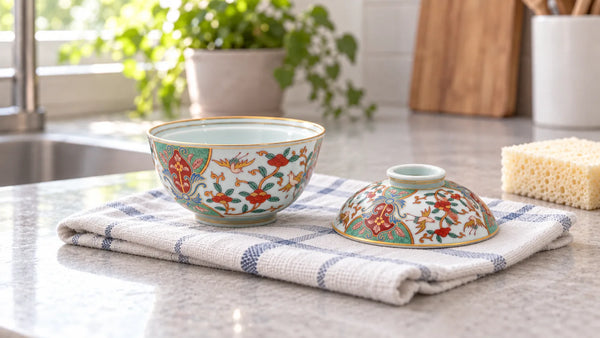
Cover: an AI-assisted table scene based on product photographs of contemporary Hakuhō wild-grape and Seikō-gama mejiro pieces. It does not depict historical Kutani objects.
Kutani’s history brings together seventeenth-century porcelain, nineteenth-century revival kilns, and Meiji export decoration. It also includes an important distinction: the history of kilns in Kutani village is not identical to the production history of every object called Ko-Kutani.
The sections below follow the early production, nineteenth-century revival and export trade. Our beginner's guide to Kutani ware introduces the decorative terms and contemporary range.
Chapter one: Kutani village and Ko-Kutani-style porcelain
Regional histories traditionally date the Kutani village kiln to 1655 under Daishōji patronage, with techniques introduced from Arita. Separately, archaeological research identifies Ko-Kutani-style porcelain production in Arita. The name of the style should therefore not be treated as proof that every surviving Ko-Kutani object was made in Kutani village.
The Arita History and Folklore Museum discusses Ko-Kutani-style production at Arita kiln sites. Its account makes the Kyushu connection central to the history of early enamelled porcelain. Our Arita ware guide provides the broader background. A particular object’s attribution needs more than its colour palette.
Aote (青手) uses green, yellow, purple and dark blue without red, often covering much of the surface. Five-colour gosai work includes red. The Ritsumeikan University Art Research Center discusses the later appreciation of Ko-Kutani, including Kitaōji Rosanjin’s response to it.

The early Kutani village kiln ceased production for reasons that remain uncertain. KOGEI JAPAN mentions a smuggling theory, but it is not an established explanation.
Chapter two: the revival kilns, 1807 to the 1860s
The nineteenth-century revival included the Kasugayama kiln in Kanazawa from 1807, guided by Aoki Mokubei, followed by other regional kilns. Yoshidaya later became especially associated with reviving the aote palette; it was part of this wider revival rather than its sole beginning.
Toyoda Den'emon, a Daishōji merchant using the Yoshidaya name, founded a kiln in Kutani village in 1824 to revive aote decoration. It moved to Yamashiro Onsen in 1826 and the business closed in 1831. The Kutani-yaki Kiln Museum explains that the site continued in use under later operators until 1940; the Kutaniyaki Art Museum describes Den'emon’s financial difficulties.

What came after Yoshidaya
Miyamotoya Uemon reopened the Yamashiro kiln after Yoshidaya closed. Its decorator Iidaya Hachirōemon became associated with fine red akae painting. The later Matsuyama kiln operated under Daishōji patronage. In the 1860s, the Kyoto Eiraku line contributed a red-and-gold idiom, while Kutani Shōza combined techniques in designs that influenced export work. The table distinguishes these names and periods:
| Style | Japanese | Palette and character | Period |
|---|---|---|---|
| Ko-Kutani aote | 古九谷 青手 | Green, yellow, purple and dark blue without red; often extensive surface coverage | Mid-17th to early 18th c. |
| Ko-Kutani gosai | 古九谷 五彩手 | All five colors; landscapes, birds and flowers | Mid-17th to early 18th c. |
| Mokubei-fū | 木米風 | Five colors; the Kanazawa revival style guided by the Kyoto painter Aoki Mokubei | From 1807 |
| Yoshidaya-fū | 吉田屋風 | Four-colour aote revival without red | 1824 to 1831 kiln; style continues |
| Iidaya-fū | 飯田屋風 | Akae: fine red line work covering the surface, gold accents | 1830s onward |
| Eiraku-fū | 永楽風 | Red ground with gold (kinrande) | 1860s |
| Shōza-fū | 庄三風 | Combines earlier techniques; dense, polychrome, gold; export base | Late Edo into Meiji |

Chapter three: "Japan Kutani" and the export era
Japan’s treaty-port trade expanded in the late Edo period, before the Meiji Restoration. Kutani’s international profile grew through exhibitions including Vienna in 1873, Philadelphia in 1876, and Paris in 1878. “Japan Kutani” became associated with its overseas trade, while production extended across southern Ishikawa.
Meiji export wares include richly detailed red-and-gold designs, dense figure painting and pieces marked “Japan Kutani”. New colourants and techniques widened the decorative range. Our Kinrande article explains gold-brocade decoration in Japanese porcelain.

Export-period work varies greatly in condition, execution, and quality. A base mark alone cannot establish age, maker, authenticity, or value; an important antique purchase merits documented provenance and specialist assessment.
Chapter four: Kutani today
Kutani became a nationally designated traditional craft in 1975, and the Kutani village kiln site received national historic-site designation in 1979. Contemporary production continues across southern Ishikawa. Hanasaka porcelain stone is an important regional material, and overglaze decoration remains central to the tradition.

Contemporary makers work with historical styles as well as new designs: aote palettes, floral hanazume and fine red akae can all appear in current production. Tea bowls may use bodies other than porcelain. Our profile of the Asakura Isokichi family follows developments in twentieth-century studio work.
A modern “Yoshidaya-style” piece refers to a decorative tradition, not the original nineteenth-century kiln. Check the stated body and care for the individual object: an aote palette does not establish earthenware, porcelain, absorbency, or appliance compatibility.
Kutani ware in the ZenKiln catalogue
These contemporary pieces show how Kutani decoration appears on tableware today. Each product page gives the material, dimensions, set contents and care; a decorative style alone does not establish the body or technique.
- Hakuhō Kiln Yoshidaya wild-grape square plate set — a contemporary interpretation of Yoshidaya-style wild-grape decoration.
- Kutani kinhanazume serving bowl — flowers and blue butterflies with gold-coloured accents; the base bears a red Kutani Tenzan mark.
- Eizan Kiln peacock and peony sake set, a tokkuri and two sakazuki in kinrande, the red-and-gold brocade idiom.
- Iroe Yū Workshop Hana matcha chawan — floral decoration on a grey-toned tea bowl.
- Seikō-gama mejiro rice bowl — a 10.5 cm porcelain bowl decorated with three white-eye birds.

The full range is in the Kutani Ware collection. For the wider map, Japan's pottery regions places Kutani alongside Arita, Seto, and the Six Ancient Kilns.
Editor’s note: This guide distinguishes regional kiln histories from the attribution of surviving objects, using the museum and research sources linked above.
Shop this guide


Selected pieces from the story
 Hakuhō Kutani Wild Grape Square Plates, Set of 5A contemporary Yoshidaya-style wild-grape design.
 Kutani Peacock & Peony Sake Set | 260 ml Bottle & 2 CupsA tokkuri and two sakazuki in the red-and-gold kinrande idiom.
 Kutani Mejiro Bird Rice Bowl by Seikō-gama, 10.5 cmA porcelain rice bowl decorated with three white-eye birds.