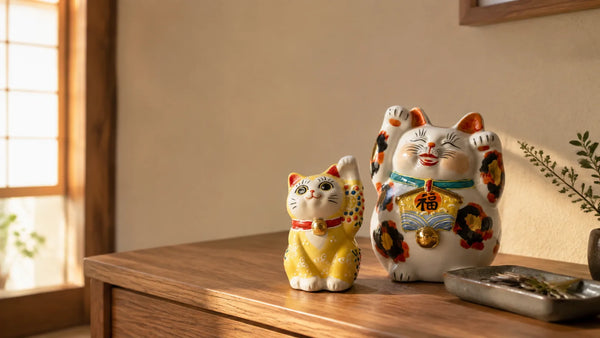
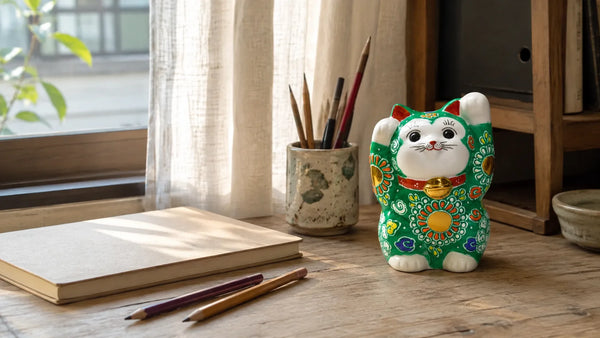
Tokoname ware (常滑焼) comes from the Chita Peninsula in Aichi. It was a major medieval pottery centre and is now well known for red-clay teapots, lucky-cat figures, and other ceramics. These products belong to one region, but differ in bodies, glazes, decoration, and use.
Medieval jars and a coastal industry
Production developed around the late Heian period, roughly 1100, in kilns on the Chita Peninsula. Storage jars, bowls and mortars were major products; clay pipes and roof tiles later became important too.
Early yakishime wares were high-fired without an applied glaze, though wood ash could melt on their surfaces. Tokoname and nearby Seto developed from the older Sanage kiln tradition. Read the Seto ware guide for its applied glazes and our map of Japan’s pottery regions for the wider context.
The largest of the Six Ancient Kilns
Tokoname belongs to the Six Ancient Kilns with Bizen, Echizen, Seto, Shigaraki and Tamba. The Japan Heritage project describes it as the largest production area in that grouping. The Met’s record of a sixteenth-century jar also identifies Tokoname as a leading medieval producer by volume.
Local clay and coastal access supported this scale. Iron-rich deposits formed in the ancient Tokai Lake basin provided material suitable for large high-fired vessels. Remains of roughly 3,000 medieval kilns have been identified across the peninsula.
Sea routes carried heavy vessels to distant markets. Tokoname pots have been excavated from Hiraizumi in the north to Hakata in the south. They held water, grain, sake, oil and other materials.

In the yoriko coil-building method, a potter carries a thick coil over the shoulder and walks around the growing vessel, adding clay without rotating the pot on a wheel. For related surfaces and material terminology, see our Shigaraki ware guide and stoneware and porcelain guide.

Shudei clay and kyusu teapots
Small teapots became important as sencha drinking spread in the late Edo period. In the mid-nineteenth century, techniques related to Chinese Yixing clay teapots were adapted to local material. The iron-rich, unglazed red body known as shudei (朱泥) is now closely associated with Tokoname.

Tokoname’s official craft description discusses the red clay’s heat retention and a reported softening of tea’s astringency. The result still depends on the individual pot, water, leaves and brewing method. A side handle, set roughly at right angles to the spout, is common but does not by itself identify Tokoname production.
When comparing kyusu, look at the lid fit, strainer and how comfortably you can pour. Our beginner’s tea set guide covers equipment, and the Shizuoka green tea brewing guide provides starting recipes.
Glazed porcelain and unglazed clay offer different surfaces for brewing and cleaning. Both can make useful teapots. Compare the material, capacity, strainer, and care of the actual piece rather than choosing by a guaranteed flavour effect.

How Tokoname became the town of lucky cats
The Tokoname Tourism Association records lucky-cat production before the Second World War and the development of a familiar rounded form from the late 1940s into the mid-1950s.

Tokoname lucky cats include rounded bodies, large eyes, varied decoration, and coin-bank designs. Compare their decoration with Kutani. The forming and painting method depends on the model; an appearance of shaded colour alone does not prove it was airbrushed.
If you want the folklore rather than the manufacturing history, our guide to what the maneki neko really means covers the origin legends, and maneki neko color meanings explains what each color is said to invite. For the Seto side of the figurine tradition, our Yakushi Kiln guide covers a hand-painted Seto maker.
Tokoname ware in the ZenKiln catalogue
The Tokoname cat below can be compared with Seto figures and porcelain teapots from other regions:
- Tokoname Maneki Neko Coin Bank, 23 cm — a white cat with a large gold-coloured koban bearing 千万両 and a coin slot. Check the footprint and weight before choosing a counter or shelf.
- Seven Lucky Cats Treasure Ship, Seto ware — from Aichi's other ancient kiln. Seven cats crowd a takarabune treasure ship, which folds the Seven Lucky Gods motif into the cat tradition.
- Large Lucky Cat Coin Bank, 23 cm — a Seto coin bank in the onegai wishing pose, paws pressed together instead of one raised. A useful comparison piece if you want to see how two figurine towns handle the same object.
- Kutani Bird Kyusu, 350 ml — a glazed porcelain teapot with a built-in strainer and painted white-eye birds.
- Arita Sakura Kyusu, 400 ml — a porcelain teapot with an iridescent lid and blossom-shaped finial.

Browse the rest in Maneki Neko & Lucky Cats and Teapots & Kyusu.
Frequently asked questions
How do I care for unglazed Tokoname pottery?
Care depends on the object and finish. Follow the maker’s instructions for an unglazed teapot, rinse after use, and dry fully. A painted or electrically operated lucky-cat figure needs different care and should not be washed like a teapot. Check the individual listing.
Researched by the ZenKiln editorial team in Japan. Historical sources are listed below; use each product’s description for its maker, materials and care.
Sources: Japan Heritage, The Six Ancient Kilns: Tokoname · City of Tokoname, Tokoname Ware · The Metropolitan Museum of Art, Large Storage Jar (Ōtsubo), Tokoname ware