Unglazed red Tokoname kyusu beside a Tokoname maneki neko coin bank and cup of green tea.

Tokoname Ware: Red Clay, Kyusu, and Japan's Lucky Cats

10 min read

Tokoname ware (常滑焼, Tokoname-yaki) is Japanese pottery from the Chita Peninsula in Aichi Prefecture, and it holds an unusual double title: it was the largest of Japan's Six Ancient Kilns, and it is the town that made the beckoning cat a national object. Most people meet Tokoname twice without realizing it. Once as a red-clay teapot that makes green tea taste rounder, and once as a lucky cat sitting by a shop register.

This guide covers where Tokoname ware comes from, why its iron-rich clay matters for tea, how a medieval jar kiln became the country's lucky-cat capital, and which pieces in our shop connect to that lineage.

What is Tokoname ware?

Tokoname ware is stoneware made in and around the city of Tokoname, on the western coast of the Chita Peninsula in Aichi Prefecture. Production began in the late Heian period, around the year 1100, in simple sloping anagama kilns dug into the local hills. For most of its history the kilns turned out utilitarian goods rather than art objects: large storage jars, bowls, mortars, and later clay pipes and roof tiles.

Tokoname ware in brief. Tokoname ware is unglazed high-fired stoneware from Tokoname, Aichi Prefecture, and one of Japan's Six Ancient Kilns. It has been fired continuously since about 1100. Its clay is unusually rich in iron, which turns the body red-brown and allows firing at lower temperatures than most stoneware. Today the tradition is best known for two things: red-clay kyusu teapots and maneki neko figurines.

The technique that defined early Tokoname is yakishime, high-fired stoneware left unglazed, so the surface is finished by fire and falling wood ash rather than by a glaze recipe. That puts Tokoname on the opposite side of a technical divide from its neighbor Seto, which built its reputation on deliberately glazed pottery. Both kilns descend from the older Sanage kilns near Nagoya, and both sit in Aichi. Our Seto ware guide covers the glazed half of that family, and our map of Japan's pottery regions puts both in wider context.

The largest of the Six Ancient Kilns

Tokoname is one of the Six Ancient Kilns (Rokkoyō), the group of medieval pottery regions recognized together as a Japan Heritage: Bizen, Echizen, Seto, Shigaraki, Tamba, and Tokoname. Among the six, Tokoname was the biggest. The Japan Heritage project describes it as the largest production area of the Six Ancient Kilns, and the Metropolitan Museum of Art puts it plainly in its catalogue entry for a sixteenth-century Tokoname storage jar: among all the medieval kilns, those at Tokoname manufactured the greatest volume of wares.

Two accidents of geography explain the scale. The first is the clay. Sediment from an ancient body of water known as Tokai Lake settled across the Chita Peninsula and left behind a deposit with a high iron content, which lowers the temperature a pot needs to vitrify. Cheaper firing meant potters could attempt very large vessels, and the remains of roughly 3,000 medieval kilns have been identified across these hills.

The second is the sea. Chita Peninsula is surrounded by water on three sides and sits centrally on the Japanese coast, so heavy jars went out by ship instead of overland. Tokoname pots have been excavated from Hiraizumi in the north to Hakata in the south. A kiln that can move its output cheaply becomes a national supplier, and Tokoname's medieval jars were the shipping containers of their era, used for water, grain, fertilizer, sake, oil, and indigo dye.

Large unglazed Tokoname storage jars in a timber storehouse beside the sea.

One coil-building method from this period is still practiced. Called yoriko, it has the potter carry a thick rope of clay over the shoulder and walk around the growing pot, stacking the coil as they go, rather than turning the pot on a wheel. It is a technique that exists because the pots were too big to do it any other way. For the unglazed, ash-marked end of this family, see our Shigaraki ware guide, and if the stoneware-versus-porcelain distinction is new, our guide to telling them apart is the companion piece.

Potter building a large Tokoname jar by laying a shoulder-carried clay coil around the rim.

Red clay and the kyusu that changed sencha

The teapot most associated with Tokoname arrived late. Sencha drinking spread through Japan in the late Edo period, and Tokoname potters began making small side-handled teapots to serve it. The decisive step came in the mid-nineteenth century, when techniques derived from Chinese Yixing purple-clay pots were adapted to local material. The result is shudei (朱泥), unglazed red clay, the finish that defines a classic Tokoname kyusu.

Unglazed red-clay Tokoname kyusu with a side handle beside a cup of green tea.

Why Tokoname clay suits green tea. A Tokoname shudei kyusu is left unglazed on the inside. The city's official craft description notes that the iron in the clay is said to soften the astringency of green tea leaves, giving a mellower cup, and that the clay is valued for heat retention. Tokoname kyusu are typically smaller than Western teapots and carry a side handle set at roughly ninety degrees to the spout, which suits the short, low-temperature steeps that sencha and gyokuro need.

The other thing Tokoname makers are known for is fit. On a good kyusu the lid sits into the body with almost no play, which matters because the pot gets tipped fully horizontal during a fast sencha pour. If you are assembling a first tea setup, our beginner's tea set guide covers what you actually need, and our Shizuoka green tea brewing guide covers leaf, water, and timing.

Worth saying plainly: we do not currently stock a Tokoname shudei kyusu. The teapots on our shelves are glazed porcelain from Arita and Kutani, which is a different tool for a different job. Glazed porcelain is neutral and easy to clean, and it will not season or take on the character of one particular tea the way unglazed red clay does. Both are legitimate, but they are not substitutes, and we would rather say so than blur the line.

Red Tokoname-style kyusu beside glazed Kutani bird and Arita sakura porcelain teapots.

How Tokoname became the town of lucky cats

The maneki neko chapter is more recent than most people assume. Tokoname artisans began making ceramic figurines in the late 1930s, and by 1950 the city was Japan's leading producer of lucky cats. The reasons were industrial rather than mystical: a town with slip-casting molds, plaster technology, coal kilns, and a century of practice at making non-tableware ceramics was well placed to mass-produce figurines when demand appeared.

Tokoname maneki neko coin bank on a workbench with a plaster mold and airbrush.

That scale is why Tokoname cats look the way they do. Many are finished with airbrushed shading over a white ground rather than the hand-painted overglaze enamel you see on Kutani cats, and many are built as chokin-bako, coin banks with a slot in the head. It is a workshop tradition aimed at shops, offices, and households, not at collectors' cabinets, and it is honest about that.

Tokoname and the beckoning cat. Tokoname, Aichi Prefecture, became Japan's largest producer of maneki neko figurines by 1950, after local artisans moved into ceramic figurine production in the late 1930s. The city remains strongly identified with the beckoning cat and features it along its Pottery Footpath walking route. Tokoname is one of several regional origins in maneki neko history, alongside the temple traditions associated with Gotokuji and Imado in Tokyo.

If you want the folklore rather than the manufacturing history, our guide to what the maneki neko really means covers the origin legends, and maneki neko color meanings explains what each color is said to invite. For the Seto side of the figurine tradition, our Yakushi Kiln guide covers a hand-painted Seto maker.

Tokoname ware in the ZenKiln catalogue

We buy and pack from Japan, so the notes below come from the pieces themselves rather than a catalogue sheet.

  • Tokoname Maneki Neko Coin Bank, 23 cm — the Tokoname piece proper. A large gold koban coin marked 千万両 rests against a white body, the shading is airbrushed rather than brush-painted, and there is a coin slot in the head, so it is a working chokin-bako. At 23 cm it is a counter-height cat rather than a shelf ornament.
  • Seven Lucky Cats Treasure Ship, Seto ware — from Aichi's other ancient kiln. Seven cats crowd a takarabune treasure ship, which folds the Seven Lucky Gods motif into the cat tradition.
  • Large Lucky Cat Coin Bank, 23 cm — a Seto coin bank in the onegai wishing pose, paws pressed together instead of one raised. A useful comparison piece if you want to see how two figurine towns handle the same object.
  • Kutani Bird Kyusu, 350 ml — not Tokoname, and we say so. A glazed Kutani porcelain kyusu with a built-in strainer, painted with mejiro white-eyes. This is the porcelain answer to the same brewing problem.
  • Arita Sakura Kyusu, 400 ml — likewise Arita porcelain, not red clay, with an iridescent lid and a sculpted blossom finial.
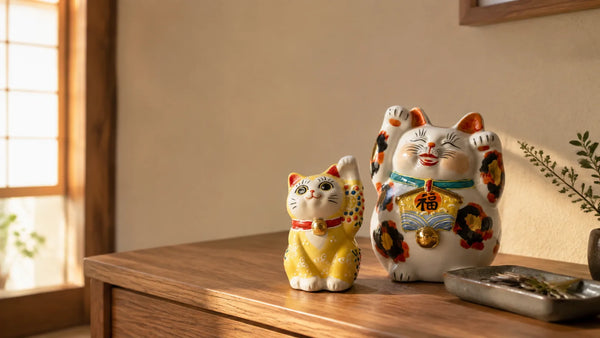
Tokoname raised-paw cat, Seto lucky-cat treasure ship, and Seto praying-paw cat displayed together.

Browse the rest in Maneki Neko & Lucky Cats and Teapots & Kyusu.

Frequently asked questions

What is Tokoname ware?
Tokoname ware is Japanese stoneware made in Tokoname, Aichi Prefecture, on the Chita Peninsula. It is one of Japan's Six Ancient Kilns and has been produced since roughly the year 1100. Historically it was unglazed high-fired ware used for large storage jars; today it is best known for red-clay kyusu teapots and maneki neko figurines.

Why are Tokoname teapots red?
The color comes from the clay, not a glaze. Chita Peninsula clay is unusually rich in iron, which fires to a red-brown. Teapots made from it in this unglazed finish are called shudei. The style was developed in Tokoname in the mid-nineteenth century using techniques derived from Chinese Yixing clay teapots.

Is a Tokoname kyusu better for green tea?
It is well suited to it. The pot is left unglazed inside, and the iron-rich clay is said to soften the astringency of green tea leaves for a mellower cup. The clay also retains heat well. Tokoname kyusu are usually small, with a side handle at about ninety degrees to the spout, which suits short sencha steeps.

Why is Tokoname famous for maneki neko?
Tokoname artisans began producing ceramic figurines in the late 1930s, and by 1950 the city was Japan's top producer of maneki neko. The town already had the molds, kilns, and industrial ceramic experience to make figurines at scale. Tokoname remains closely identified with the beckoning cat today.

Is Tokoname ware one of the Six Ancient Kilns?
Yes. The Six Ancient Kilns are Bizen, Echizen, Seto, Shigaraki, Tamba, and Tokoname, recognized together as a Japan Heritage. Tokoname was the largest producer among them, helped by iron-rich local clay and sea routes that carried heavy jars from Tohoku to Kyushu.

How do I care for unglazed Tokoname pottery?
Rinse unglazed ware with hot water and no detergent, since a porous body absorbs soap and holds the smell. Let it air-dry fully before storing so nothing musts. Avoid the dishwasher. Glazed pieces are less demanding, but each ZenKiln listing carries its own care guidance for the specific body and decoration.

Editor's note: Researched and written by the ZenKiln editorial team in Japan, drawing on the Japan Heritage Six Ancient Kilns project, the City of Tokoname's official craft description, and the Metropolitan Museum of Art's collection records. We hand-pack every piece in Japan. Where a maker, date, or attribution could not be verified, we describe the period rather than invent a name.

Sources: Japan Heritage, The Six Ancient Kilns: Tokoname · City of Tokoname, Tokoname Ware · The Metropolitan Museum of Art, Large Storage Jar (Ōtsubo), Tokoname ware

Back to blog

Leave a comment