Chinkin: The Sunken-Gold Carving of Wajima Lacquerware
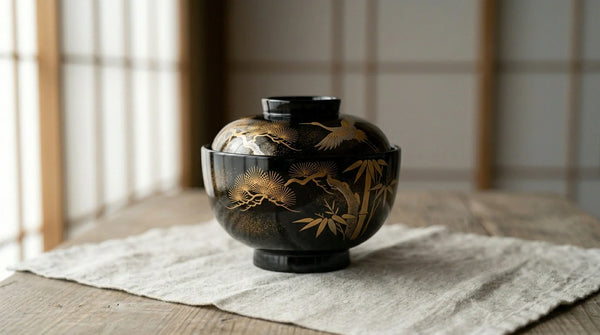
Run a fingertip across a piece of Wajima lacquerware decorated in chinkin (沈金) and you will feel almost nothing. The gold is there — fine lines of it, sometimes whole flocks of cranes or fields of autumn grasses — but it sits inside the surface rather than on top of it. Chinkin, written with characters meaning "sunken gold," is Japan's carved gold-inlay technique for urushi lacquer: the artisan engraves a design into cured lacquer with a fine chisel, rubs fresh urushi into the cuts as an adhesive, and presses gold leaf or gold powder into the grooves. What remains after the excess is swept away is a drawing in buried gold.
This is the sixth study in our Urushi Studies series. We have already walked through Wajima-nuri, Japan's most durable lacquer tradition, and maki-e, the sprinkled-gold painting that decorates so much of the country's finest lacquer. Chinkin is maki-e's quieter sibling — subtractive where maki-e is additive, engraved where maki-e is painted — and no town in Japan is more closely identified with it than Wajima, on the Noto Peninsula of Ishikawa Prefecture.
What Is Chinkin?
Chinkin is a decoration technique, not a type of lacquerware. It begins only after a piece is otherwise finished: dozens of coats of urushi applied, cured, and polished to a deep, still surface — most often mirror-black roiro or vermilion. Onto that finished skin the chinkin artist works like an engraver, cutting a design directly into the lacquer. The cuts are shallow, often finer than a sheet of paper is thick, because they must stay within the lacquer layers and never break through to the wood beneath.
Gold enters last. Raw urushi is rubbed into the carved lines, acting as a glue; gold leaf or fine gold powder is pressed over the surface and settles into the wet grooves; the excess is cleaned away. The gold that stays behind sits flush with or just below the surrounding lacquer — sunken, sealed, and protected.

Chinkin (沈金) — at a glance
- Meaning: "sunken gold." The metal sits in carved grooves below the lacquer surface, not on top of it.
- Method: engrave cured urushi → rub raw urushi into the cuts → press in gold leaf or powder → sweep away the excess.
- Signature effect: crisp, engraved linework — hairlines, feathers, wave crests — that flashes only when light strikes at an angle.
- Home ground: Wajima, Ishikawa Prefecture, where the famously hard Wajima-nuri undercoating makes fine carving possible.
- Durability: because the gold is recessed and bonded with urushi, it resists the everyday surface wear that slowly rubs away raised decoration.
From Qiangjin to Chinkin: How Sunken Gold Reached Japan
Like many of Japan's lacquer techniques, chinkin descends from a Chinese ancestor. In China the method was called qiangjin (戧金, "incised gold"), and lacquer decorated this way was being made during the Song and Yuan dynasties. Trade carried examples across the sea, and by the Muromachi period (1336–1573) imported qiangjin wares were treasured in Japan — studied, collected, and eventually answered in kind.
Japanese lacquerers did what they have always done with imported ideas: they absorbed the method and bent it toward local taste. Where much Chinese incised-gold work favors dense, filled compositions, Japanese chinkin came to prize the eloquence of the single line — a reed, a bird's wing, the crest of a wave — surrounded by generous black silence. By the Edo period (1603–1868), as Wajima's lacquer industry matured into its famous division of specialized labor, chinkin had become one of the town's two signature decorating arts, alongside maki-e.
How Chinkin Is Made: Carve, Rub, Gild
A chinkin artist's toolkit centers on the chinkin-nomi — small chisels whose blades are ground into different profiles for different marks. The work follows a strict sequence:
- Design transfer. The motif is drafted on paper and transferred faintly onto the polished lacquer surface.
- Carving. The artist cuts the design into the cured urushi. Line carving (suji-bori) produces continuous engraved strokes; dot carving (ten-bori) builds tone from thousands of tiny points, the way an etcher stipples shadow. Angling the blade changes the width and character of every mark.
- Lacquer as glue. Raw urushi is rubbed across the carving and worked down into the cuts, then the surface is wiped almost clean — lacquer remains only in the recesses.
- Gilding. Gold leaf or gold powder is pressed over the design and adheres where the wet urushi waits. Silver, platinum, and colored pigments can be applied the same way.
- Finishing. Once the urushi in the grooves has cured, the excess metal is swept off and the surface is cleaned. The gold now lives inside the lacquer, flush with the surface.

The linear nature of the craft was long considered its boundary — an engraved stroke is either there or it is not, with none of maki-e's soft gradients. Wajima carvers spent the modern era pushing against that limit, and one of them, Mae Taihō, later recognized as a Living National Treasure for chinkin, showed how far dot carving could go: fields of stippled points dense enough to model fur, feathers, and three-dimensional form out of pure engraving.
Chinkin and Maki-e: Two Roads to Gold
Japan's two great gold-decorating techniques for lacquer solve the same problem from opposite directions.
| Chinkin 沈金 | Maki-e 蒔絵 | |
|---|---|---|
| Gesture | Carving — the design is cut into cured lacquer | Painting — the design is drawn in wet lacquer, then gold is sprinkled on |
| Where the gold sits | In grooves, below the surface | On or above the surface |
| Character of line | Engraved crispness; hairline precision | Painterly softness; blooms and gradients |
| Strengths | Fine linework, stippled tone, geometric clarity | Clouds, mist, scattered gold fields, relief effects |
| Wear over decades | Recessed gold is protected by the surrounding lacquer | Raised gold can slowly soften at high points with heavy use |

The two are collaborators more than rivals — plenty of masterpieces carry both. If you want the full story of the sprinkled-gold side, our study of maki-e covers it in depth. And the instinct is not confined to lacquer: Japanese porcelain developed its own gold-on-color language in kinrande, the "gold brocade" style, which reads like chinkin's ceramic cousin.
Why Wajima Owns This Technique
Chinkin is practiced across Japan's lacquer regions — Tsugaru, Yamanaka, Kyoto, and Aizu among them (see our study of Tsugaru-nuri for how differently a region can think about lacquer) — but Wajima and chinkin are nearly synonymous, and the reason is under the surface.
Wajima-nuri's foundation is its ground: many undercoats of urushi mixed with jinoko, a baked, powdered diatomaceous earth local to the Noto Peninsula. Those undercoats cure into a base that is unusually hard, even, and thick. A chisel can cut a hairline groove into that ground without chipping, tearing, or punching through — softer, thinner lacquer surfaces crumble at the edge of a cut. The same engineering that makes Wajima-nuri Japan's most durable everyday lacquerware is precisely what makes it the ideal canvas for engraving. The technique and the tradition grew into each other.
Wajima's craft community was struck hard by the Noto earthquake of January 2024, which destroyed workshops and historic streets across the town. Rebuilding a craft that depends on generations of accumulated specialization is slow work, and it continues. It is one more reason honest Wajima pieces — carved by hand, gilded line by line — deserve to be understood and valued.
Gold, Elsewhere in the Collection
ZenKiln's current catalogue is built around Japanese ceramics and glass rather than lacquerware, but the sensibility chinkin represents — precious metal used with precision and restraint — runs straight through it:
- Arita Imari Red & Gold Kinrande Chrysanthemum Cup & Saucer — hand-painted gold brocade over red enamel, porcelain's answer to sunken gold.
- Arita Imari Blue & Gold Kinrande Chrysanthemum Cup & Saucer — the same chrysanthemum idiom keyed to underglaze blue.
- Edo Glass Sake Cup with Gold Leaf — gold leaf suspended in deep blue glass, catching light the way an engraved line does.
- Shigaraki Black Gold Ikebana Vase — matte black stoneware with restrained gold, the chinkin palette in ceramic form.
For more gilded porcelain from the same region as two of these pieces, browse the Arita & Hasami Ware collection.
FAQ: Chinkin, Answered
Is chinkin decoration real gold?
Traditionally, yes — gold leaf or fine gold powder, bonded into the carved lines with raw urushi. Silver, platinum, and colored pigments are also used, and some contemporary work mixes metals within one design. Inexpensive souvenir pieces sometimes carry printed imitation "gold" patterns instead, which is one reason provenance matters.
What is the difference between chinkin and maki-e?
Direction. Chinkin cuts the design into cured lacquer and fills the cuts with gold — subtractive. Maki-e draws the design in wet lacquer and sprinkles gold onto it — additive. Chinkin excels at crisp engraved lines; maki-e excels at soft gradients and raised effects. Many fine pieces use both.
Is chinkin the same as kintsugi?
No. Kintsugi is a repair practice for broken ceramics — urushi joins the fragments, and the seam is dusted with gold. Chinkin is a planned decoration for intact lacquerware. They share materials, urushi and gold, but not purpose; our guide to kintsugi tells that story.
How can I tell hand-carved chinkin from a printed imitation?
Angle the piece against the light. Engraved gold flashes directionally — lines brighten and dim as the piece turns, because the metal sits in V-shaped grooves. Printed gold reads flat and even from every angle. Up close, hand carving also shows minute variation in line width that no transfer process reproduces.
How should I care for chinkin lacquerware?
Exactly as you would any fine urushi piece: hand-wash gently with lukewarm water and a soft cloth, no dishwasher, no microwave, no long soaking, and no abrasives — the gold is protected in its grooves, but the surrounding lacquer still dislikes harsh treatment. Our urushi care guide covers the full routine.
Can chinkin pieces be used every day?
Wajima-nuri was built for use, and recessed chinkin decoration is among the most wear-resistant gold ornament in Japanese craft. Everyday use with gentle washing is exactly what these objects were designed for; reserve display-only treatment for antique or museum-grade examples.
Editor's note: This study keeps dates at the level of historical eras where primary records are thin, and names only artisans whose attribution is well documented. ZenKiln is a Japan-based curator of ceramics, glass, and craft objects — this series exists so the traditions behind the objects can travel with them.