Yakushi Kiln (Yakushigama): Seto's Modern Maneki Neko Tradition
7 min readManeki Neko — the beckoning cats displayed on shop counters and given for new beginnings — come from many Japanese ceramic centres. Yakushi Kiln, or Yakushigama (薬師窯), is a brand of Chugai Touen in Seto City, Aichi Prefecture. Its cats belong to a wider catalogue of seasonal and auspicious ornaments. Here is the brand’s history, the story behind its name, and how to choose a piece.
What is Yakushi Kiln (Yakushigama)?
Yakushigama (薬師窯) is a ceramic brand of Chugai Touen (中外陶園) in Seto, Aichi. The company’s official website gives August 13, 1952 as Chugai Touen’s founding date; this is not a separately documented launch date for the Yakushigama brand. The company identifies Suhara Ceramic Workshop (須原陶磁工房) as its production division.
Yakushigama is a workshop brand rather than one individual potter’s studio. Its range includes moulded ceramic forms and painted decoration. Materials and finishes vary by model, so the product specification is the place to distinguish pottery from porcelain, or gold-coloured decoration from gold leaf.
The story behind the name "Yakushi"
The kiln takes its name from Yakushi Nyorai (薬師如来), the Buddha of Medicine in Japanese Buddhism. According to local accounts, a small shrine dedicated to Yakushi Nyorai once stood on the grounds of Chugai Touen during the Edo period. The shrine is said to have been built by Gyoki (行基), an eighth-century Nara-period monk known across Japan for founding temples and directing public works.
According to the brand’s account, the Yakushi Nyorai image is now enshrined at Hosenji Temple (宝泉寺) in Seto, with festivals on November 8 and 12. Yakushigama, literally “Yakushi kiln,” preserves that local connection. The temple history explains the name; the inscriptions on individual ornaments should be read in their own context.
Seto novelty and Yakushigama’s figurines
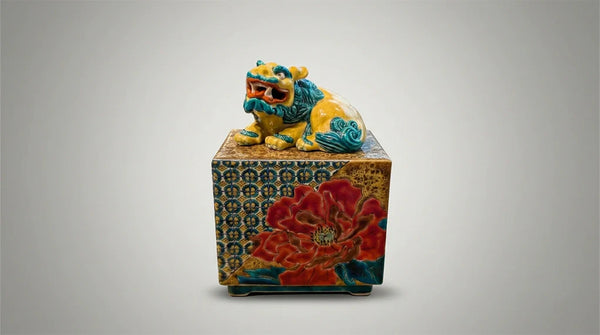
Seto novelty refers to the region’s decorative ceramic figures, particularly porcelain figures developed for overseas markets from the Meiji period onward. Mould-making and detailed painting became important parts of this industry. It is a regional tradition encompassing different workshops and production methods.

Seto is one of Japan’s Six Ancient Kilns (六古窯), alongside Tokoname, Shigaraki, Bizen, Tamba, and Echizen. This grouping recognises six historic pottery centres; it is not a ranking of the six oldest kilns in Japan. Read the Six Ancient Kilns project for Seto’s history and the place of setomono in Japanese ceramic culture.
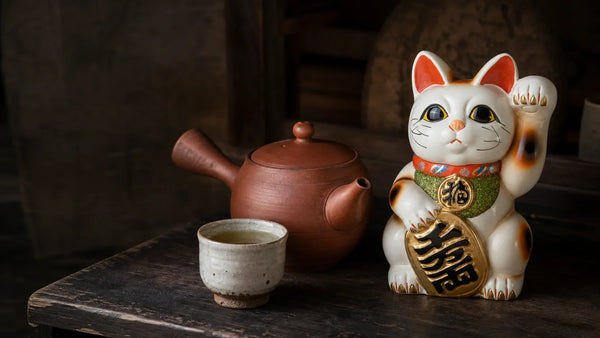
Yakushigama draws on Seto’s figurine-making tradition, with clay bodies and finishes specified by model. Common inscriptions include shōfuku (招福, “invite good fortune”), kaiun (開運, “opening to good fortune”), and kinun (金運, “financial luck”). The wording, decoration, and production method should be checked on the particular cat.
What makes a Yakushigama Maneki Neko different?
Three features are useful when comparing the range:
- Auspicious inscriptions and motifs. Some cats combine wishes for good fortune with a mallet, sea bream, or the Seven Lucky Gods. Shichifuku (七福) means “seven blessings”; the fuller name Shichifukujin (七福神) refers to the Seven Lucky Gods. Read the actual inscription and figures together.
- Painted expressions. Compare the eyes, whiskers, ears, and collar details of each design. The range includes different expressions and finishes rather than one standard face shared by every model.
- More than cats. The catalogue also includes zodiac animals, Seven Lucky Gods figures, treasure boats (takarabune), and seasonal ornaments.
Yakushigama's modern Maneki Neko range
Our Yakushi Kiln collection includes pieces in different sizes for desks, shelves, and shop counters. Current availability is shown on each product page. Examples include:
- Yakushi Kiln Double-Paw Maneki Neko — Seven Lucky Gods, 25.5 cm — a large statement piece. Both paws raised (a less common variant, said to invite customers and prosperity together), featuring the Seven Lucky Gods around the body.
- Yakushi Kiln Maneki Neko — Mallet, Sea Bream & Chirimen Collar, 26.5 cm — a large cat with celebratory motifs and a textured collar. Chirimen describes a crepe fabric; it does not by itself establish that the fibre is silk.
- Mother and Kitten Maneki Neko, 7 cm — a compact piece for a desk or small display shelf.
- Electric Waving Maneki Neko, 21 cm — battery-powered. Same Yakushi finish, but with mechanical right-paw motion.
- Yakushigama Takarabune Treasure Boat with 12 Zodiac Figures — a New Year piece that shows how Yakushigama applies its technique to the broader Japanese auspicious-imagery tradition.
Browse the full Yakushi Kiln collection, or the wider Lucky Cats catalogue for variants by colour and paw position from Yakushigama and other named kilns.
Cultural meaning: why people buy a Yakushigama cat
A lucky cat can carry a wish as well as decorate a room. Common ways to choose one include:
- For a new shop — choose a stable position on a counter or shelf, where the cat can be seen without obstructing work.
- For a new home — select a size and expression the recipient will enjoy living with.
- For New Year — zodiac ornaments offer a seasonal alternative to a cat; 2026 is the Year of the Horse.
- For a personal collection — compare the expression, inscription, and ceramic finish with pieces already displayed.

A common convention associates a raised right paw with financial good fortune and a raised left paw with welcoming people. Double-paw cats may combine those wishes. These are customary interpretations rather than promises. For colour variations, read Maneki Neko Color Meanings: 8 Lucky Cat Colors Explained.
How to choose your Yakushi Kiln Maneki Neko
A few practical pointers when buying a Yakushigama piece:
- Decide on scale. A seven-centimetre piece fits a small shelf; a large cat needs a stable, adequately sized surface. Check the dimensions and base of the actual model.
- Choose the paw position and inscription as a message for the recipient, or simply select the expression you prefer.
- Read the inscription. Shōfuku and kaiun express wishes for good fortune; choose wording that suits the occasion rather than treating a longer inscription as inherently better.
- Check the packaging. A maker’s printed box can be useful for gifting and identification. It is not automatically a tomobako, the inscribed presentation box associated with an artist’s work. The listing should state what is included.
- Year of zodiac. If giving for New Year, look for the current year's zodiac — 2026 is the Year of the Horse.

FAQ
Where is Yakushi Kiln (Yakushigama) located?
Yakushi Kiln is in Seto City, Aichi Prefecture, Japan, a region with over a thousand years of ceramic history and one of Japan's Six Ancient Kilns. Yakushigama is the brand name of Chugai Touen, a workshop whose Seto location places it at the historical heart of Setomono porcelain figurine production.
When was Yakushi Kiln founded?
Chugai Touen, the company behind Yakushigama, was founded on August 13, 1952. The official company history does not establish that date as the separate launch of the Yakushigama brand.
What is Yakushigama known for?
Yakushigama is known for Maneki Neko, zodiac figures, auspicious ornaments, and seasonal decorations. The company’s catalogue specifies the materials and finishes of individual models.
What is Seto novelty technique?
Seto novelty is the region’s decorative ceramic-figurine tradition, developed notably for export from the Meiji period onward. Moulded forms and detailed painting are characteristic, but the term does not prescribe the same body, firing sequence, or gilding method for every product.
Are Yakushi Kiln Maneki Neko handmade?
The brand describes ceramic production and painting at its Suhara workshop. A model may combine moulded forming with hand finishing. Check the maker’s description of the specific design rather than assuming every inscription is handwritten or every gold detail is gold leaf.
What does Yakushi in Yakushigama mean?
“Yakushi” refers to Yakushi Nyorai, the Buddha of Medicine. The brand links its name to a shrine formerly on Chugai Touen’s grounds and traditionally associated with the monk Gyoki. The image is now at Hosenji Temple (宝泉寺) in Seto, where the brand records festivals on November 8 and 12.
Written by ZenKiln Editorial. Sources: Yakushigama’s official brand and company history and its 2026 Maneki Neko catalogue. Product pages provide the current model details and included packaging.
This guide is part of ZenKiln's Kiln Studies series. To see where Seto sits among Japan's ceramic regions, read our overview of Japan's pottery regions.