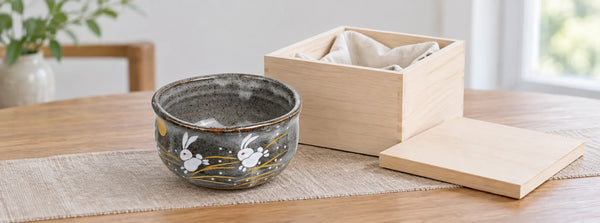
Hagi ware (萩焼) comes from Yamaguchi Prefecture and is closely associated with tea ceramics. Many pieces have pale glazes, visible crackle and absorbent clay bodies. Their surfaces can change with use, which makes washing, drying and checking the condition particularly important.
Image note: The scenes in this guide are illustrative visualizations, not documentary photographs of a specific Hagi workshop, kiln site, maker, firing, or historical object.
Where Hagi ware comes from
The nationally designated production area covers Hagi, Nagato and Yamaguchi cities, and Abu Town. Hagi ware received that designation on January 30, 2002.
Hagi’s early-seventeenth-century kilns developed under Mōri patronage with Korean potters brought to Japan during the invasions of Korea. The brothers Yi Jak-gwang and Yi Gyeong are central to the origin account. The latter received the name Saka Kōraizaemon, which continues in the pottery lineage.

Early Hagi tea bowls drew on Korean models, including the Ido tradition. The region’s kiln organisation changed over time: the Hagi cooperative describes a semi-official, semi-private Fukagawa kiln from 1657. The end of domain patronage in the Meiji period was therefore a later transition, not the first appearance of private enterprise.
Clay, glaze and firing
Hagi clay bodies commonly combine daidō, mountain and mishima clays, sometimes with local jido. Washing and settling remove unwanted coarse particles before the clay is worked and formed. The blend and preparation vary with the workshop.
Wood-ash, straw-ash and iron glazes create different surfaces. A transparent ash glaze can reveal the body’s warm colour; a straw-ash glaze can produce the opaque white associated with white Hagi. On undecorated pieces, the profile, trimming and glaze distribution provide details to compare.

Traditional climbing-kiln firings can take thirty to forty hours and reach roughly 1,250–1,300°C, depending on the kiln and ware. Gas and electric kilns are also used. Fuel, atmosphere, clay and glaze all contribute to the result.

Nanabake: the seven changes of Hagi
Hagi no nanabake, the “seven changes of Hagi”, describes gradual changes in appearance as liquids enter an absorbent body through fine glaze crackle. It does not prescribe seven stages or a timetable.
The pace depends on the body, glaze, liquids and care. Enjoy changes from ordinary use without trying to force a darker surface; mould, unusual odour and damage need separate attention.

For more on gradual changes and everyday care, see Hagi no Nanabake: Why Hagi Ware Changes Colour With Use.
Glaze crackle, absorbency, and signs to check
Kannyū is fine cracking within the glaze, usually associated with differences in expansion and contraction between glaze and body. It is distinct from a crack through the ceramic body. If a line crosses the body or you are uncertain about new damage, stop using the piece and ask the seller.
An absorbent Hagi piece can let moisture through. Do not assume persistent leakage will resolve with use: check the maker’s instructions and contact the seller before continuing to hold hot drinks in a leaking cup.

Avoid sudden temperature changes. For material terminology, see Japanese Stoneware vs Porcelain: Clues and Limits.
Living with a Hagi piece
- Before first use, wash away dust and rinse well. Follow the maker’s instructions if pre-wetting is recommended. The Hagi Ware Cooperative also recommends wetting before serving strongly staining foods such as sauces; this is different from an indefinite soak.
- Wash by hand in warm water with mild detergent, and go easy on strongly scented soap — a porous body can hold onto fragrance.
- Let the piece dry fully in open air before storing it. Overnight may be insufficient for a thoroughly wet, absorbent body; check that it is dry rather than relying on a fixed time.
- Use a microwave or dishwasher only if the maker permits it. Avoid sudden changes between cold and hot temperatures.
On a sound tea bowl, the trimmed kōdai, or foot ring, is another feature to compare. Some Hagi feet have a deliberate notch. Our guide, Reading a Chawan's Foot Ring: What the Kōdai Reveals, explains safe observation and the limits of those clues.

Hagi ware in the ZenKiln catalogue
The examples below offer different surfaces and forms to compare. Check the individual product pages for current dimensions, material, maker attribution, and care.
- Hagi coffee cup and saucer pair — compare the pale pink-toned surface and cup shape. The listing should supply the maker, capacity, and care for this particular set.
- Kutani Matcha Chawan by Kōzan Kiln — a painted bowl from another ceramic tradition, useful for comparing decoration and form.
- Shigaraki Bud Vase by Hechimon — a small vase from another pottery tradition. Its particular body, glaze, and making technique should be established from the listing rather than inferred from its shape.
Browse Matcha Ritual and our Stoneware collection for current examples. Japan's Pottery Regions provides the wider map; Shigaraki Ware and Raku Ware introduce two other traditions.
Frequently asked questions
What does "first Raku, second Hagi, third Karatsu" mean?
It is a traditional tea-world saying expressing appreciation for Raku, Hagi, and Karatsu. It is not an objective quality ranking or a requirement for choosing a tea bowl.
Editor’s note: This guide draws on the Hagi Ware Cooperative and the craft-history references below. The maker’s instructions take priority for the care of an individual piece.
Sources: Traditional Crafts Aoyama Square, HAGI Yaki (Pottery) · JAANUS, Columbia University, hagiyaki 萩焼