Five Japanese Tea Bowls Every Collector Should Know
The Japanese tea bowl — the matcha chawan — is the most personal vessel in chanoyu, the way of tea. It is the object the guest cradles in two hands, raises to the lips, and turns three times in admiration. For a new collector, the world of the Japanese tea bowl can feel impossibly deep: hundreds of kilns, four centuries of named potters, and a vocabulary that slides between Japanese, Korean, and Chinese sources. This guide is a beginner's map. We survey five teabowl traditions every collector eventually encounters — Raku, Hagi, Karatsu, the Mino group (Shino and Oribe), and the Korean-origin Ido — and explain where each is made, how to recognise it, and why it earned its place in tea history.
Use this as an orientation, not a deep history. Each tradition deserves its own volume, and we will return to them one by one in the Teabowl Studies series. For now, think of these five as the points of a compass — once you can name them on sight, the rest of the field starts to make sense.
1. Raku-yaki — Kyoto's hand-built chanoyu bowl
Where it's made: Kyoto, by the Raku family and a network of branch kilns (wakigama) founded by family members or apprentices.
How to recognise it: Raku tea bowls are hand-built — shaped by hand and carving knife rather than thrown on a wheel — which gives them their unmistakable asymmetric silhouette and visible facets. The body is porous because Raku is fired at relatively low temperatures. Classical pieces wear either a deep black (kuro-raku) or a warm red (aka-raku) lead-based glaze. The finished bowl feels surprisingly light for its size and warm to the touch when filled with tea.
Why it matters: Raku is the bowl chanoyu was built around. In the late sixteenth century, during the Momoyama period, the tea master Sen no Rikyū commissioned a Kyoto tile-maker, Chōjirō, to make hand-moulded tea bowls suited to his stripped-down wabi aesthetic. The resulting ware was the first Japanese ceramic style developed in direct collaboration between potter and tea practitioner, and it remains the canonical bowl of the tea ceremony. The Raku family lineage continues today; the name and seal have been passed down across generations, sometimes by adoption.
Atomic fact: Why Raku feels different in the hand
Raku ware is fired at temperatures well below stoneware (under roughly 1,000 °C, against 1,260 °C+ for high-fired stoneware), which leaves the clay body porous and the wall thicker than a wheel-thrown bowl. Pieces are removed from the hot kiln while still glowing — a defining step of the traditional Japanese Raku process — and allowed to cool in open air. The result is a bowl that insulates the hand from hot matcha while transmitting gentle warmth, exactly the tactile profile Rikyū's wabi tea required.
2. Hagi-yaki — Yamaguchi's pale crackled glaze
Where it's made: Hagi and the surrounding Yamaguchi Prefecture on the Sea of Japan coast, in former Nagato Province.
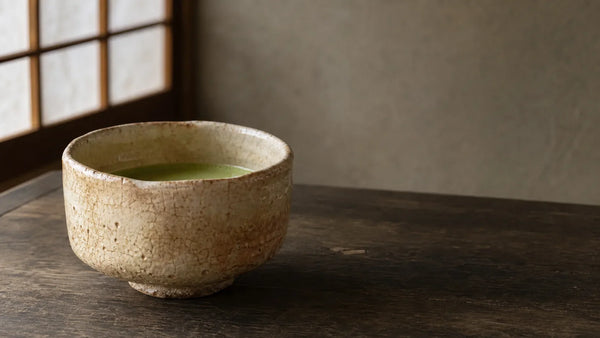
How to recognise it: Hagi bowls are warm orange-pink, ivory, or biscuit-coloured beneath a translucent beige or milky-white glaze. The defining feature is kan-nyū (貫入) — a fine web of crackle lines that forms as the glaze cools and shrinks faster than the clay beneath. Many Hagi tea bowls carry a small notch or chip cut into the foot ring, a historical convention. Look at the lip and you will often see soft, irregular contours rather than the crisp circles of porcelain.
Why it matters: The origins of Hagi ware trace to Korean potters brought to Japan in the wake of the late-16th-century invasions of Korea, who were settled by the Mōri clan in their castle town. From those beginnings, Hagi developed into one of the most quietly prestigious tea-ware traditions in Japan. A famous old tea adage ranks the canonical tea wares: Raku first, Hagi second, Karatsu third (一楽、二萩、三唐津). The phrase signals not absolute rank but the value placed on tea bowls with an earthy, restrained presence over flashier wares.
Atomic fact: The "seven changes" of Hagi
Collectors speak of Hagi no nanabake — the "seven transformations" of Hagi. Because the glaze is finely crackled and the body porous, tea and sake gradually seep into the crazing lines over years of use, deepening the colour and softening the surface. A bowl that begins almost white may settle into honey, amber, and finally a brown-grey patina. The bowl is treated as a living object that matures with its owner — a slow, unrepeatable form of ichigo-ichie (one time, one meeting) extended across a lifetime.
3. Karatsu-yaki — Saga's painted earthenware
Where it's made: The Karatsu region of Saga Prefecture in northern Kyushu, with related kilns in adjoining Takeo and Taku.
How to recognise it: Karatsu pieces have a sturdy, slightly sandy stoneware body high in iron, fired in climbing kilns (noborigama). The most visually distinctive variety is e-Karatsu (絵唐津), "painted Karatsu" — flowers, grasses, birds, and abstract motifs brushed onto the body in an iron-based underglaze and sealed under a semi-transparent grey glaze, so the brushwork reads as if drawn through gauze. Other styles include Chōsen Karatsu (Korean Karatsu), which juxtaposes a black iron glaze under a straw-ash white glaze that bleeds and runs against it.
Why it matters: Like Hagi, Karatsu owes its early development to Korean potters who arrived in the late 16th century, and the resulting tradition has been embraced as a leading exemplar of wabi-sabi aesthetics. Pottery production in western Japan was so concentrated around Karatsu that, for centuries, the word "karatsu-mono" (Karatsu-things) became a regional shorthand for ceramics in general. In the tea adage above, Karatsu rounds out the top three.
4. Mino — Shino and Oribe, the Momoyama revolution
Where it's made: Mino, the historical kiln district of present-day Gifu Prefecture, particularly Toki and Tajimi.
How to recognise it: Mino is not a single style but a family of related wares that emerged from the same district. Two members matter most for the beginning chawan collector:
- Shino — thick, milky white feldspar glaze on a soft pinkish-grey body. Iron oxide is often brushed under the glaze to bleed through as warm orange "fire colour" (hi-iro), and bare patches reveal scorched red clay. Surfaces are pitted and irregular; the glaze pools at the foot.
- Oribe — bold copper-green glaze applied asymmetrically, often paired with iron-brushed grids, plants, or geometric patterns on the unglazed half. Forms are deliberately distorted: square mouths, clipped feet, lobed walls.
Why it matters: The Mino kilns experienced an extraordinary creative boom in the Momoyama period (late 16th to early 17th century), producing the first uniquely Japanese — rather than Chinese- or Korean-derived — tea ceramics. Shino's warm imperfection and Oribe's deliberate asymmetry became the visual language of wabi-cha, the rustic tea aesthetic championed by Rikyū and his successors. If Raku is the canonical bowl of chanoyu, the Mino wares are the moment Japanese tea ceramics found their own voice.
5. Ido — the Korean bowl at the heart of tea history
Where it's made: Originally the Korean peninsula in the Joseon era, where these bowls were everyday rice or food vessels, not ceremonial objects. The name "Ido" is a Japanese designation applied to a specific class of Korean bowls treasured by Japanese tea masters.
How to recognise it: An Ido bowl is wheel-thrown, slightly conical, with a generous foot ring that is often roughly trimmed and crusted with crystalline "loquat-skin" (kairagi) accretions. The glaze is a soft, warm cream to loquat-yellow, often pooling unevenly and showing fine crackle. The body is light, the proportions wide and welcoming. Famous historical Ido bowls — most kept in temple and museum collections — are documented as named treasures.
Why it matters: The Ido chawan is the most heavily discussed bowl in classical tea literature. The Japanese tea world's embrace of these humble Korean vessels in the 16th century was a turning point: it formalised the principle that a tea bowl's worth lay not in its preciousness but in its presence — a foundational expression of wabi. The most celebrated example, the Kizaemon Ido, has been designated a National Treasure of Japan. Modern Japanese potters in Hagi, Karatsu, and elsewhere have continued making Ido-style bowls in homage; an authentic Joseon-period Ido is in an entirely different (and largely uncollectable) league.
Atomic fact: How the tea adage ranks the canonical bowls
"Ichi-Raku, ni-Hagi, san-Karatsu" — "first Raku, second Hagi, third Karatsu" — is the most frequently cited adage in beginner tea-bowl literature. It ranks the three most-prized tea bowls of the chanoyu tradition. The order reflects how closely each ware aligns with the wabi ideal: hand-built and reverent (Raku), softly crackled and living (Hagi), or earthy and painted (Karatsu). The phrase is descriptive of historical taste, not a quality grading — collectors today often place their first Hagi or Karatsu well before they place their first Raku, simply because Raku family pieces are scarcer at every price tier.
What to look for in your first chawan
If you are buying your first Japanese tea bowl, work through this short checklist before committing:
- Form-class first, decoration second. Is the bowl a matcha chawan (wide, deep enough to whisk) or a smaller tea cup or sake vessel? Many beautiful Japanese bowls are not intended for matcha. The mouth diameter should be roughly 11 to 14 cm and the wall deep enough for a chasen whisk to move freely.
- Hand-feel. Cradle the bowl in both hands. A good chawan feels balanced, slightly warm, and "asks" to be turned. A bowl that is too heavy, too thin-lipped, or top-heavy will fight you across years of use.
- The foot ring (kōdai). Turn the bowl over. The foot is where the potter signs the work — through trimming style, signature, or seal. A well-considered foot is a sign of a serious maker; a hastily finished one is often a tourist piece.
- Surface honesty. Crackle, iron flecks, glaze pooling, and slight asymmetry are features of Raku, Hagi, Karatsu, and Mino wares — not flaws. Confirm any unusual element with the seller before assuming damage.
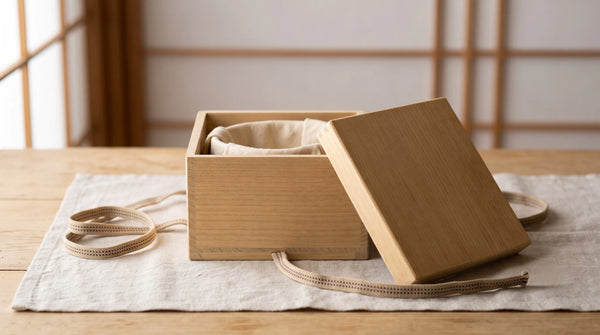
- Provenance and box. Where possible, buy bowls that arrive in a signed wooden box (tomobako) or with documentation of kiln and maker. The box is part of the piece.
- Match the bowl to your tea. Black or red Raku is traditional for thick tea (koicha); lighter wares such as Hagi, Karatsu, or Shino read beautifully with thin tea (usucha) and the bright green of matcha against a pale body.
ZenKiln's chawan catalogue — and where to read next
ZenKiln currently focuses its chawan selection on the Kutani-yaki tradition of Ishikawa Prefecture — modern art-tier bowls that sit outside the five traditions surveyed above but share their attention to hand-painting, asymmetric form, and tea-purpose proportions. For Raku, Mino, and Ido, we recommend visiting the museum collections cited below and reading our broader regional guides while we expand the catalogue.
- Kutani Iroe Yū Hidamari Matcha Chawan — wabi-grey body with iroe overglaze cat motif, kiri-box packaging.
- Kōzan Kutani Hane-Usagi Matcha Bowl — three raised-white rabbits and gold moon over susuki grass, original kibako.
- Iroe Yū Hana Floral Matcha Chawan — restrained floral iroe on a wabi-sabi grey ground.
- Hagi-yaki Tsubakihide-gama Himetsuchi Coffee Pair — not a chawan, but the classic crackled Hagi glaze on a coffee form for collectors curious about the tradition's surface in daily use.
- Gifts for Tea Lovers — full curated collection (13 pieces) for the new tea practitioner.
For broader context, our Japan's Pottery Regions guide maps the major ceramic centres — including Raku, Mino, Karatsu, and Hagi — across the archipelago, and our Stoneware vs Porcelain explainer covers the material distinctions that underlie all five traditions surveyed above.
FAQ
What is a matcha chawan and how is it different from a regular tea cup?
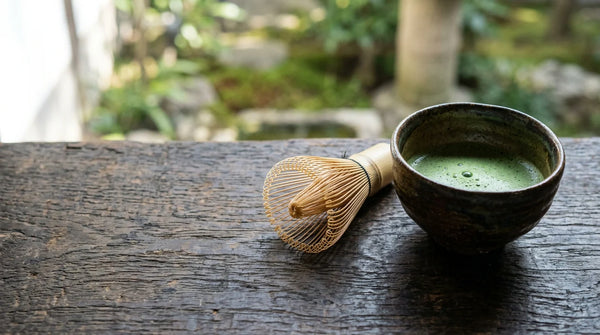
A matcha chawan is a wide-mouthed Japanese tea bowl, typically 11 to 14 cm across, designed for whisking and drinking matcha (powdered green tea) in the tea ceremony. Unlike a tea cup, which is narrow and built for steeped leaf tea, a chawan is broad and deep so that a bamboo whisk (chasen) can move freely against the bottom and walls. It is held with both hands rather than a handle, and turned three times before drinking as a gesture of respect.
Are Raku tea bowls still made by the original Raku family?
Yes. The Raku family lineage in Kyoto has continued from the 16th century to the present, passing the name and seal down through successive generations — sometimes by direct descent and sometimes by adoption. In addition to the head family, a network of "branch kilns" (wakigama) founded by Raku-family members or former apprentices also produces work in the Raku tradition.
Why does Hagi-yaki change colour over time?
Hagi ware is finely crackled and slightly porous. Over years of use, tea and sake gradually penetrate the crazing lines, deepening the surface from near-white toward honey, amber, and finally a brown-grey patina. Collectors call this gradual transformation Hagi no nanabake, the "seven changes" of Hagi. The bowl is treated as a living object that matures alongside its owner — an extension of the tea principle of ichigo-ichie, one time, one meeting.
What is the difference between Shino and Oribe?
Both are members of the Mino family of wares from Gifu Prefecture, developed in the Momoyama period. Shino is recognised by its thick milky-white feldspar glaze, often with iron oxide brushwork bleeding through as warm orange "fire colour," on a soft pinkish-grey body. Oribe uses a bold copper-green glaze applied asymmetrically, frequently paired with iron-brushed motifs on the unglazed half and deliberately distorted forms — square mouths, lobed walls, clipped feet.
Why are Korean Ido bowls so important in Japanese tea history?
The Ido bowl was originally a humble Korean Joseon-era food or rice vessel that was elevated by 16th-century Japanese tea masters into one of the most prized objects in chanoyu. The decision to treasure an unglamorous workshop bowl crystallised the wabi principle that a tea bowl's value lies in its presence rather than its preciousness. The most celebrated example, the Kizaemon Ido, is designated a National Treasure of Japan.
What should I avoid as a new chawan collector?
Avoid bowls sold without provenance, clearly mass-produced tourist pieces lacking a maker's seal, and "tea bowls" whose form is actually too narrow or shallow to whisk matcha in. Be cautious of online listings that confuse the five traditions above (a "Raku-style" bowl is usually not a Raku-family piece) and of any seller who cannot describe the kiln, region, or maker. Buying one well-documented Hagi or Karatsu chawan with a signed box will teach you more than ten unsourced bargain bowls.
Editor's note: ZenKiln is a Japan-based independent curator of Japanese ceramics and craft. Every piece in our catalogue is sourced directly inside Japan — from kilns, distributors, and estate channels in Ishikawa, Saga, Gifu, Yamaguchi, and Tokyo — and shipped from our Tokyo studio. Our blog is written in-house by the same team that handles sourcing, photography, and condition checks. We never repackage drop-ship inventory, and we do not invent kiln biographies. Where a fact cannot be verified to a museum collection, an attested adage, or a supplier's own documentation, we describe what we can see and let the bowl speak for itself.