How to Hold a Chawan: Etiquette, Grip, and Why It Matters
5 min readRest a matcha bowl on your left palm and steady its side with your right hand. Supporting it from beneath lets you lift and turn it without relying on the rim. For a formal tea gathering, follow the host’s or teacher’s guidance; the example below comes from Urasenke’s usucha practice.
Chanoyu, literally “hot water for tea”, brings together the preparation, serving and appreciation of matcha. Holding and viewing the bowl are part of that exchange.
Before picking up the bowl
Use a sound bowl intended for drinking tea, with room for whisking and a shape you can hold securely. Let hot contents cool to a comfortable drinking temperature.
The sequence below follows Urasenke’s introductory usucha guidance. Other schools and gatherings may use different greetings, turns or finishing gestures.
How to hold a chawan: the basic grip
Historic or fragile objects need their owner’s handling instructions. For an ordinary bowl made for use:
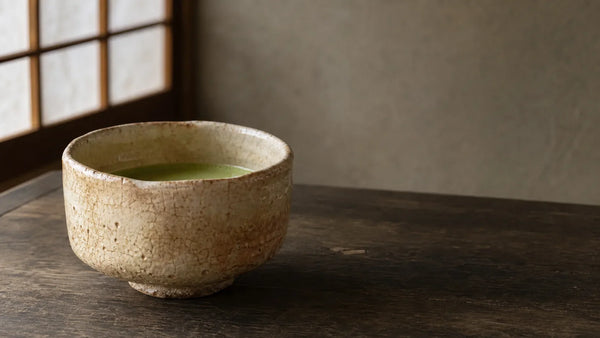
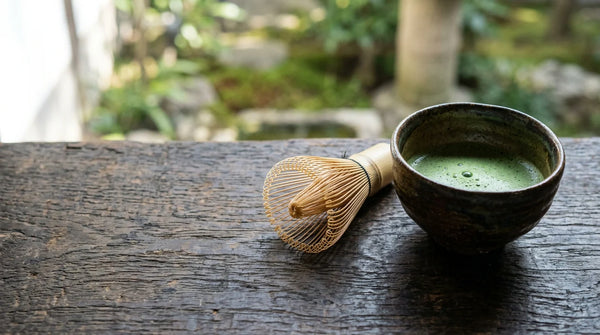
Rest the bowl on your left palm and steady its side with your right hand. Support the weight underneath and keep a controlled grip while turning or lifting it.
Receiving the bowl
Acknowledge the host and neighbouring guests as appropriate to the gathering. Watch how the bowl is presented; not every setting involves a direct hand-to-hand pass.
Turning away from the front
The presented front is the shōmen (正面), chosen through the bowl’s form or decoration. The guest turns the bowl to drink from another point, then restores its orientation. Follow the particular school’s movements rather than applying one turn count everywhere.
The host presents the chosen view for you to appreciate. Turning the bowl leaves that front clear of the drinking point; it also gives you time to notice the painting or glaze.
The drinking hold
Keep the bowl supported as you raise it to drink. Follow the host or teacher for the pace and finishing gestures of formal practice.
Setting it down
In Urasenke’s introductory example, the guest cleans the drinking point with thumb and forefinger, wipes those fingertips on kaishi paper and restores the bowl’s orientation. The chakin is the host’s bowl-cleaning cloth, not a substitute for the guest’s kaishi. At home, wash your own bowl after use.
Reading the bowl in your hands
Look at an empty bowl over a low, suitable surface, holding it securely while you turn it.
The kōdai (高台), or foot, reveals exposed clay, trimming and how the base meets the body. Named forms include ring, split and bamboo-node feet. These details offer clues to making, while attribution still needs evidence about the piece.
Notice balance, rim shape and the usable interior. A lighter bowl is not automatically better: choose a weight and grip that feel comfortable and an interior suited to your whisk. Check for roughness or damage that could catch the whisk or affect use.
Bowl shapes and seasons
Tall, narrow tsutsu-gata (筒形) bowls retain warmth and are often chosen in colder months. Wide, shallow hira-gata (平形) bowls allow tea to cool more readily and suit summer. Rounded wan-nari bowls sit between these shapes and can serve throughout the year.
For a first bowl, a rounded form with room for your whisk is a useful starting point. Check the dimensions and choose a weight and rim that feel comfortable to you.
The tea traditions behind the bowl
Imported Chinese bowls were important in medieval Japanese tea, and Seto makers produced Japanese interpretations. Tenmoku covers a broader historical group than Jian ware alone.
Sixteenth-century wabi tea, associated with Sen no Rikyū, valued varied Korean and Japanese wares alongside earlier imports. Korean bowl types had different histories and original uses. The saying “Raku first, Hagi second, Karatsu third” expresses esteem rather than a universal ranking.
Matcha chawan from the ZenKiln catalogue
These contemporary Kutani-yaki bowls offer different shapes and painted surfaces:
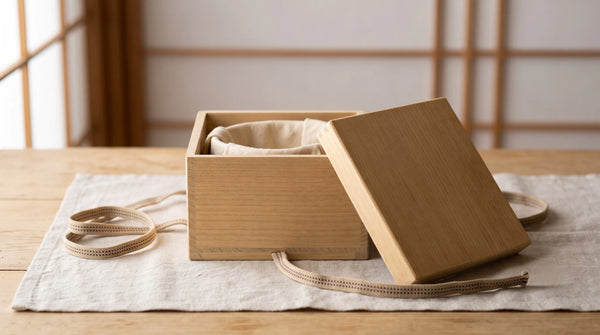
- The Iroe Yū "Hidamari" cats matcha chawan (Ø 11 × H 6.7 cm / 4.3" × 2.6") is a hand-painted Kutani stoneware bowl from the Iroe Kōbō Yū workshop, with two cats curled in a wildflower meadow and a paulownia kiri-bako gift box.
- The Kōzan kiln Hane-Usagi bowl has leaping white rabbits and a moon against a speckled grey ground.
- The Iroe Yū Hana bowl carries flowers on a grey ground.
- The Iroe Yū Hidamari rabbit bowl combines pale rabbit motifs with a cream-coloured ground.
Compare more designs in Kutani Ware and Gifts for Tea Lovers. For context, read the five tea-bowl traditions and our beginner’s guide to Kutani ware.
FAQ
Why do Japanese tea bowls have no handle?
Most matcha bowls are supported directly in both hands. This lets you feel the weight and texture while keeping the bowl steady; the form also leaves space for whisking.
Is it okay to use a chawan every day at home?
Yes, when the bowl is made and suitable for that use. Follow its preparation and washing instructions, including any recommended pre-wetting, and dry it thoroughly before storage.
References: Urasenke’s introductory usucha instructions and the museum tea-history resources linked above. For each bowl’s materials, dimensions and care, use its product page.