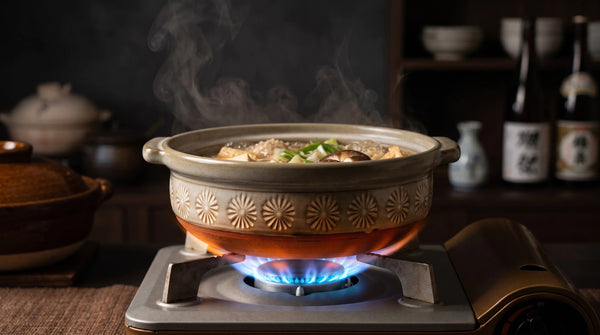
A Japanese hot pot, or nabe (鍋), brings a shared simmering dish to the table. A donabe (土鍋) is a clay pot suited to many such meals, though nabe can also be cooked in other appropriate cookware. This guide covers pot size, heat-source compatibility, side bowls, and spoons.
What's on a Japanese hot pot table
Start with suitable cookware for the shared dish. Give each guest a side bowl, such as a lipped tonsui, and a spoon for broth. Small kobachi dishes can hold dipping sauces such as citrus-based ponzu or sesame goma. The number of dishes depends on the meal.

Choosing a donabe: size, gō, and your stovetop
Begin with the number of diners and the heat source you plan to use.
Donabe size numbers commonly use 号 (gō). They are model-size designations, not the rice-measuring unit 合, and do not correspond to one fixed capacity. Compare the exact model’s usable capacity, dimensions, and manufacturer’s serving suggestion instead of applying a universal people-per-size chart.

Check the exact model’s approved heat sources. For induction, choose a model explicitly approved for IH, such as the linked IH-compatible Ginpo donabe, and follow its instructions. The Ginpo Hana-Mishima donabe and 9-gō Yuzuriha sukiyaki pot each need their own current compatibility information; their series names alone are insufficient.
Same size number, different pots
Two Hana Mishima listings in our catalogue make the distinction concrete:
- Gas model, size 7: listed capacity 1.5 L.
- IH model, 7-gō: listed capacity 1.3 L, supplied with a removable metal heating plate.
These are the capacities in the individual product records, not instructions to cook with liquid at the brim. Leave the working space required by the maker. The similar name and number do not make the two pots interchangeable.

Banko ware from Mie Prefecture is an important donabe tradition. Suitable heat-resistant body formulations help make these pots work for cooking; that property should not be assumed for every local clay or every Banko object. See our Banko ware guide.
What is a tonsui bowl?
A tonsui (呑水) is a small side bowl with a projecting lip or thumb tab. It holds a portion transferred from the shared pot. Depending on its size, it can also serve small portions of salad, rice or dessert.

The Ginpo Hana-Mishima tonsui coordinates with the series’ pot. Check its dimensions and plan one side bowl per guest.
Renge and dipping dishes: the rest of the table
A renge (蓮華) is a ceramic spoon named for its lotus-petal shape. Our Hana-Mishima renge and rest set coordinates with the pot and bowls. The Kutani whale-tail renge is another design to compare. Use a suitable spoon rest between servings rather than assuming every handle can hook securely over a pot.

Small dishes let each guest keep sauces separate. Compare the dimensions and set contents of our Mino ware kobachi, eight to a box, with the space available on your table.
Building a matched set
Ginpo’s Hana-Mishima series offers coordinated pots, bowls, and spoons. Slight colour differences may be visible between pieces; check the actual products rather than assuming the accessories and pot use the same body or manufacturing process.
A practical first setting is one suitable donabe, a side bowl and spoon for each guest, and small sauce dishes. Browse Donabe & Accessories and Tableware.
Before the first use
Check whether the exact pot requires medome, a first-use seasoning treatment. Some modern donabe do not. Our donabe care guide covers preparation, cooking and storage. Follow the maker’s instructions, avoid sudden temperature changes and let the pot dry fully before putting it away.

A coordinated bowl or spoon may use different materials from the donabe. Do not put matching tableware over a heat source unless it is specifically approved for that use.