Kinrande: How Gold Brocade Came to Japanese Porcelain
Written by Team ZenKiln · from our Tokyo atelier
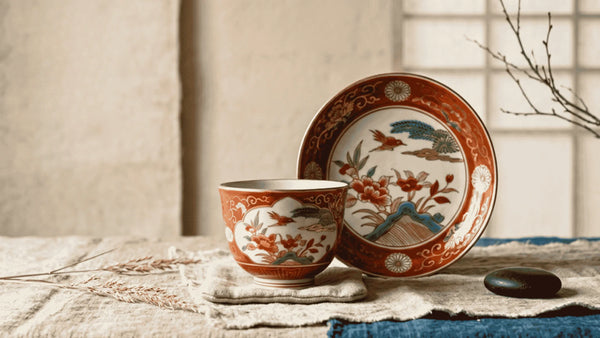
Of all the colors that appear on Japanese porcelain, gold is the one that behaves least like a color. Kinrande (金襴手) — literally "gold-brocade hand" — is the overglaze style in which gold is fired onto an already-glazed, already-enameled vessel until the surface carries the sheen of woven gold thread. The name is borrowed from kinran, the gold-brocade silk used in Noh costumes and tea-ceremony pouches, and it tells you exactly what the style aims for: not a gold accent, but textile-like richness wrapping the entire form. This installment of Color of Utsuwa looks at where kinrande came from, how gold actually bonds to porcelain, and how to read — and care for — the gold pieces on your own shelf.
What "gold brocade" means on a pot
Plenty of Japanese tableware carries a little gold: a rim line (kin-buchi), a picked-out flower center, a signature. Kinrande is something else. In the brocade style, gold is laid over a colored enamel ground — most classically a deep overglaze red, sometimes a solid gold field — in dense, repeating pattern-work: scrolling vines, sayagata key-fret bands, shippō linked-circle collars, packed florals. The visual logic comes from textiles. Where a weaver floats gold-wrapped thread across silk, the porcelain painter floats fired gold across enamel, and the eye reads both the same way: as fabric of extraordinary cost.
That density is the diagnostic. A cup with a gold rim is gilded; a cup whose shoulder dissolves into continuous gold pattern over red or gold ground is working in the kinrande idiom.
Atomic fact: Kinrande (金襴手) takes its name from kinran (金襴), gold-brocade silk textile — the style is defined by brocade-dense gold patterning over an enamel ground, not by the mere presence of gold.
From Ming export ware to Japanese kilns
The brocade style did not begin in Japan. Gold-decorated porcelain of this type was produced in Ming-dynasty China in the sixteenth century, and surviving examples reached Japan, where tea practitioners and daimyo collectors prized them as imported luxuries. When Japan's own porcelain industry matured at Arita in the Edo period (1603–1868), its workshops absorbed the idiom: Imari export wares combined underglaze cobalt blue, overglaze red enamel, and fired gold into the opulent palette that European buyers came to call "Imari" — and its gold-saturated registers belong to the kinrande tradition. If you have read our sometsuke and aka-e installments, kinrande is the third layer of that same construction: blue under the glaze, red over it, gold over the red.
Kutani took the idiom furthest. In the Meiji era (1868–1912), gold-heavy Kutani wares became one of Japan's signature ceramic exports, and the gold-ground styles developed then — including the flower-packed hanazume treatments — remain signatures of Ishikawa workshops today. For the broader Kutani story, see our beginner's guide to Kutani ware.
How gold is fired onto porcelain
Gold cannot go into the kiln with the glaze. Porcelain glaze matures at very high temperature — far above the point where applied gold decoration would be destroyed — so gold always arrives last, in its own dedicated firing. The painter decorates the finished, glazed, enamel-fired piece with gold and returns it to a low-temperature decorating kiln, just hot enough to fuse the gold permanently to the glaze surface without re-melting anything beneath it.
The gold itself comes in several forms. Honkin (本金, "true gold") is real gold — applied as a paste or solution and often burnished after firing to bring up its warm, slightly soft luster. Liquid bright gold is a gold compound that fires to a mirror shine with less gold content. And kinpaku (金箔) is gold leaf, cut and applied as foil before a fixing fire — a technique porcelain shares with lacquerware, where sprinkled and applied gold reaches its other great expression in maki-e.
Atomic fact: A kinrande vessel has survived at least three firings — the high-temperature glaze firing, the overglaze enamel firing, and a final low-temperature gold firing that fuses the gold to the glaze without re-melting it.
A vocabulary of gold
Japanese ceramics uses several overlapping terms for gold decoration. They are easiest to hold apart by asking how much gold and in what role:
Kinsai (金彩) is the umbrella word — "gold decoration" of any kind, from a rim line to full coverage. Kinrande (金襴手) is the brocade style: dense gold pattern-work over an enamel ground. Kinpaku-sai (金箔彩) is gold-leaf work — flakes or cut foil fired onto the surface, reading as scattered light rather than drawn line. Hanazume (花詰, "packed flowers") is the Kutani millefleur treatment in which the surface fills edge-to-edge with small blossoms; when those flowers sit on a gold ground with gold outlining — often raised with mori-e slip relief — it becomes kinhanazume (金花詰), one of the most labor-intensive surfaces in Japanese porcelain. And honkin (本金) is a grade claim rather than a style: it tells you the gold is real gold, not a substitute luster.
Gold in the ZenKiln catalogue
These terms stop being abstract the moment you put pieces side by side. In our current collection:
- Kutani Sake Set — Eizan Kiln Peacock & Peony is kinrande proper: a gold-ground tokkuri and sakazuki pair with sayagata and shippō collar bands framing iro-e peacock-and-peony painting.
- Kutani Kinhanazume Bowl — Tenzan Kiln shows the packed-flower gold ground at full density: raised-slip chrysanthemums and butterflies over edge-to-edge gold.
- Kutani Honkin Hanazume Cup & Saucer carries the honkin grade — real-gold millefleur in a Western tea form.
- Kutani Kinpaku-Sai Wine Cup is the gold-leaf approach: dense applied flakes over a red tinted glaze, on a gold-toned metal stem.
- Arita Gold Glazed Tea Set shows gold as a full glaze-surface statement in the Arita porcelain tradition.
You can browse the full range of gold-decorated and enamel work in our Kutani ware collection.
Caring for gold-decorated porcelain
Fired gold is permanent but sits on the glaze surface, so it asks for gentler handling than plain porcelain. Hand-wash only, with a soft sponge and mild detergent — dishwasher detergents are abrasive and will dull and eventually wear through gold over repeated cycles. Never microwave gold-decorated ware: metallic decoration arcs in a microwave and can scorch both the piece and the appliance. Skip scouring pads and abrasive powders entirely, and when stacking, place a soft cloth or paper between gold-decorated surfaces. Treated this way, fired gold outlasts its owner; most wear on antique kinrande comes from decades of dishwashing-era abrasion, not age.
Frequently asked questions
Is the gold on kinrande porcelain real gold?
Often, yes. Honkin (本金) marks pieces decorated with real gold paste or solution; gold leaf (kinpaku) is also real gold. Liquid bright gold contains less gold and fires to a harder mirror shine. Suppliers state the grade when it is honkin — if no grade is claimed, assume standard gold luster.
What is the difference between kinrande and kinsai?
Kinsai means any gold decoration — a rim line qualifies. Kinrande is a specific style: dense, brocade-like gold patterning over a colored enamel or gold ground, named after gold-brocade silk.
Can I put gold-decorated porcelain in the microwave or dishwasher?
No to both. Gold is metallic and arcs in a microwave; dishwasher detergent abrades gold over repeated cycles. Hand-wash with a soft sponge and dry with a soft cloth.
Does fired gold wear off?
Fired gold is fused to the glaze and survives normal use for generations. What damages it is abrasion — scouring pads, dishwasher cycles, stacking without padding — and microwave arcing. Avoid those and the gold stays.
Is kinrande a Kutani style or an Arita style?
Both, by different routes. Edo-period Arita absorbed the Ming brocade idiom into its Imari export palette; Meiji-era Kutani made gold-ground decoration a regional signature and developed treatments like kinhanazume. Today the densest gold-brocade work on the market is most associated with Ishikawa's Kutani workshops.
Editor's note: Technique descriptions in this article follow supplier-published specifications for the pieces linked above and established, era-level craft history. Where individual workshop histories are not documented by the maker, we name eras rather than inventing dates or masters. Previously in this series: vol.01 — Sometsuke and vol.02 — Aka-e.