Yamanaka Lacquerware: Japan's Wood-Turned Urushi Tradition
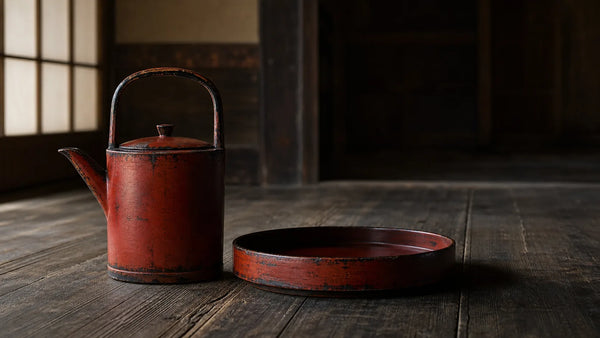
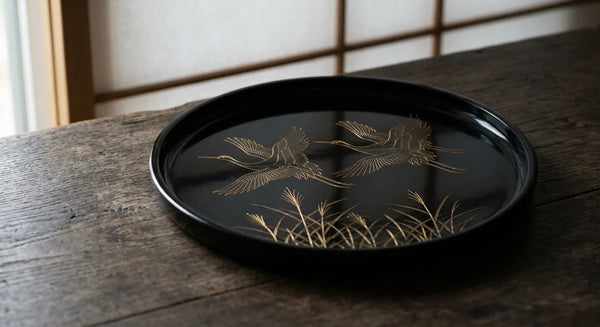
3 min readFine rings cut around a bowl and a lid fitted closely to its body show the woodturning skills associated with Yamanaka lacquerware. Made in the Yamanaka Onsen district of Kaga City, Ishikawa, the craft includes both grain-revealing lacquer finishes and decorated surfaces.
What is Yamanaka lacquerware?
Traditional Yamanaka work uses turned wooden bases finished with lacquer. The region also produces moulded resin ware and synthetic coatings, so check the base and coating on the individual product description.
The Yamanaka cooperative describes the district as a leading producer of turned wooden bases, alongside its lacquering and maki-e work.
From turned wooden objects to lacquerware
The cooperative traces the craft to woodturners who settled at Masago, upstream of Yamanaka Onsen, during the Azuchi-Momoyama period. They sold turned objects to hot-spring visitors. Its historical account describes hand-operated, rope-driven lathes.
During the Edo period, lacquering and maki-e techniques came from Kyoto, Kanazawa and Aizu under Kaga domain patronage. Workshops that supplied wooden bases developed finishing and decorating skills, and Yamanaka became a centre for tableware and tea utensils.
Shaping and finishing the wood
Wood orientation, cutting tools and lacquer application each affect the finished vessel:
Turning the wooden body
In tategi-dori, the vessel is oriented along the direction in which the tree grew. Together with careful drying and turning, this helps limit distortion and allows precise thin-walled and lidded forms. The wood can still move or suffer damage.
Decorative ring-turning (kashoku-biki)
The artisan holds a specially shaped blade against the spinning piece to cut fine concentric lines. This decorative turning, kashoku-biki, produces rings, threads and narrow bands whose texture remains visible through a suitable lacquer finish.
Wipe-lacquering (fuki-urushi)
Fuki-urushi is a wipe-lacquer finish that leaves the grain visible. Repeated applications are worked into the surface and excess lacquer is wiped away, with curing between stages. It is one option alongside more fully coated and decorated Yamanaka finishes.
The cooperative’s production guide follows the work from rough blank through final turning and lacquering. Thin walls demand careful preparation and finishing, though not every Yamanaka piece is made thin.
Yamanaka and the tea ceremony
Yamanaka’s turning skills suit natsume, the small lidded containers used for matcha in tea practice. The body and lid need careful fitting before any decoration is added. The region also produces other tea utensils, including trays and incense containers; these pieces make good use of its turning and decorating skills.
Yamanaka among Ishikawa's lacquer traditions
Yamanaka’s reputation for wooden bases is often compared with Wajima’s lacquer foundations and Kanazawa’s maki-e decoration. Wajima foundations use local diatomaceous earth as part of their construction. These regional specialisms help explain differences in emphasis; they do not define everything each workshop makes.
Caring for wooden urushi lacquerware
For wooden tableware finished with urushi, wash gently by hand in lukewarm water with a soft cloth or sponge, then dry promptly. Avoid dishwashers, microwaves, prolonged soaking and abrasive scrubbers. Keep pieces out of direct sunlight and away from dry heated air. The urushi lacquerware care guide explains the routine. Some modern Yamanaka products have synthetic bases and coatings rated for a dishwasher; use those ratings only for the specified product.
Continue the Urushi Studies series
Continue the series with our notes on Wajima-nuri, Kishū lacquerware, and the maki-e decoration technique that Yamanaka adopted in the Edo period.
FAQ
How can I tell whether a Yamanaka bowl is wood or resin?
Look for the base material and coating in the maker’s description. A photograph or regional name may not reveal either reliably. Ask before buying if you need a wooden, natural-urushi piece or a particular appliance rating.
Sources: the Yamanaka cooperative’s overview and production guide linked above.