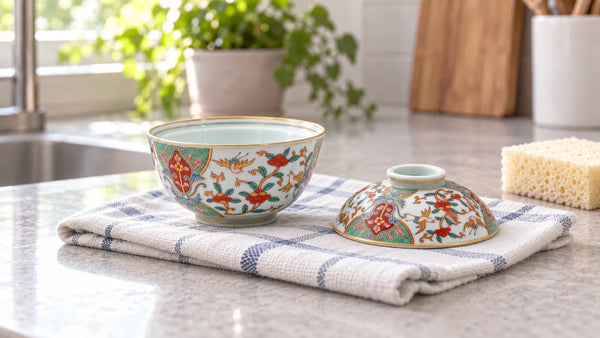
Asakura Isokichi II (1913–1998) explored vivid yellow grounds, deeper greens, metallic decoration and restrained pale surfaces over a long career in Kutani ceramics. In 1996, he became the first Kutani artist to receive Japan’s Order of Culture. His work forms part of a family history that continues at Isokichi Shinkō-gama in Komatsu.
Who was Asakura Isokichi?
Born in Terai, Ishikawa, Asakura trained under his father, Tokuda Yasokichi I and Kitade Tōjirō. He developed his work through decades of exhibiting at Nitten, Japan’s national fine-arts exhibition.
The Tokyo National Research Institute for Cultural Properties records his birth on 26 February 1913 and the principal awards of his career: the Prime Minister’s Award at Nitten in 1977, the Japan Art Academy Prize for Impressions of Sado in 1981, Academy membership in 1984, recognition as a Person of Cultural Merit in 1992 and the Order of Culture in 1996.
The family kiln: Isokichi Shinkō-gama in Komatsu
Isokichi Shinkō-gama (五十吉深香陶窯) is in Hachiman, Komatsu. Its four-generation history includes forming the ceramic body as well as overglaze decoration. The founder’s name, 磯吉, and the second generation’s art name, 五十吉, are both romanised as Isokichi; identifying the generation matters when reading an attribution.
Changing colour and form
The artist’s memorial museum describes substantial changes in his colour, form and technique roughly every ten years. His palette moved from luminous yellows to deeper greens and mixed tones, later including platinum and silver decoration and restrained pale surfaces. Looking across these periods gives a broader view of his work than a single signature colour would.


Nature appears in his documented work as painted motifs and sculptural forms.


Colour within the Kutani tradition
Kutani is associated with overglaze colour in Ishikawa. Its five-colour palette, gosai (五彩), is conventionally described as green, yellow, red, purple and deep blue. These are colour names rather than a chemical description of the pigments. Our beginner’s guide to Kutani ware and aka-e study provide historical context.


Compare the balance of coloured ground, pattern and unpainted space, while using each work’s catalogue record to establish its maker and date.
The family kiln today
The second generation’s work is held in museums and documented collections. Contemporary production at the family kiln involves other makers; the family name alone does not attribute a piece to Isokichi II.
For a contemporary piece intended for daily use, follow its own care instructions. Our Kutani and Arita porcelain care guide explains general differences between surfaces and decoration.
The kiln’s official website lists the third-generation Isokichi, Asakura Kazuna (浅蔵一華) and Asakura Hiroaki (浅蔵宏昭). Kazuna’s romanised name also appears in the 2026 craft exhibition catalogue. Use the kiln’s announcements for exhibition and enquiry information.

FAQ
Where can you see Asakura Isokichi’s work?
The Asakura Isokichi Memorial Hall, part of the Nomi City Kutani Museum in Ishikawa, presents the second generation’s work across different periods. Architect Yoshiro Ikehara designed the building. Check the museum’s visitor information when planning a visit.
Can you buy Asakura Isokichi pottery?
Work by members of the family and contemporary pieces from the kiln may be available. Ask which artist and generation made the piece, then check its date, provenance and condition. The kiln’s website provides information about contemporary work and enquiries.
References: the Tokyo National Research Institute for Cultural Properties’ artist record and the official kiln website linked above. Consult the catalogue record for the attribution of an individual work.
This guide is part of ZenKiln's Kiln Studies series. For how Kutani fits among Japan's ceramic regions, see our overview of Japan's pottery regions.