5 Thoughtful Japanese Ceramics for a Housewarming Gift
3 min readA useful housewarming gift should suit the recipient’s space and habits. Japanese ceramics offer several practical forms: a donabe for shared cooking, mugs for daily drinks, a vase for flowers or branches, sake ware for serving, and a Maneki Neko for an entrance or shelf. The five examples below cover different uses and price levels.
Why ceramics make a good housewarming gift
Ceramics work well when the material, dimensions, care, and intended use are clear. Maker and kiln attribution can add context, but the object still needs to fit the household. Packaging also varies: some pieces include a paper box or wooden presentation box, while others do not.
1. For the home cook: a donabe
A donabe is a Japanese clay pot used for rice, soup, simmered dishes, and shared hot pot. Choose by actual capacity and household needs, and confirm stove compatibility before ordering. Compare the decorated pot shown below.
2. For the morning ritual: a pair of mugs
A matched pair of mugs is straightforward to use and does not require specialist equipment. Compare capacity, handle size, decoration, care, and included packaging on the product card below.
3. For the new living room: a vase
A vase requires more space than drinkware, but it can suit a recipient who already keeps flowers or branches at home. Check the footprint, opening, and water-tightness guidance. This Shigaraki vase has a textured stoneware surface associated with one of Japan’s Six Ancient Kilns:
4. To toast the move: a sake set
A set of sake cups suits someone who enjoys serving sake with others. Check the number of pieces and included packaging on the individual product page.
5. For luck at the door: a maneki-neko
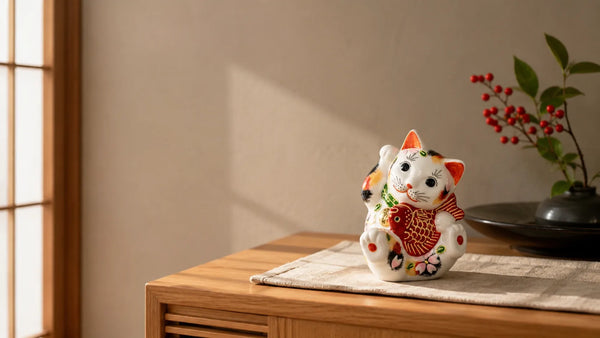
The Maneki Neko, or Japanese beckoning cat, is commonly associated with welcome and good fortune. This Kutani example holds a red tai sea bream, a traditional celebratory motif. For the history and customary meanings of paw position and colour, see Maneki Neko meaning and origins.
A note on choosing
If the recipient’s taste is uncertain, begin with a familiar form and verify the practical details. A donabe requires compatible cooking equipment and storage; a vase needs a suitable place; mugs require little preparation. Porcelain and stoneware differ in weight, surface, translucency, and care, as explained in Japanese stoneware vs porcelain.
FAQ
What is a good housewarming gift for someone who likes to cook?
A donabe can suit someone who already cooks rice, soup, or shared hot pot. Confirm household size, stove compatibility, seasoning instructions, and storage space on the product page before choosing one.
How much should I spend on a housewarming gift?
There is no fixed amount. Set a budget that suits your relationship with the recipient, then compare usefulness, material, maker, dimensions, care, and included packaging within that range.
Why is a lucky cat a traditional housewarming or new-business gift?
The Maneki Neko is commonly placed near an entrance and associated with welcome or good fortune. A raised left paw is often linked with welcoming people, while a raised right paw is more often associated with fortune or prosperity. These are customary interpretations rather than guarantees.
Are these gifts ready to give?
Packaging varies by item. Check the individual product page for a paper box, presentation box, or wooden box, and contact ZenKiln before ordering if the packaging is important.
Further reading: Tokoname Tourism’s introduction to beckoning cats explains customary associations, and Japan’s agriculture ministry discusses sea bream and celebrations. Choose the gift by the recipient’s habits as well as its symbolism.