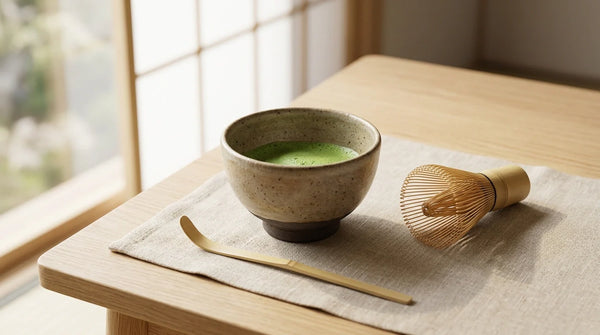
Before choosing a matcha bowl
- Whisking room: look at the space inside the bowl, not just its rim diameter.
- Interior: consider the curve of the walls and the glaze against the green tea.
- Rim and weight: choose a bowl that is comfortable to hold and drink from.
- Foot and care: check that it sits steadily and follow the individual bowl’s care instructions.
A matcha bowl, or chawan, needs room for a bamboo whisk to move and a shape that feels comfortable in your hands. When choosing one for everyday use, start with its interior, rim and weight.
What a matcha bowl has to do
To prepare usucha, move the chasen quickly back and forth through the matcha and water. The bowl needs enough space for this movement without spilling the tea. Its warmth, surface and interior colour also shape the experience of drinking. The Metropolitan Museum of Art's essay on the Japanese tea ceremony describes guests pausing to notice "the warmth of the bowl and the color of the bright green matcha against the clay."
Size: why the bowl is so much bigger than the tea
The amount of liquid is small. Ippodo's basic usucha recipe uses 2 grams of sifted matcha and 60 millilitres of water at 80°C; its koicha recipe uses 4 grams and only 30 millilitres. The bowl may look large for such a small serving, but the extra space allows you to whisk without spilling.

For a concrete example, our leaping-rabbit bowl is listed at about 11 cm across and 6.5 cm high. These are overall dimensions, not a measurement of the whisking space. Compare them with the top and side photographs: the wall curves into the base, so the room available to the whisk is narrower than the rim. Check the current listing for each bowl rather than assuming the whole collection has one size.
Shape: rounded, tall or shallow
Rounded, tall and shallow bowls provide different spaces for the whisk. A wide opening alone does not tell you how much room there is lower down: follow the curve of the wall into the base. Seasonal tea practice also uses taller and shallower forms, but heat retention depends on the individual bowl’s thickness, material and serving conditions as well as its profile.

Our guide to how to hold a chawan covers the grip. For choosing, the short version is this: pick the bowl up. It should feel balanced in your hands, with a rim you can comfortably drink from.
Interior and glaze
Consider the interior as well as the decoration outside. Its colour provides the background against which you see the tea. A pale or grey interior shows the green clearly; a dark interior, such as a black tenmoku glaze, makes the tea look deeper. The rabbit bowl pictured below has a speckled grey interior and decoration on the outside. Compare the photographs of each design in our matcha bowls and tools collection.

Kutani ware comes from the Kaga area of Ishikawa Prefecture and is known for overglaze enamel painting in a palette called Kutani gosai: red, yellow, green, purple and deep blue. The bowls we stock carry that painting on the outer face: a white and black cat among wildflowers, three leaping rabbits under a gold-coloured moon, or a bird among wild cherry blossoms on a yellow ground. A plain glazed bowl is another option if you prefer an undecorated surface. For more on the painted tradition, see our beginner's guide to Kutani ware.

Read the rabbit bowl from two angles
The top view above shows grey speckling across the bowl’s interior, with a darker band following the rim. In the side view below, the white rabbits and gold-coloured moon sit on the outside; the rounded lower wall narrows toward the foot. Together these views separate the drinking and whisking surface from the decorative face. They do not measure weight or prove how comfortable the bowl will feel in your hand.

Material and feel
Consider the bowl's weight, wall thickness and surface texture, as well as its material. Look for a bowl that feels balanced and comfortable to hold. The bowls we stock are ceramic. The Met describes Raku ware as lightweight glazed earthenware moulded by hand rather than thrown on the wheel, and our Raku article explains why it is prized and why it needs gentler handling.
Turn the bowl over before you buy. The foot ring, or kōdai, tells you how the bowl was finished and whether it will sit steadily on the table. Our piece on reading a chawan's foot ring goes into detail; for everyday use the test is simply that the bowl does not rock.

The tools that go with it
You need one tool, the chasen. Kazuho is a common designation for everyday usucha whisks; check the maker’s specification for the tine count. Our Kazuho chasen has a head about 6 cm wide. Soften the tines in warm water before the first use, rinse after each bowl, and let it dry fully before it goes back in its tube. Our chasen guide explains how the whisk is made and how to use and care for it. A chashaku (bamboo scoop) and a small sieve are useful but optional; a teaspoon and a fine kitchen strainer will do for a start.

Care and storage
Hand-wash the bowl with a soft sponge and mild detergent, and avoid sudden temperature changes. Each bowl in our current collection comes with a wooden presentation box. Let the bowl dry fully before storing it. For background on traditional paulownia storage boxes, see our article on kiri-bako. For the whisk and scoop, see the care guide for the full matcha set.

For a closer look at the tea itself, read our companion article on matcha benefits and the research behind them.
FAQ
What size should a matcha bowl be?
A rim of about 11 to 12 cm (4.3 to 4.7 in) with a rounded interior is a common starting point for usucha. The serving is only about 60 millilitres, so the extra room is for the whisk. Check that the whisk head can move freely inside and that the bowl sits steadily.
Can I use a regular bowl for matcha?
Yes, if the whisk head can move freely and 60 millilitres does not splash out. A rice bowl or cereal bowl often works. A purpose-made chawan is shaped around the whisking motion and the two-handed grip.
Does the inside colour of a matcha bowl matter?
It sets the background for the tea. A pale or grey interior shows the green clearly; a dark interior makes it look deeper. Both are traditional, and painted decoration is usually kept to the outside.
Do I need a chasen, or can I use a spoon or frother?
A bamboo chasen is made for whisking matcha and is the tool used in the Ippodo preparation linked above. An electric frother is another mixing option, but foam depends on the tea, water and technique; the photographs here are not a comparison test. Sifting the powder first can help you avoid clumps.
Editor's note: the sizes in this guide are the dimensions listed on the product pages of the matcha bowls and whisk ZenKiln stocks and ships from Tokyo. We do not sell matcha powder.